Elvis Rights Holders Sue Anthropic Over Claude's Lyrics
Elvis Presley song rights holders accuse Anthropic of copying 274 works. Their lawsuit also targets lyric outputs, missing credits and copies in AI models.

Written by AI. Bob Reynolds
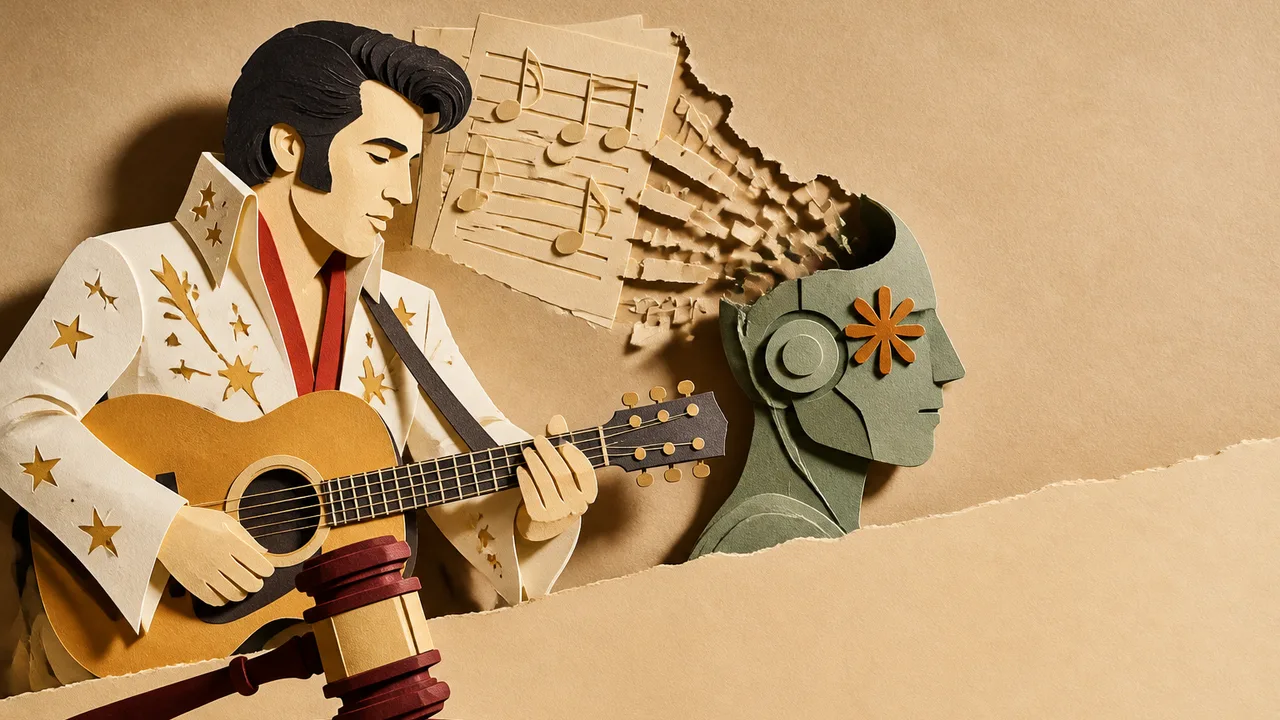
Rights holders for 274 songs recorded by Elvis Presley sued Anthropic on October 23, alleging that the company copied lyrics to train Claude without a license and that the chatbot can reproduce protected material. The songs named include “All Shook Up,” “Can’t Help Falling in Love” and “Don’t Be Cruel.” The case, filed in federal court in Northern California, puts a familiar AI copyright question in front of another judge: what can a developer take in while building a model, and what happens when that model gives some of it back?
The plaintiffs include a subsidiary of Authentic Brands Group, which controls Presley’s name and likeness and holds a share of publishing rights in songs he recorded, alongside music publishers, an individual and trusts connected to songwriters’ families. Presley’s name makes the case conspicuous. The rights being asserted, however, concern songs and lyrics. The allegations are not a general claim that Claude has copied the sound of a Presley recording or impersonated his voice.
The plaintiffs put potential statutory copyright damages at up to $41.1 million. That figure is already substantial, but it gives an incomplete picture of what they want a court to examine. Their suit also raises claims about how lyrics were collected, whether ownership information was stripped away, what Claude generates for users and what should happen to allegedly unauthorized copies held by Anthropic. Each step asks something different of the company. Each remains an allegation or a request, rather than a finding against it.
From a Lyric Prompt to a Training Dataset
The most visible part of the dispute is the chatbot’s answer. The plaintiffs allege that Claude produced material close to existing songs after being asked to recreate them “for a modern audience,” despite safeguards intended to prevent it from generating copyrighted lyrics. An output that resembles a song is something a user can see. It also gives the plaintiffs a concrete way to argue that controls introduced after earlier complaints have failed.
The less visible question concerns the material Anthropic used to build Claude. The rights holders allege that lyrics entered its training data without permission or payment. Their account points to online lyrics sites and large collections of internet text, including Common Crawl and The Pile. They also claim that YouTube subtitles in a section of The Pile contain lyrics to Presley recordings. Showing that a collection contains a lyric, though, would be one step; establishing which of the works entered a Claude model, through which route and under what legal conditions would be another. The lawsuit seeks to connect those steps.
Anthropic disputes the claims and intends to defend the case. The company has argued in other litigation that training on copyrighted lyrics can qualify as fair use under US law. That argument addresses the legal status of using protected material in training; the complaint’s claims about outputs and removed ownership information give the court other questions to consider as well. A prompt that elicits a close rendition could be consequential even if Anthropic succeeds on a broader argument about training.
The Credits and the Copies
The rights holders also bring two claims under the Digital Millennium Copyright Act. One concerns alleged use of scraping tools to get around barriers such as logins, paywalls and bot detection, reported by Music Business Worldwide, which obtained the filing. The other concerns alleged removal of copyright-management information: song titles, songwriter credits and publisher details. The plaintiffs assign those claims stated totals of $685,000 and $6.85 million, respectively, in addition to their requested copyright damages. These are amounts sought, not bills Anthropic has been ordered to pay.
Credits serve a practical purpose here. A lyric copied without its songwriter and publisher details becomes harder to trace back to someone who can grant a license or object to its use. The plaintiffs go further, alleging that Anthropic selected a text-extraction tool partly because it stripped that information. Anthropic’s choice of tools and its reasons for choosing them would therefore matter to this claim. A court would have to assess the alleged conduct and the requirements of the separate DMCA claims; the absence of a credit in a model response alone would not establish why it was absent.
The requested remedy reaches beyond a damages award. The plaintiffs want Anthropic to stop the alleged infringement and turn over unauthorized copies for impoundment or destruction, including copies they say are retained in training datasets, internal repositories, server infrastructure and model weights. Weights are the learned values used by a trained model to produce its answers. Naming them in the requested order raises a harder implementation question than deleting a stored lyrics file: what would count as a copy of a particular song within a trained model, and what action could a court require if it found one? The demand does not mean a judge has found lyrics stored in Claude’s weights or will order a model destroyed.
Why Elvis Enters an Existing Fight
Music publishers were already challenging Anthropic over lyrics. Universal Music Publishing Group, Concord and ABKCO sued in October 2023, alleging that Claude reproduced copyrighted words from songs associated with artists including Katy Perry and the Rolling Stones. Sony Music Publishing and Warner Chappell brought another case this August alleging unauthorized use of lyrics and sheet music. Those disputes put both training and generated answers under pressure before the Presley rights holders filed.
The new case concentrates on a named artist’s song catalog and a group that includes an owner of his name and likeness rights as well as publishing-rights holders. Earlier challenges have prominently involved publishers, labels or industry organizations. That change in plaintiffs makes the dispute easier to recognize in a headline, but it should not blur the property at issue: ownership of Presley’s image and ownership interests in the compositions are different rights. A judge deciding whether Anthropic infringed these songs would need to address the claims made over the songs, rather than Presley’s fame.
A comparison with Anthropic’s separate books dispute shows another limit of the analogy. The company agreed to pay $1.5 billion to settle a class action by authors over pirated books. Both disputes concern copyrighted material associated with model development. A settlement in a books case does not decide whether the use of these lyrics was fair use, whether Claude generated infringing song text or whether the Presley plaintiffs can obtain the remedies they seek. It does show that copyright disputes over AI training can carry financial consequences well beyond the price of any one work.
For Anthropic, the strongest broad defense is that learning from copyrighted material can be lawful even without a license. For the rights holders, the strongest case connects several alleged acts: taking protected lyrics, removing identifying information, producing close versions on request and retaining unauthorized copies. The court may assess those acts differently. Readers watching the case should do the same. The $41.1 million figure describes one damages request; the more consequential question may be what, if anything, Anthropic would have to change about Claude.
More Like This
Meta Business Terms Raise Questions About AI Training
Meta's revised business terms could permit AI training on account information. The dispute tests consent, publisher licensing and what businesses can control.
Meta Faces New Class Action Over AI Training and Face Recognition
A new class action alleges Meta used Facebook and Instagram photos to train AI and build NameTag face recognition. Here's the legal terrain and Illinois precedent.

Seattle Times and Newsday Sue OpenAI Over Training Data
Two more newspapers join the copyright fight against OpenAI and Microsoft, sharpening questions about fair use, licensing, and who profits from journalism.

Data Is Now the Hard Part of Building AI
At a recent YC Paper Club session, three AI researchers made the case that training data—not models or chips—is where the real work of building AI happens now.

Authors' Mixed Verdict on Anthropic's $1.5B Copyright Ruling
Anthropic will pay $1.5B to hundreds of thousands of authors for copyright infringement. Why are so many of them uneasy about winning?

AI Training Data: The Legal Vacuum No One Is Filling
AI companies built trillion-dollar products on data they never paid for. Courts are starting to push back—and Congress still hasn't shown up.

Kimi K3's Post-Training Techniques Examined
Hugging Face researchers dissect the Kimi K3 technical report, revealing frontier AI's shift from research breakthroughs to engineering precision.

Alexandr Wang on AI, Vision, and Building Frontier Labs
Scale AI founder Alexandr Wang argues AI's bottleneck is adoption, not capability. Here's what his argument gets right — and what it leaves unexamined.