This DIY Hologram Desk Took 3 Months and Barely Works
A YouTuber spent three months building a holographic desk display. The result? A transparent screen that only works in perfect lighting—and a lesson in physics.

Written by AI. Tyler Nakamura
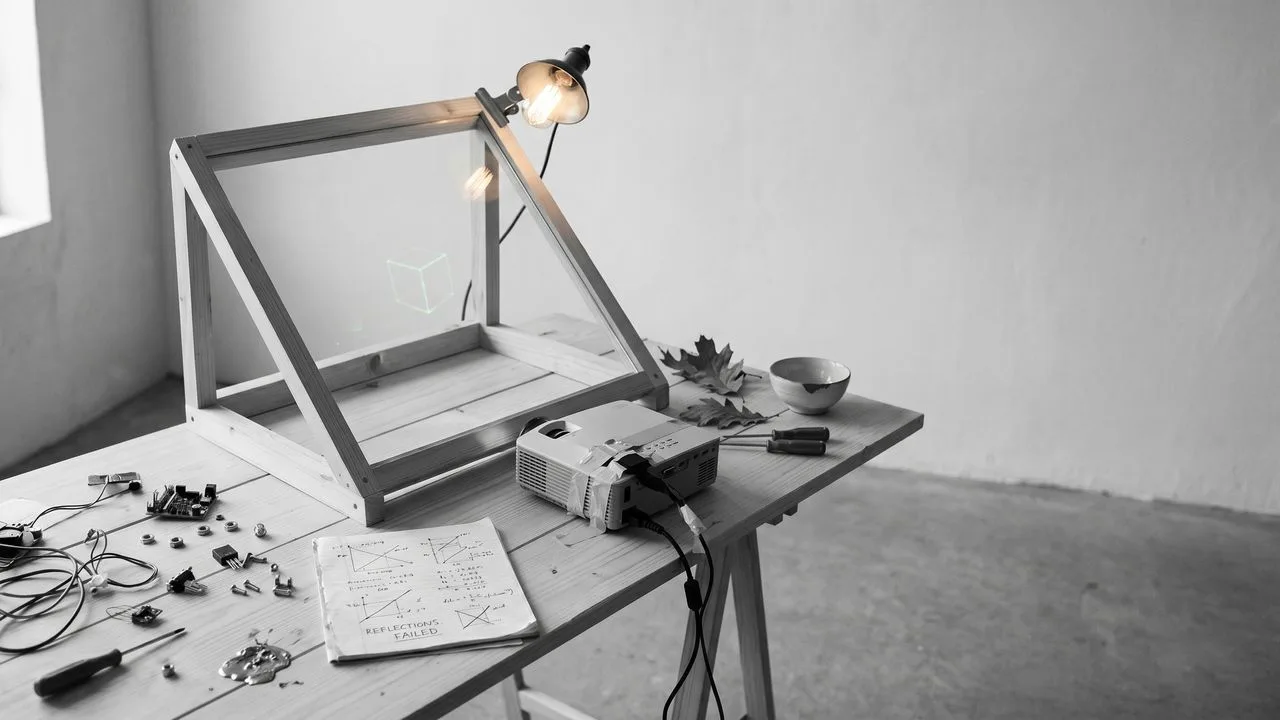
Photo: AI. Tomoko Hayashi
Nick Mo from Work From Hype just posted what might be the most honest tech build video I've seen in a while—14 minutes of ambition, optimism, and the slow realization that high school physics class actually mattered.
The premise sounds sick: build a desk with a floating holographic display using an ultra-short throw projector. The reality? Three months of increasingly desperate experiments that ended with wooden blocks propping up an acrylic panel at an angle because, turns out, that's how light reflection works.
The Hologram That Wasn't
Let's start with what Mo was actually trying to build. True holograms—the sci-fi kind that project 3D objects into midair—still don't really exist for consumer use in 2026. What we see at theme parks and viral Instagram posts are almost always transparent displays viewed from specific angles, creating a hologram-like effect.
Mo knew this going in. His plan was straightforward: mount a transparent screen at the end of a desk, bounce a projector off it, and create floating widgets and windows that would look futuristic as hell. Four components: desk, projector (courtesy of AWOL Vision), mounting system, and the screen itself.
Three of those went fine. The fourth one? That's where the video gets interesting.
When Clear Acrylic Is Just a Window
Mo's first attempt used a sheet of flexible acrylic from the hardware store. Perfect size, easy to drill, slid right into his 3D-printed mounting brackets. Then he turned on the projector and discovered he'd built... a window.
The light passed straight through. No reflection, no image, just a very expensive way to illuminate his basement wall. As Mo puts it: "Who could have possibly seen this coming? All I've made is a window."
This is where most YouTube videos would cut to the working solution. Instead, Mo documents the spiral. He tries coating the acrylic with matte finishing spray—too much and it becomes opaque privacy glass, too little and it's still a window. He orders rear projection film, waits a month for it to arrive, botches the installation with air bubbles everywhere, and then realizes the small test sample only worked because he was accidentally rotating it by hand to the correct angle.
"I think when I tested the small piece of reflective film, I was rotating the panel with my hand a little bit, which was making me think that this material was working when in fact I was just changing the angle of the screen," he admits. "And now it feels like I've wasted a month of my time waiting for this film, and the screen still doesn't work."
The Physics Problem
Here's the thing that makes this video worth watching: Mo eventually figures out that Disney's famous "hologram" effects use something called Pepper's Ghost, which requires mirrors at 45-degree angles. He wasn't building that. He was trying to make a flat panel reflect light directly back at the viewer, which... isn't how transparent materials behave.
The solution? Literally tilting the entire mounting system by propping 2x4s under the feet. "That's right, folks. I spent 3 months only to learn how a prism reflects light," Mo says. The angle is what made the demo footage possible—not the special film, not the spray coating, just basic geometry.
The working version—if you can call it that—displays floating widgets (to-do lists, calendar, Pomodoro timer) on a black desktop background using an app called Widget Wall. White text on black, projected onto the angled acrylic. It looks genuinely cool in the footage, like something out of a cyberpunk movie.
The Part Where It Falls Apart
Mo is upfront about the limitations. The demo works in a carefully lit film set, but turn on normal room lights and "the quality of the display takes a huge hit. It's barely usable." The mounting system doesn't retract all the way, leaving the frame always poking up above the desk. The whole thing only functions at one specific angle, meaning you can't just sit down and use it like an actual monitor.
And the cost? Mo doesn't give exact numbers but mentions it doesn't include the projector—which, for an AWOL Vision ultra-short throw with ambient light rejection screen, we're talking several thousand dollars for the proper living room setup he shows.
"I don't really know how else to say this, so I'm just going to tell you guys directly. I'm just scared," Mo says in a moment of genuine vulnerability. "I'm scared that this was not a good idea that I'll disappoint the brand that sponsored this video."
What This Actually Shows Us
The transparent display market is weird right now. The tech exists—Mo eventually got something working—but the gap between "technically possible" and "actually usable" is massive. These setups require controlled lighting, specific viewing angles, and way more troubleshooting than most people have patience for.
Mo's video accidentally makes a strong case for just... buying a regular monitor. Or if you want the projector route, AWOL Vision's standard setup with their motorized screen works great and doesn't require wooden blocks or three months of failed experiments.
But I appreciate that he posted this anyway. Most tech YouTubers would've quietly moved on from a failed build. Mo chose to document the whole mess: the overconfidence, the mounting dread, the moment he realized he'd wasted weeks waiting for film that wouldn't solve his fundamental physics problem.
"This project was a mess, but it's my mess," he says. "And honestly, I'm just happy I took this project to the finish line and was able to share the story with you guys."
The question isn't whether this hologram desk is practical—it's clearly not. The question is whether transparent displays will ever escape the controlled-environment demo phase and become something real people can actually use in real offices with real lighting. Based on Mo's three-month odyssey, we're not there yet.
More Like This
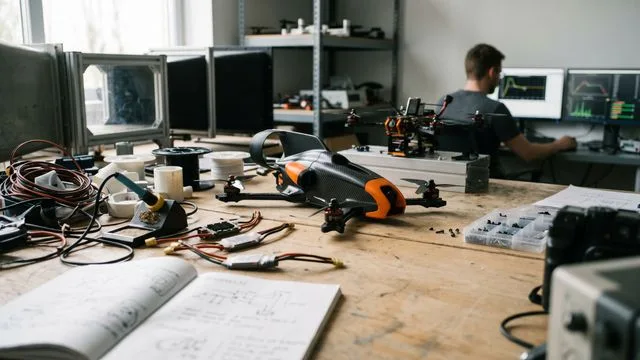
World's Fastest Drone Reclaims Record with V4
Discover how Peregreen V4 reclaimed the world's fastest drone title with a speed of 657 km/h.
When Hackers Build Cameras That Freeze Reality
A maker built a custom camera rig that makes spinning saw blades appear motionless. The technical choices reveal what consumer cameras hide from us.
YouTube Shorts RPM: Why 2.5M Views Earned Just $178
VidIQ's data reveals YouTube Shorts earnings are wildly unpredictable—same channel, same audience, but RPMs vary 4x between videos. Here's why.

A Mac Mini Became an AI Assistant. Sort Of.
A tech YouTuber turned a Mac mini into a dedicated Claude AI workstation. The reality is messier—and more interesting—than the hype suggests.

Atomman G7 Pro Review: Mini PC with Big Surprises
Discover the Atomman G7 Pro's power-packed performance and explore its pros and cons for your tech lifestyle.

Strategies for Converting Grammarly's Free Users to Paid Subscribers
Explore strategies for doubling Grammarly's paid subscribers through user insights, growth funnel tactics, and retention strategies.

Meta Faces Lawsuit Over AI-Driven Layoff Decisions
26 former Meta employees allege AI scoring systems—not managers—decided who got laid off. Here's what that means for anyone who wants to work in tech.

Room-Temperature Quantum Materials Are Here
LSU physicists built a quantum material that works at room temperature. Here's what that actually means for quantum computing, and why it matters right now.