DeepMind WeatherNext 3 Brings 5km Hourly AI Forecasts
Google DeepMind's WeatherNext 3 delivers 5km resolution global weather forecasts refreshed every hour using live satellite data and weather station inputs.

Written by AI. Dev Kapoor
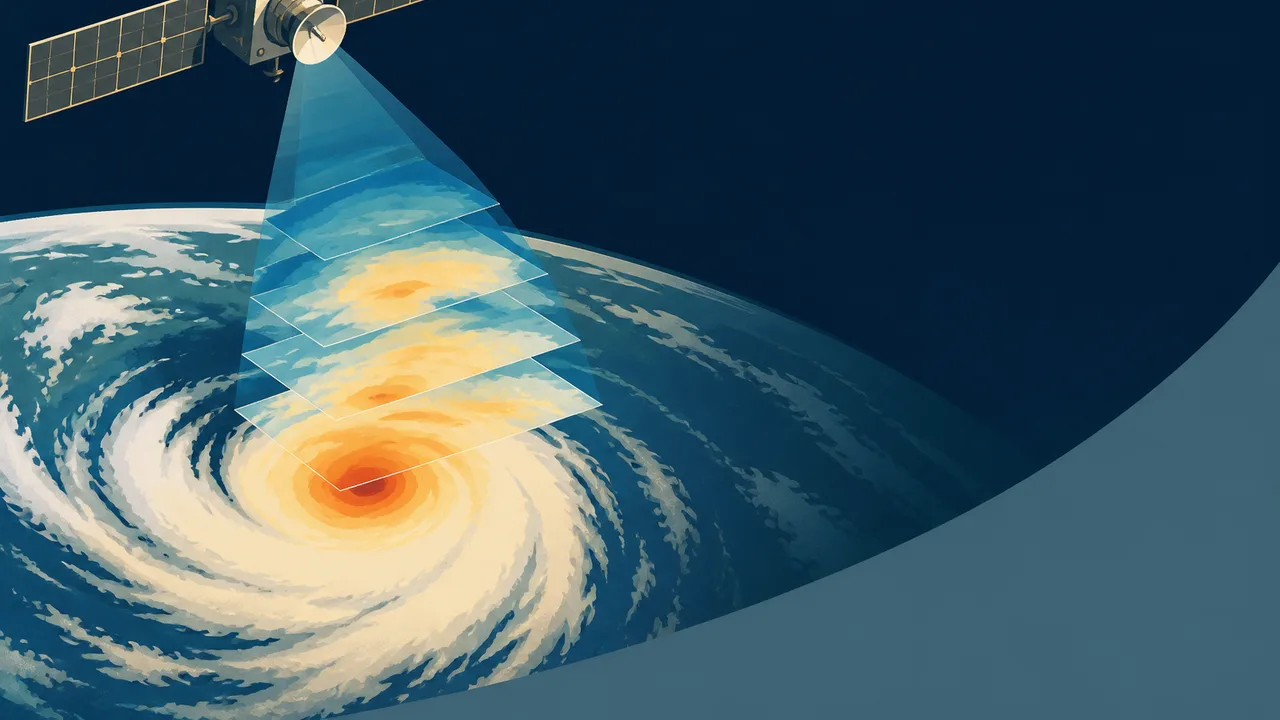
WeatherNext 3, Google DeepMind's latest AI forecasting model, updates its global weather predictions every hour at 5 km resolution, according to the DeepMind blog. That combination of spatial detail and refresh rate puts it ahead of most operational numerical weather prediction systems, which typically run on three- to six-hour cycles and at coarser grid scales. Whether it actually outperforms those systems in practice is a more complicated question, and one the broader meteorological community is starting to take seriously.
The model pulls from two data streams that previous generations skipped or handled separately: live geostationary satellite imagery stitched into continuous global mosaics, and direct surface weather station observations. Marktechpost notes that integrating those station readings is a key differentiator, because ground truth from actual sensors helps correct the kinds of systematic biases that pure satellite or reanalysis-trained models accumulate over time. The outputs feed into Google Search, Gemini, and Maps, meaning a significant fraction of the planet will now be getting AI-generated weather without necessarily knowing it.
What the satellite integration actually requires
Geostationary satellites sit fixed above a point on Earth's equator and image the same region continuously. The major operators, NOAA's GOES system over the Americas, EUMETSAT's Meteosat over Europe and Africa, Japan's Himawari over the Asia-Pacific, collectively generate an enormous, unbroken stream of infrared and visible imagery. Stitching those images into a coherent, model-ready mosaic at scale, and doing it continuously, is an infrastructure problem that only a handful of organizations on the planet can solve. Google is one of them. The compute requirements for ingesting, processing, and feeding that data into an ML model at hourly cadence are not incremental; they represent a qualitative shift in what kind of organization can field a competitive weather product.
Engadget frames this as Google's new model using "live" satellite data, which is the correct framing. Earlier AI weather models, including DeepMind's own GraphCast, trained on ERA5 reanalysis data: a retrospective, quality-controlled reconstruction of historical atmospheric states produced by the European Centre for Medium-Range Weather Forecasts. ERA5 is excellent for training but it represents the atmosphere as it was, not as it is. WeatherNext 3's use of live satellite inputs means the model's initial conditions are drawn from the actual current state of the atmosphere, which should reduce the error accumulation that plagues forecasts initialized from stale data.
The power markets angle is the sharpest signal
Bloomberg leads with a detail that the consumer tech coverage largely buries: the hourly update frequency was designed with power markets in mind. Electricity grids running high shares of wind and solar generation are acutely sensitive to short-term forecast accuracy. A grid operator managing a system with 40 percent renewable penetration needs to know, with as much advance notice as possible, whether wind speeds will drop in three hours and how much gas capacity to hold in reserve. Six-hour forecast cycles are not sufficient for that. Hourly forecasts at 5 km resolution are.
This is where the commercial logic of WeatherNext 3 becomes clearest. Google's cloud business sells to utilities, grid operators, and energy trading desks. A model that delivers hourly forecast updates at sub-10 km resolution is not primarily a consumer feature; it is a product for customers who pay substantial sums for marginal improvements in operational decisions. The Search and Maps integrations are distribution, but the power markets application is where the economic case sits.
Quartz covers the hourly cadence as the central innovation, and it is the operationally meaningful one. The shift from six-hour to one-hour refresh cycles does not sound dramatic, but for dispatch decisions on a power grid, for rerouting logistics, or for agricultural spray timing, the difference between a six-hour-old forecast and a one-hour-old forecast can be the difference between a correct and an incorrect operational call.
What the benchmarks don't settle
DeepMind claims WeatherNext 3 is its "most advanced and accurate" model, and Gizmodo repeats that framing. The Verge notes more cautiously that Google says its AI weather model is getting better, which is accurate and rather less committal. The meteorological community has learned to ask this question carefully after several high-profile AI weather systems posted impressive retrospective scores and then performed less impressively in real-time verification.
Numerical weather prediction (NWP) models run by NOAA, ECMWF, and the UK Met Office are not static targets. They are continuously improved, run on dedicated supercomputing infrastructure, and benefit from decades of physics-based refinement. The question for WeatherNext 3 is not whether it outperforms a five-year-old NWP baseline, but whether it holds up against current operational systems across a range of forecast lead times, weather regimes, and geographic regions. DeepMind has not, as of the model's launch, published an independent third-party verification study covering those conditions. That does not mean the accuracy claims are wrong; it means they are not yet fully testable from the outside.
The 5 km resolution figure also deserves scrutiny. Resolution describes the grid spacing of the output, not the actual predictive skill at that scale. A model can produce output at 5 km intervals and still have effective skill that degrades substantially at scales below 20 or 30 km, particularly for convective events. High-resolution output is necessary but not sufficient for high-resolution skill. This is a standard caveat in operational meteorology and applies equally to NWP and AI-based systems.
The access and dependency question
National meteorological agencies around the world operate as public goods: NOAA, the Met Office, the Bureau of Meteorology in Australia publish forecast data openly, and their products underpin everything from aviation routing to emergency management. A Google product that surfaces through Search, Gemini, and Maps occupies a different position. Most users will have no visibility into what model generated the forecast they see, how that model's accuracy is independently verified, or what happens to forecast access if Google changes its product decisions.
This is where the story connects to dynamics that come up repeatedly in AI infrastructure: concentration of capability in a small number of vertically integrated platforms, limited external auditability, and user populations that cannot easily switch to alternatives once they are accustomed to a given interface. Meteorological data has historically been a domain where international cooperation and open data norms were strong. ECMWF data is expensive for commercial users but publicly available for research. NOAA data is free. WeatherNext 3's outputs, distributed through Google's consumer and enterprise products, sit inside a closed platform.
Techbuzz.ai covers the launch largely as a product announcement, which is how Google has positioned it. But the infrastructure and access questions are not afterthoughts; they are the context in which a forecast system's long-term significance gets determined.
DeepMind's model is impressive engineering. Hourly global forecasts at 5 km resolution, initialized from live satellite data, represent a real advance over what was possible even three years ago. The world's most capable weather infrastructure increasingly runs inside a single company's product stack, verified primarily by that company's own benchmarks, distributed through interfaces that 2 billion people use without knowing what model they are trusting with decisions that can matter a great deal. The forecast may be better. Who gets to check is a separate question.
More Like This
Matt Wolfe's YouTube Playbook: Money, AI & Workflow
Matt Wolfe opens the books on his YouTube AdSense, AI video workflow, and why he thinks faceless AI channels are mostly a losing bet.

Gemma 4's Architecture Rethinks Multimodal AI
Google DeepMind's Gemma 4 ditches separate vision encoders for a unified architecture. Here's what that design choice actually means for open-source AI.
Google's Gemma 4 Rewrites the Rules for Open-Source AI
Google released Gemma 4 under Apache 2.0—truly open-source AI that runs on consumer hardware. Here's what the compression breakthrough actually means.
Perplexity Open Sources Lily, a Local AI Engine for Apple Silicon
Perplexity has open-sourced Lily, a Rust-based inference engine for Apple M5 Max. Here's what the benchmarks mean and why the OSS move matters.

Gemini 3.7 Flash and the Agent Economics Race
Google's Gemini 3.7 Flash arrives three weeks after 3.6 with sharp gains in coding and agents—and a pricing strategy designed to buy market share fast.
OlmoEarth Brings Open Geospatial AI to Planetary Scale
Ai2's OlmoEarth platform turns satellite data into real-time, decision-ready insights. Here's what it does, how it works, and what's still an open question.

Croc Is an Open-Source CLI File Transfer Tool Worth Knowing
Croc is a free, open-source CLI tool that uses full-duplex relays and PAKE encryption to make file transfers fast, secure, and genuinely simple.

Kimi K3 and the Open-Weight AI Shakeup
Moonshot AI's Kimi K3 tops the AI performance frontier as a fully open-weight model. What it means for US labs, compute policy, and who builds what next.