Clustering Two AMD Ryzen AI Halos to Run 400B Models
Can two AMD Ryzen AI Halos act as one AI system? Alex Ziskind tested the cluster setup, performance, and real-world limits of AMD's 400B parameter claim.

Written by AI. Bob Reynolds
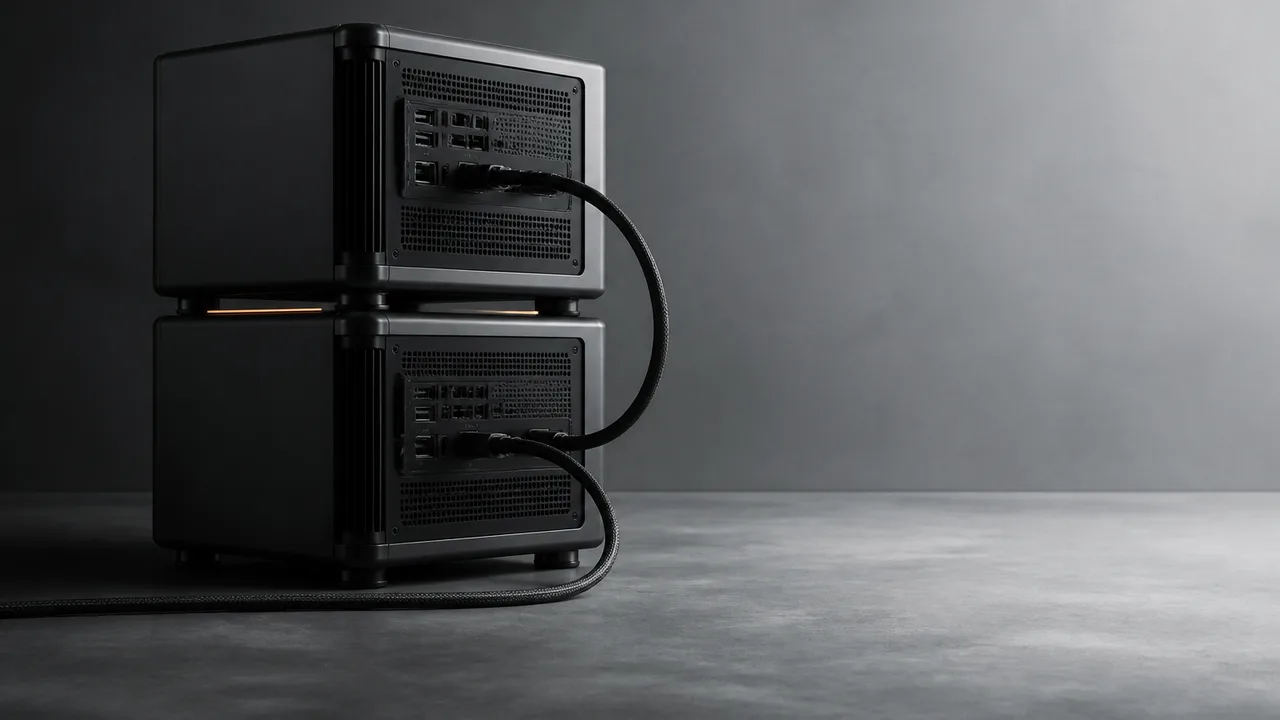
Photo: AI. Tomoko Hayashi
AMD's claim is straightforward enough: pair two Ryzen AI Halo mini-PCs, and you can run AI models with up to 400 billion parameters — the kind of scale that, until recently, required a server rack and a facilities manager. That's the claim. Youtuber Alex Ziskind decided to find out whether the reality matches it.
The short answer is yes, with caveats that matter quite a bit depending on what you're trying to do.
What the Hardware Actually Is
Each Ryzen AI Halo is a compact box built around AMD's Strix Halo APU — a chip that combines a CPU and GPU on a single piece of silicon, sharing 128 GB of unified memory between both. Ziskind benchmarked it previously against NVIDIA's DGX Spark, but this test is about something different: not single-unit performance, but whether two units can be stitched together into something greater than the sum of their parts.
Two machines, 256 GB of combined memory, a pair of 10-gigabit Ethernet ports, and AMD's own clustering documentation. The question is whether a consumer-grade Ethernet connection can do the job that purpose-built interconnects do in professional AI infrastructure.
For context, NVIDIA's high-end GPU clusters use NVLink — a proprietary interconnect that, according to IntuitionLabs, delivers far higher bandwidth than standard networking by design. Ethernet, even at 10 gigabits, is a different category of pipe. Whether that matters in practice is what Ziskind's test was designed to find out.
The Setup Is Not Plug-and-Play
The first thing Ziskind's video makes clear is that "clustering" doesn't mean connecting a cable between two machines and watching them cooperate. Two computers don't automatically become one larger computer, as he puts it. The AI model has to be split across both systems, and the GPUs have to constantly exchange data while generating output. That communication happens over Ethernet — and it requires a proper 10-gigabit switch in the middle, not a direct cable.
Ziskind used a Ubiquiti UniFi Flex XG for this. According to Flytec Computers' product coverage, the Flex XG ships with four 10-gigabit ports and one 1-gigabit management port, runs completely passively cooled — no fan, just a large heatsink — which matters when you're running hardware continuously. The four high-speed ports mean you could scale this cluster to four Halo units if you wanted to test AMD's further claims about larger configurations.
The second complication: both machines need to run Linux. AMD's clustering documentation doesn't support Windows for this use case. One of Ziskind's two Halos came with Windows pre-installed, so he cloned the Linux environment from the configured machine onto the Windows machine's SSD. Practical, but not what most buyers would expect to be doing before they run their first model.
Then there's a memory allocation problem that Ziskind describes as "really funny — well, it wasn't that funny." A machine that had previously run Windows carried a GPU memory limit of 64 GB set by the Windows installation — a limit not visible in the BIOS and not changeable through standard Linux commands. The fix required the AMD Ryzen AI Developer Center software. Linux, once properly configured, can allocate up to 120 GB of that 128 GB to the GPU. Windows caps it at 96 GB maximum, and a Windows-to-Linux transition can leave you stuck at 64 GB until you know where to look.
None of this is insurmountable. All of it is the kind of friction that separates a proof-of-concept from a product you hand to a non-technical colleague.
Two Methods, Two Different Trade-Offs
AMD's playbooks offer two distinct approaches to clustering, and they serve different use cases.
The first uses llama.cpp with RPC — Remote Procedure Call, which means one machine acts as the coordinating node and the other exposes its GPU as a remote worker the first machine can borrow. It's the simpler approach. One machine does the thinking; the other lends its memory. Ziskind ran GLM-4.7, a 358-billion-parameter model confirmed by Z.AI's developer documentation, using this method and recorded roughly 7.6 to 8.2 tokens per second for a single conversation — a usable pace for an interactive session. With four simultaneous requests, throughput climbed toward 13-13.5 tokens per second, though it fell back sharply when prompt length increased significantly.
"RPC still lets you fit a giant model and run one conversation at a time, maybe two," Ziskind notes. For a solo developer or a small team with modest concurrency needs, that's a reasonable result.
The second method uses vLLM with RCCL (ROCm Collective Communications Library — AMD's documentation spells out the full name, and Ziskind pronounces it "Rickel" in the video, drawing a comparison to NVIDIA's equivalent NCCL library). Where RPC lets one machine borrow the other's memory, RCCL does something more architecturally sophisticated: it uses tensor parallelism, meaning the model is genuinely split across both GPUs simultaneously, with both processors doing real computational work in parallel and coordinating continuously over the network link.
The trade-off is complexity. Ziskind describes a setup process involving Podman containers — isolated software environments that package all the required dependencies so the software runs consistently regardless of what else is installed on the machine — plus a coordination layer called Ray that manages communication between the two nodes. "If you get one flag wrong, you have to start over and wait another 15 minutes. Don't ask me how I know," he says.
The reward for that complexity: Ziskind ran Qwen 3.5 at 397 billion parameters using this method and measured nearly 18 tokens per second at concurrency four. Both machines were running at full GPU utilization, consuming about 110 GB of memory each — 220 GB total across the cluster — and drawing around 60 watts per unit at roughly 52 degrees Celsius.
"It's like running a little mini data center at home or in your office," Ziskind observes. That's an accurate description, and it cuts both ways.
What This Actually Costs
Ziskind's video doesn't provide a combined price for the two-unit setup. At time of writing, the Ryzen AI Halo is available exclusively through Micro Center, and pricing for units with this specification — 128 GB unified memory — has been reported in press coverage at approximately $1,400 per unit, though buyers should verify current pricing directly with Micro Center as availability and configurations vary. The Ubiquiti UniFi Flex XG switch retails for roughly $200 to $250. A realistic budget for this cluster is somewhere in the range of $3,000 to $3,200 before any accessories, cables, or storage additions. That is not cheap for a hobbyist. For a small business or a research team that would otherwise pay cloud inference costs on a large model indefinitely, the calculus looks different.
Who Should Buy This, and Who Should Wait
Ziskind's testing establishes that AMD's core claim holds up: two Halos can run a 400-billion-parameter model, and the 10-gigabit Ethernet link doesn't ruin the exercise. The vLLM path in particular produces throughput that's genuinely useful for multi-user or agentic workloads.
But the setup process tells you exactly who this is for. If you're comfortable with Linux system administration, comfortable building software from source, and comfortable debugging memory allocation settings through vendor-specific tools, this cluster works as advertised. If you expected to unbox two devices, connect a cable, and start prompting a 400-billion-parameter model, you will have a bad week.
The RPC path is appropriate for a developer who wants to run large models locally for personal or small-team use and can tolerate some throughput ceiling. The vLLM path is for teams who need genuine multi-user capacity and are prepared to treat this like infrastructure — because that's what it is.
The honest verdict: this is impressive hardware in an impressively small form factor, running software that was enterprise-only territory eighteen months ago. The gap between "AMD says it can do this" and "it does this reliably for non-experts" is still real, and anyone making a purchasing decision should account for it. The technology works. The product experience is still catching up.
More Like This
Anthropic's Claude Routines Targets No-Code Automation Market
Claude Routines lets users automate workflows with natural language instead of drag-and-drop builders. Is this the end of traditional no-code platforms?
Intel's Budget GPU Play: 96GB of VRAM for $2,600
Four Intel ARC Pro B60 cards deliver 96GB of VRAM at a fraction of Nvidia's cost. But cheap memory doesn't guarantee useful performance.

Splitting One LLM Across Two Machines: Does It Actually Work?
Alex Ziskind tested disaggregated inference by combining a DGX Spark and Mac Studio to run LLMs. Here's what actually happened when theory met reality.

oMLX: A Smarter Local AI Runner for Apple Silicon
oMLX beats LM Studio 47 vs 16 tokens/sec on Apple Silicon—but occasional 400 errors mean it's not plug-and-play. Here's what the tradeoff actually looks like.

The MacBook Pro That Questions Every Dollar You Spent
Real-world testing reveals the M5 Pro matches the Max in most tasks while costing significantly less. The gap only matters for one specific workload.
AMD Ryzen AI Halo Review: Hardware Milestone, Software Story
AMD's Ryzen AI Halo developer workstation arrives with polished software, 128GB unified memory, and a $4,000 price tag. But is it the platform—or the pipe cleaner?

Grok 4.6 and 4.7 Are Weeks Away: What to Know
xAI announced Grok 4.6 and 4.7 weeks after 4.5 launched. Here's what's confirmed, what's speculation, and what it means for your workflow.
DeepSWE Is a Coding Benchmark Built to Resist Cheating
DeepSWE uses 113 original tasks to test AI coding agents without contamination. Here's what Datacurve's benchmark reveals about how top models actually perform.