China Ditches Windows for Linux in a Big OS Shakeup
China's Ministry of State Security has ordered government agencies off Windows and onto domestic Linux. Here's what that actually means — and why it matters beyond the headlines.

Written by AI. Zara Chen
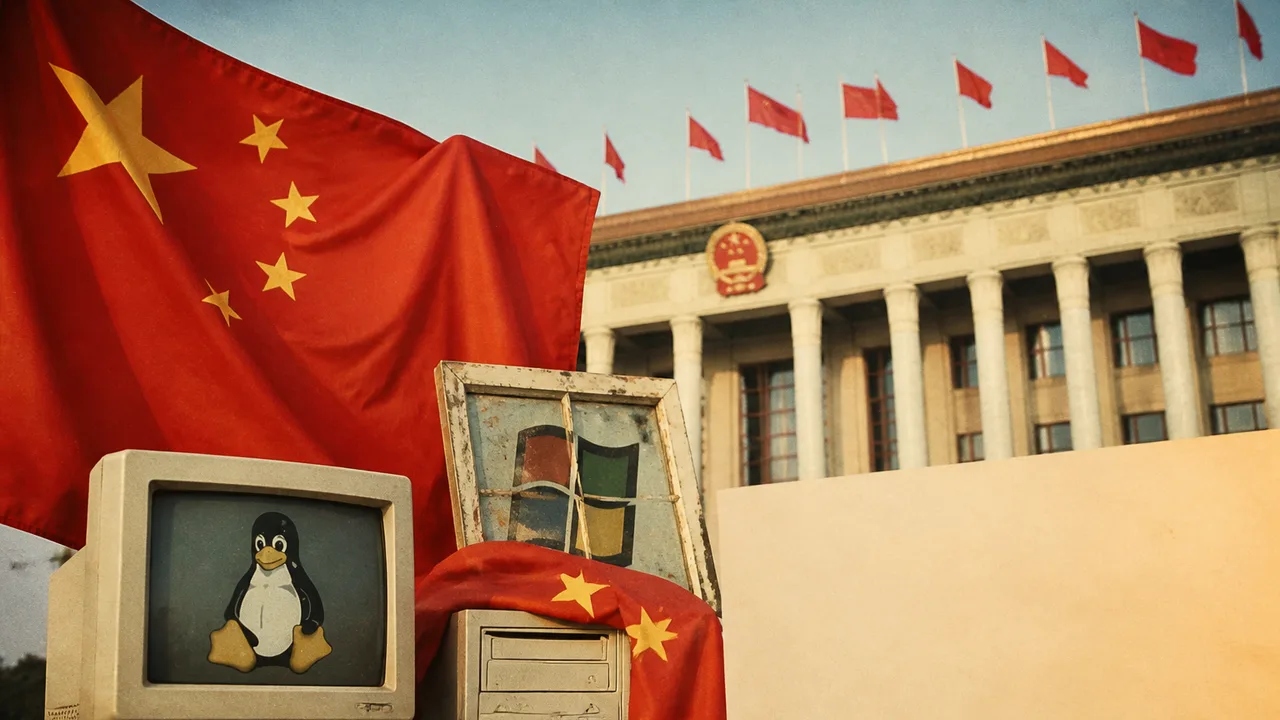
Okay, so China just told its government agencies to uninstall Windows. And before you scroll past thinking "geopolitics, boring" — stay with me for a second, because this one is actually wild in ways the headlines aren't capturing.
Here's the short version: China's Ministry of State Security has ordered state agencies to drop Windows 10 China Government Edition and migrate to homegrown Linux distributions, according to India Today. The move is happening faster than originally planned — ZDNet reports that the specialized Chinese version of Windows was already scheduled for retirement, but that timeline has now been moved up. Beijing is not waiting around.
The Linux community, for the record, is absolutely losing it over this. We're talking a highly engaged r/linux thread full of people who have spent literal decades evangelizing Linux as a serious Windows alternative and are now watching two of the world's biggest governing bodies make exactly that call. You love to see your niche moment arrive, even if the reasons behind it are a lot messier than "Linux is just better, actually."
And here's where it gets interesting.
Wait, didn't France just do this?
Pretty much, yeah. XDA Developers notes that the French government made a similar move, explicitly calling its dependence on U.S. tech a strategic risk. China is now following suit by fast-tracking its own migration. Two governments, very different political systems, same conclusion: running your national infrastructure on software you don't control is a problem.
That parallel is doing a lot of work here, and I think it's the most important framing for understanding what's actually going on. The easy read on China's move is "authoritarian government doesn't trust American companies" and just... stops there. But France isn't an authoritarian government, and France made the same call. The shared logic isn't ideology — it's something more structural. When you depend on foreign software for your government's operating infrastructure, you're trusting that the company behind it will never be weaponized against your interests. That's a bet a lot of governments are no longer comfortable making, for reasons that stretch from legitimate security concerns all the way to "we just watched tech get turned into a geopolitical lever in real time."
Whether you think those concerns are fully warranted is up to you. But the pattern across both France and China tells you this isn't fringe thinking anymore.
The "China Government Edition" thing is worth understanding
Here's a detail I don't see getting enough attention: China wasn't even running the same Windows you're running. Windows 10 China Government Edition is a specialized variant of the OS, built specifically for Chinese government use, with certain features modified or removed to meet Beijing's requirements. ZDNet and Slashdot both cover this detail.
So the question was never really "should China use normal Windows?" — it was always "how much trust do we extend to any version of this, even one negotiated specifically for us?" And the answer Beijing just landed on is: not enough. The Ministry of State Security ordering the switch is a pretty clear signal about who's driving this decision and why. This isn't an IT procurement thing. This is security policy.
Linux: ready for government prime time, or...?
Okay, here's where I want to pump the brakes just a little, because the Linux-has-won narrative is genuinely exciting but also skips some real friction.
The practical challenge of migrating government agencies to any new operating system is massive, and Linux has historically struggled hard with the desktop UX thing. How-To Geek has a whole piece cataloguing the Linux distributions that tried to clone Windows' look and feel over the years — which tells you something about how long the "make Linux approachable" problem has been on the table. It's been a minute.
And it's not just aesthetics. There's the software compatibility problem (government agencies run specialized applications that may not have Linux versions), the training problem (you can't just tell thousands of civil servants "same but different, good luck"), and the hardware compatibility problem (Linux doesn't always play nicely with enterprise hardware configurations). A personal account of KDE Linux migration experiences linked via Hacker News illustrates exactly how uneven the day-to-day Linux desktop experience can still be — even for technically literate users. That's a harder problem to solve with a software update.
The thing is, China has resources and political will to push through that friction in ways that, say, a single company migrating its employees off Windows probably wouldn't. Beijing can mandate training programs, fund compatibility development for domestic software, and enforce compliance in ways that democracies can't quite replicate. Whether that's a feature or a bug of the approach depends entirely on your vantage point.
So what does this mean for Microsoft?
Honestly? For Microsoft's core business, probably less than the headlines suggest in the short term. Government contracts are significant but not the majority of what Windows earns. The bigger story is directional: if the logic of "we shouldn't depend on foreign OS infrastructure" keeps spreading — and given that both a major European democracy and the world's second-largest economy have now landed there, it has real momentum — then Microsoft is looking at a slow erosion of a category of customer it had probably assumed was stable.
TechBuzz.ai frames this as a potential "seismic shift in enterprise operating systems driven by data sovereignty concerns," which is the kind of phrasing that usually means "we don't know how big this gets yet." That's probably right. The honest uncertainty here isn't whether this trend is real — it clearly is — it's about velocity. Does the France-China pattern become a template that other governments follow, or does it stall out once the practical headaches of migration become apparent?
The global software market fragmenting along geopolitical lines is a real possibility now, not a thought experiment. And that has downstream effects for interoperability, for international software development, for companies building products that need to run everywhere — basically for the entire assumption that the internet and its infrastructure were always going to be one big shared thing.
That assumption has been wobbling for a while. This week, it wobbled a little more.
More Like This

This Creator Got Shadowbanned on YouTube in 25 Days—On Purpose
A vidIQ creator deliberately shadowbanned their channel with AI-generated content to expose how YouTube's algorithm actually works. The results are wild.

Master Remote Access with Comet Pro KVM
Explore the Comet Pro KVM for seamless remote PC access: Wi-Fi 6, out-of-band management, and Tailscale security.

DeepSeek V4 Undercuts AI Giants While France Ditches Windows
DeepSeek's V4 slashes AI inference costs by 90% as France commits to Linux migration. Plus: Ubuntu's local inference push and Linux drops 486 support.

Fragnesia, KDE's €1.2M, and Linux's Container Future
Fragnesia vulnerability explained, KDE gets €1.2M from Sovereign Tech Fund, and Fedora Hummingbird points to a container-native Linux future.

Linux in 2026: AI Rules, BSD Shifts, and a Sega Genesis
Linus Torvalds sets AI policy for the Linux kernel, Ubuntu ships a known AMD regression, FreeBSD goes GPL-free, and Linux boots on a 1994 Sega Genesis.

Why Installing Linux on a MacBook Reveals a Regulatory Gap
A YouTuber's 30-minute struggle to install Ubuntu on an Intel MacBook exposes how proprietary hardware creates barriers Linux users shouldn't face.

Anthropic Found a Secret Tracker in Claude Code
A hidden tracker in Claude Code was secretly monitoring Chinese users until a security researcher exposed it. Here's what happened and why it matters.

US and China Train Almost All the World's AI Models
US and Chinese companies train nearly every major AI model the world uses. Here's what that concentration means for global power, values, and sovereignty.