ChatGPT Blocks Author Style Cloning Requests
ChatGPT now refuses to clone famous authors' writing styles. OpenAI says it's a principled move — but the timing and the loopholes tell a more complicated story.

Written by AI. Tyler Nakamura
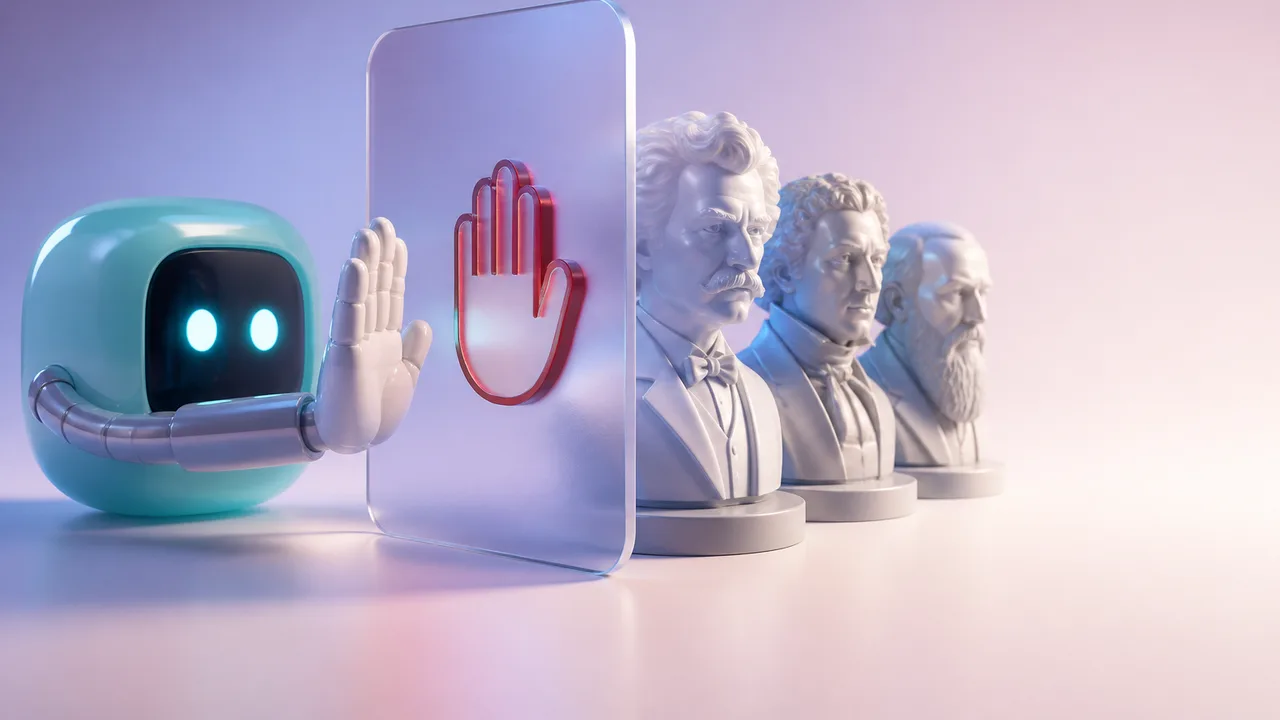
Let's say you open ChatGPT and type something like: "Write a short story in the style of Cormac McCarthy." That prompt — which probably millions of people have used without a second thought — now gets you a polite refusal and a pivot. ChatGPT won't clone McCarthy's voice anymore. It'll offer to capture the "overall feeling" instead.
Android Authority reports that OpenAI has quietly updated ChatGPT to reject direct requests to clone the writing styles of living authors. No big announcement, no blog post. Just a changed behavior, noticed by users and then picked up by the tech press. According to Ars Technica, the new behavior applies to contemporary figures — the report names Cormac McCarthy and George R.R. Martin specifically — and the change comes while OpenAI is still actively defending itself in multiple copyright lawsuits.
That last part is doing a lot of work.
The Tracing vs. Color Analogy Is Actually Good
Explosion frames the distinction cleanly: "You can think of it as the difference between tracing someone's artwork and learning how they use color. ChatGPT is still open to the latter but won't allow the former."
That's a genuinely useful framing. Style itself — the set of techniques, tonal choices, structural habits that define how a writer works — has never been copyrightable under U.S. law. Copyright protects specific expression, not the approach behind it. A thousand student writers have learned to write by imitating Hemingway's short declarative sentences, and none of them owe his estate a royalty check. What's different with AI is the scale, the speed, and the fact that "inspired by McCarthy" can shade into something that looks a lot like reproduction when you're pulling from a training set built on his actual novels.
So the policy change makes a certain kind of sense as a principle. The problem is the reason it's happening now, three-plus years into ChatGPT's existence, is almost certainly not primarily principle. As Ground News notes, the change comes "as OpenAI continues defending itself against multiple copyright" suits. Futurism put it more bluntly: "It only took them three and a half years, but the powers that be at OpenAI have apparently directed ChatGPT to start refusing requests to copy a specific author's style."
A defensive move dressed up as a principled one is still a defensive move.
Who Actually Gets Hurt Here
Here's what bugs me about the framing of this as a clean win for authors: the people who were most actively using style prompts weren't necessarily the bad actors.
Think about who actually types "write in the style of [author]" into a chat box. It's a lot of students trying to understand what makes a particular voice work. It's writing workshop participants doing craft exercises. It's hobbyist writers who want to try on different styles the way you'd try on different running shoes before committing. It's screenwriters sketching a pitch that needs a tonal reference point. These are legitimate, generative uses of the feature — the kind of thing that, in any other context, we'd call learning from influence.
The actual bad actors — content farms hammering out AI slop to flood Kindle with knockoff McCarthy novels — probably don't type "in the style of Cormac McCarthy." They know how to describe what they want without triggering a keyword filter.
Which points directly at what the restriction is probably actually doing under the hood: it almost certainly just watches for a named author in your prompt. That's it. Type the name, get refused. Don't type the name, describe the exact same stylistic qualities in your own words, get what you wanted anyway. Anyone who's spent more than a few hours with ChatGPT can tell you: the workarounds here take about thirty seconds to figure out. "Minimalist prose, sparse dialogue, violent landscapes, moral ambiguity" gets you exactly where "write like McCarthy" was going. The filter is superficial, and the people who most needed to get around it will get around it before lunch.
Ars Technica flags that the new behavior "capturing a writer's broad qualities could have legal implications" — which is actually a fascinating acknowledgment that the alternative OpenAI now offers isn't necessarily clean either. If ChatGPT refusing to clone McCarthy but still willing to capture his "broad qualities" creates legal exposure, then the restriction hasn't actually solved the underlying problem. It's created a new one with a different name.
The Signal OpenAI Is Actually Sending
What this move accomplishes in practice is mostly optics, and I don't think that's nothing — but let's be honest about what it is.
In a courtroom, OpenAI can now say: we've taken affirmative steps to prevent our product from directly mimicking the expression of working authors. That's not nothing when you're in front of a judge. And for the authors who've complained publicly about seeing their names used as style prompts, it's at minimum a signal that OpenAI heard them, even if the mechanism is shallow.
What it doesn't do: protect authors from having their work used in training data. That's the core of most of the lawsuits, and this policy change touches none of it. The question of whether OpenAI should have been allowed to train on copyrighted novels at all — that fight is still ongoing, and a prompt filter changes zero about it.
There's also a version of this where OpenAI does believe it's the right call, and that belief happens to align with their legal positioning. Those two things aren't mutually exclusive. But "right call that also helps us in court" and "right call we would've made in 2022 if we were purely motivated by ethics" are very different sentences, and the three-and-a-half year gap makes the second version hard to sell.
What Legitimate AI Writers Should Actually Know
If you're using ChatGPT as a writing tool — for craft, for drafts, for style exploration — this change matters less than the coverage suggests. The restriction is narrow. You can still ask for "terse, understated prose with a focus on subtext over exposition." You can describe rhythms, sentence lengths, image patterns, thematic preoccupations. You just can't use the author's name as the shorthand for all of that.
That's... a minor inconvenience, honestly. More annoying for casual users who didn't know there were workarounds than for anyone doing serious work with the tool.
What's worth watching is what happens next. Does OpenAI expand these restrictions? Does the alternative — capturing "broad qualities" — get challenged in court the way the direct style cloning might have been? Do other AI companies follow suit, or do they quietly position the lack of restrictions as a feature?
The authors who sued OpenAI didn't sue because ChatGPT could write a sentence that sounded vaguely like them. They sued because their entire bodies of work were fed into a system without consent or compensation. A prompt filter doesn't touch that grievance at all. So when this change gets described as OpenAI "respecting creative integrity," just know: the authors who have the most at stake haven't gotten what they actually asked for.
They got a renamed refusal. That's not the same thing.
More Like This

World's Fastest Drone Reclaims Record with V4
Discover how Peregreen V4 reclaimed the world's fastest drone title with a speed of 657 km/h.
Google Pays $250K for 16-Year-Old Linux KVM Flaw
A 16-year-old Linux KVM flaw called Januscape earned a $250K bounty after enabling guest VM escapes on Intel and AMD systems. Here's what it means for cloud security.

Authors' Mixed Verdict on Anthropic's $1.5B Copyright Ruling
Anthropic will pay $1.5B to hundreds of thousands of authors for copyright infringement. Why are so many of them uneasy about winning?
This Tool Treats Your Home Lab Like Infrastructure Code
RackPeek documents home labs as YAML code in Git. Brandon Lee shows how this infrastructure-as-code approach beats static diagrams and spreadsheets.
30 Self-Hosted GitHub Projects Trending Right Now
From media automation to AI chat apps, here are 30 trending self-hosted GitHub projects that put you back in control of your data and infrastructure.
Inside Anthropic's Project to Scan Millions of Books for AI
Anthropic's Project Panama destroyed hundreds of thousands of books to train Claude. Here's how AI companies are turning literature into training data.

Marina Wyss Went From $60K to $600K in 8 Years
Marina Wyss details the pay cuts, pivots, and 100+ job rejections that took her from $60K to $600K in AI—and what her creator business actually reveals.

AI Is Reshaping Services Jobs—Are You Ready?
Y Combinator thinks AI-native startups will rewrite tax, law, insurance, and healthcare. Here's what that means if you're early in your career in those fields.