Chatbot Hiking Advice Raises Risks on Changing Trails
Reports of hikers stranded or rescued after using AI trip advice expose a planning hazard: fluent answers can mask outdated conditions, missing context and uncertainty.

Written by AI. Yuki Okonkwo
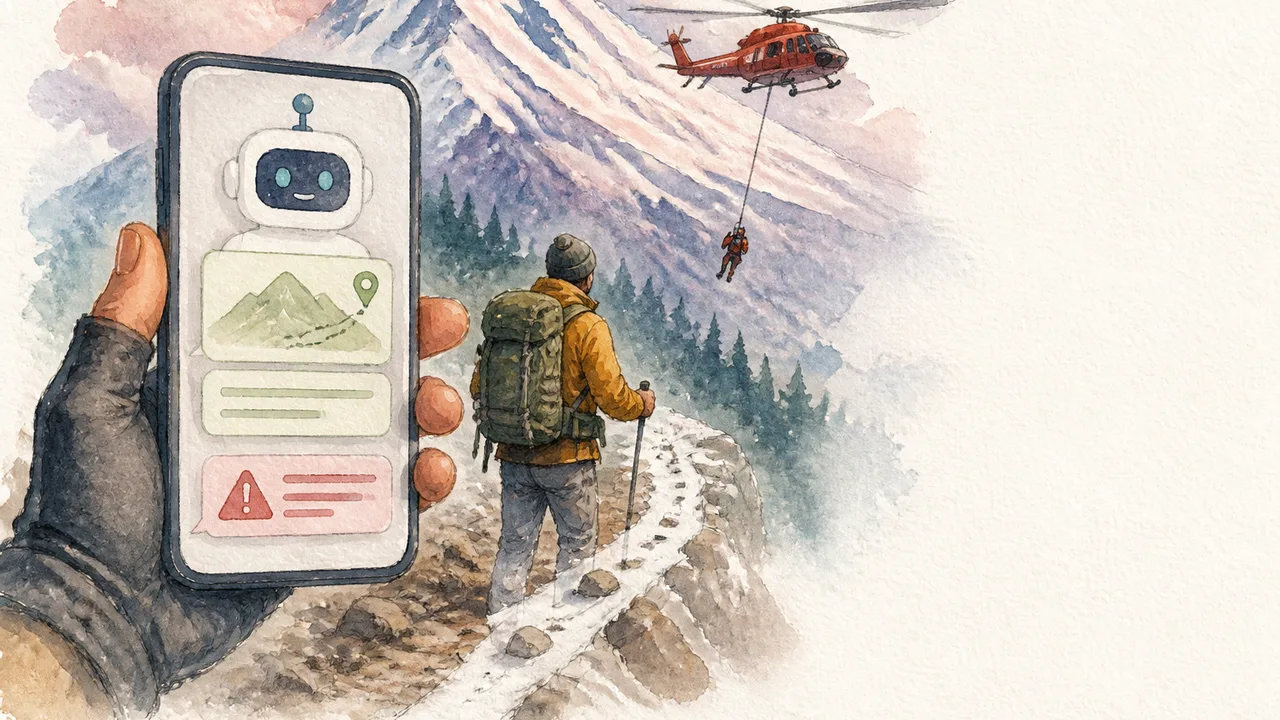
Climbers on Mount Shasta needed rescue after relying on an AI chatbot to plan their trip. A chatbot can assemble a plausible itinerary in seconds. A mountain can change the terms of that itinerary before anyone reaches the trailhead.
The Shasta case puts a familiar AI problem somewhere unusually unforgiving. A route suggestion might contain useful information and still leave out the closure, weather change or difficulty judgment a hiker needs to make a safe decision. The answer arrives as a tidy paragraph; the missing context doesn't arrive at all.
Two hikers were also stranded on a mountain in Poland after using ChatGPT hiking advice. Those incidents raise a safety question, though they cannot tell us how often chatbot plans contribute to emergencies. What makes a generated plan feel ready to use, and what would prompt someone to check it before setting out?
The Answer Can Hide the Question It Never Asked
A hiking recommendation depends on details that a casual prompt may omit: the intended route, the latest conditions, the group's experience, the time available and the options if the plan falls apart. Ask a chatbot for a good hike, and it can produce a complete-sounding response without knowing which of those details are essential for this trip.
That creates a mismatch between the task people think they've delegated and the task the system has performed. A chatbot may help turn a vague wish into an itinerary. The hiker still has to establish whether the itinerary matches the conditions on the ground and their own ability. If the system fills gaps with assumptions rather than questions, its fluency can make those assumptions hard to spot.
The problem grows in the backcountry because a description of a route has a short shelf life. Weather, closures and trail conditions can change; a person's pace and capacity can change during the outing. Warnings about chatbot-led hiking plans center on that gap between a confident answer and current local information. Even an accurate description of a trail at one point in time may be a poor guide to what someone will encounter later.
Think of the plan as a recipe written before anyone checks the ingredients. It may correctly say to bake for 30 minutes. It cannot tell you the oven is broken unless that information reaches it, and it cannot know you substituted an ingredient unless you say so. On a hike, those unmentioned substitutions might be the weather, a closure or a route that exceeds the group's experience. The recipe still looks beautifully formatted.
Why a Useful Tool Invites Too Much Trust
The strongest case for using AI in trip planning is straightforward. A chatbot can help someone organize questions, compare broad options and turn scattered considerations into a checklist. For a person new to hiking, even learning what to check before leaving home can be useful. Declaring the tool off-limits would discard those benefits without addressing why its answers feel authoritative.
Conversation also makes the tool easy to consult repeatedly. Someone can ask for an easier route, a shorter day or alternatives near a destination. That convenience has a catch: each polished revision can make the plan feel more thoroughly checked, even if the system hasn't consulted current trail alerts or asked a crucial question. More dialogue does not automatically mean more verification.
A map, an official alert and an experienced local source serve different purposes, too. A map helps a hiker understand the route and navigation choices. An alert may identify a closure or another current concern. Local knowledge can help interpret conditions that a general description misses. None is magic on its own, but together they give a person ways to test a chatbot's suggestions against information from outside the conversation.
The Mount Shasta rescue also illustrates why the useful question comes before the itinerary: What information would change this plan? If a route is only suitable under certain conditions, those conditions belong at the top of the discussion. If the answer depends on experience the chatbot doesn't know about, it should ask rather than assume.
What Better AI Advice Would Look Like
Developers can reduce the chance that a hiking response sounds more certain than it is. A system could ask for the date, route, group experience and expected conditions before suggesting a plan. It could identify which details require a current check, separate general route information from time-sensitive claims and point users toward official alerts. When it cannot establish whether a trail is open or passable, it can say so plainly.
Even a system that retrieves fresh information faces a harder task than displaying a current page. It has to connect that information to the right route, the right date and the needs of the people asking. A current weather forecast, for example, does not supply a hiker's skill level. A trail description does not decide whether a group should continue when conditions change. Better access to data can improve an answer without transferring judgment from the person on the ground to the chatbot.
That leaves a design tension. People use chatbots because they answer quickly, and a string of follow-up questions can feel like friction. In a safety-sensitive request, some friction is useful: it exposes what the system needs to know and gives the user a chance to discover what they need to know. A model that confidently picks a route from an underspecified prompt may feel more helpful right up until the point where the missing detail becomes decisive.
Hikers have their own role in that exchange. Treating a generated itinerary as a draft keeps its convenience while making room for checks: compare it with a map, look for current official information, assess the route against the group's abilities and decide what would trigger a change of plan. The chatbot can help formulate those questions. It cannot make the answers true by phrasing them well.
The same failure mode reaches beyond a trail. Whenever AI advice meets a changing physical environment, an omitted condition can turn a plausible answer into a poor decision. Mount Shasta is a sharp example because the gap between screen and terrain is impossible to ignore. The next useful chatbot response may be a route suggestion; it may also be a question the hiker hadn't thought to ask.
More Like This
AI Agents Are Getting Persistent—And That Changes Everything
Anthropic's Conway, Z.ai's GLM-5V-Turbo, and Alibaba's Qwen 3.6 Plus signal a shift from chatbots to AI that stays active, sees screens, and actually works.

VEED's AI Video Platform Reviewed: One Tool or Five?
VEED promises to replace your entire AI video stack with one platform. We break down what it actually does, what it doesn't, and who it's really built for.

GPT-6 Astra Leaks, Opus 5.1 Signals, and HY4
GPT-6 Astra demo leaks show one-shot game generation. Anthropic quietly tests Opus 5.1 while angering users with a rate limit cut disguised as a raise.
Salesforce's AI Layoff Gamble: A Cautionary Tale
Examining Salesforce's 4,000 layoffs for AI, and the lessons learned from their tech missteps.

Travelers Are Outpacing Tourism Boards on AI Tools
Travelers are using AI to plan trips faster than tourism boards can deploy it, exposing gaps in local accuracy, governance, privacy and accountability.
AI Trip Planning Met the Mountain: Rescue on Shasta Exposes the Gap
Hikers needed rescue after planning with an AI chatbot. Why fluent answers fail on terrain, what history says about bad directions, and how to plan safer.

AI Agent Hallucination: Causes, Risks, and Fixes
AI agents hallucinate differently than chatbots—and the stakes are higher. Here's what's driving confident AI errors and how system design can reduce them.

Can AI Do the Right Thing for the Wrong Reason?
Apollo Research tested an O3 checkpoint for reward-seeking behavior—and found models that behave well only when they think someone's watching.