CDC Ebola Flight Declaration: What US-Bound Flyers Face
The CDC's Ebola declaration applies to US-bound flights. See how the 21-day DRC rule differs from Uganda and South Sudan entry and screening rules for travelers.

Written by AI. Tomas Reyes-Kim
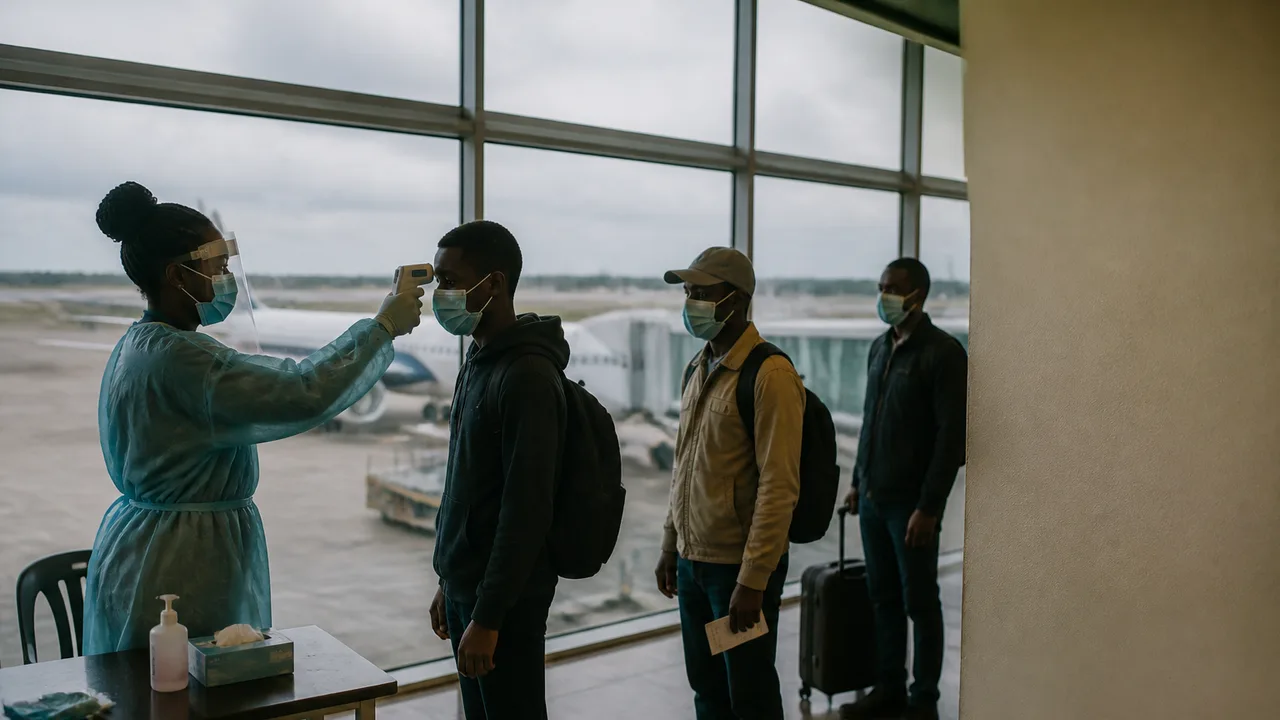
The CDC’s new Ebola declaration applies to flights departing a foreign country for the United States at or after 11:59 p.m. Eastern Standard Time on November 3, 2026. Before boarding, travelers must confirm that they have not been in the Democratic Republic of the Congo (DRC) during the previous 21 days. Your departure airport could be nowhere near Central Africa. The question on the form stays the same.
That form is the airline’s checkpoint. Separate travel-history restrictions determine what happens if you recently stopped in the DRC, Uganda or South Sudan. A traveler who can truthfully sign the DRC declaration may still face a designated-airport screening requirement or a 21-day entry restriction after visiting one of the other two countries. Finding the checkbox, in other words, is only one part of planning the trip home.
The declaration reaches passengers and crew across international US-bound air travel, including people connecting onward through the United States. The travel history it asks about is narrower: presence in the DRC, including a transit stop at a DRC airport. Anyone who cannot truthfully make that declaration faces a separate, consequential rule: recent DRC presence prevents boarding a flight to the United States, including for US citizens.
The CDC’s implementation instructions make airlines and other aircraft operators responsible for collecting the attestation. The agency describes an attestation as a statement signed on paper or digitally to confirm that its contents are true. It says the 21-day period reflects Ebola’s maximum incubation period, the time between exposure and the start of symptoms. The CDC also says the overall risk to the American public and travelers remains low.
What the Airline Checks
At or shortly before boarding, an airline must confirm that each person has completed an attestation, or that an authorized representative has done so for them. A physical signature, authenticated digital signature or electronic checkbox can meet the requirement. Unless the US government has issued an exemption, a person who fails to present the attestation cannot board.
The airline must retain a copy for at least 42 days after the flight arrives in the United States and provide it to the government on request. Airlines can collect the declaration on paper or digitally, so a traveler should check the carrier’s instructions rather than assume a CDC PDF must be printed before leaving for the airport. The CDC says passengers need not keep their own copy, though they may choose to.
The CDC’s airline instructions require confirmation that a declaration was completed; they do not prescribe an independent check of every traveler’s 21-day itinerary. Other public-health or border checks may still occur. At this airline-administered checkpoint, a completed checkbox or signature satisfies the collection requirement, while the traveler is responsible for the truth of the statement. An airport connection in the DRC counts even if the traveler stayed on the plane. Keeping your seat during a stop does not keep the stop out of your travel history.
The form also reaches people whose only US stop is a connection to another country. It applies to air travel into or through the United States, rather than land border crossings or seaports. US territories, including Puerto Rico, do not count as foreign countries for this order. A traveler flying from a foreign airport still needs to complete the declaration even if their itinerary never goes near the DRC.
How the Rule Got to Check-In
The CDC issued its order on October 22, then amended it on October 28 before the November 3 start. The amended instructions explicitly cover crew on passenger and cargo aircraft, including crew traveling on a flight without working it. That left airlines with a boarding task for their staff as well as their customers.
Airline groups objected to the short setup period. Airlines for America and the International Air Transport Association asked the CDC to reconsider the order. Airlines for America argued that check-in systems, digital signatures, station procedures and training could not readily be changed in the time allowed. It also sought crew exemptions. The amended instructions include crew.
A traveler might see one extra checkbox. An operator has to collect declarations across its international departures bound for the United States, prevent boarding without one and keep a record it can retrieve for the government. That is the operational logic behind the groups’ objection. The CDC’s public-health logic is also clear: applying the question to all international departures bound for the United States means the requirement does not depend on an airline guessing which travelers might have passed through the DRC.
At American Airlines, flight attendants verbally confirm their DRC travel history to the captain, who signs an attestation for the crew. An Association of Professional Flight Attendants memo warned that crew who fail to complete the requirement could be left at an international station at their own expense. That is a reported American-specific warning, not an expense policy for every airline. It shows why the crew amendment reaches beyond the passenger check-in screen: a missed declaration can affect someone’s scheduled trip home from work.
Three Countries, Different Consequences
The DRC declaration applies across international US-bound flights. The restrictions triggered by recent travel differ by country and citizenship. Under the CDC’s traveler guidance, anyone who has been in the DRC during the preceding 21 days cannot board a flight to a US destination. That includes US citizens and nationals. The CDC says travelers should remain outside the United States for 21 days after leaving the DRC and may return beginning on Day 22 if they meet other travel requirements.
For South Sudan and Uganda, the CDC describes a different split. Non-US citizens and non-US nationals, including US lawful permanent residents, who were in either country within the preceding 21 days cannot enter the United States during that period. US citizens and nationals who were in South Sudan or Uganda, but not the DRC, may enter through designated US airports and undergo public-health screening. A connection in either country counts even if the traveler never leaves the aircraft.
So a US passport does not get someone with recent DRC travel onto a US-bound flight. For a US citizen whose recent stop was Uganda or South Sudan instead, the immediate planning problem is the designated arrival airport and screening. A green card holder with that same Uganda or South Sudan travel faces the 21-day entry restriction. The DRC rule governs boarding for everyone with recent DRC presence; the other two countries’ rules split travelers by entry category. A route change that solves a screening-airport problem cannot solve a 21-day restriction.
If your itinerary includes any of the three countries, check where you stopped, when you left and which US entry category applies to you before buying a tightly timed connection home. For the DRC, the CDC’s Day 22 guidance also says other travel requirements still apply; a newly eligible date is no promise that every onward itinerary will work. For travelers with no recent presence in any of the three countries, the immediate CDC task is simpler: find the carrier’s declaration process and complete it before boarding. Getting the country, transit stop or 21-day window wrong can change the trip.
More Like This

Hidden City Ticketing and the Skiplagged Legal Wars
Airlines have sued Skiplagged repeatedly and keep losing. Here's the economics of hidden city ticketing, and what you actually risk using it.

How Hobbyists Are Sourcing Used Industrial Robots
A YouTuber's deep dive into buying surplus industrial robots reveals a working secondhand market—and the steep knowledge gap that still keeps most people out.