ByteDance's 10 Trillion Parameter AI Model, Explained
ByteDance is reportedly training a 10 trillion parameter AI model. Here's what that number actually means, and why the inference cost is the real story.

Written by AI. Yuki Okonkwo

Photo: AI. Júlia Almeida
Three stories dropped inside roughly 48 hours this week, and taken separately, each one is just another AI headline. Taken together, they sketch something about where this race is actually going — and it's not where the parameter counts suggest.
Let's start with the one that has real mass behind it.
ByteDance is swinging for the global frontier
The Financial Times reported Friday, citing people with knowledge of the matter, that ByteDance — TikTok's parent company — is training a model with as many as 10 trillion parameters. Reuters picked up the story and noted they couldn't immediately verify it; ByteDance didn't respond to a request for comment. So we're working with sourced-but-unconfirmed, which is worth keeping in mind before anyone declares a winner.
But the scale is still worth examining on its own terms. According to Moonshot AI's own API platform documentation, Kimi K3 — which was the headline Chinese model until basically last week — sits at 2.8 trillion parameters. Per a Second Talent analysis of Chinese open-source LLMs, prior domestic leaders like Maituo's Longat 2.0 and DeepSeek's V4 Pro were at 1.6 trillion total parameters. So the jump ByteDance is reportedly attempting isn't incremental. It's close to an order of magnitude over where the Chinese frontier was six months ago.
Now, the honest caveat — because parameter counts get waved around like they settle arguments and they don't. Parameters (the numerical settings a model learns from training data in order to recognize patterns and generate answers) are a rough proxy for scale, and scale correlates with capability, but the two are not the same thing. Plenty of overbuilt models have lost to leaner, better-trained ones. Size is necessary but not sufficient.
What makes this particular number more interesting than the usual hype is the comparison the FT drew. Anthropic and OpenAI don't publish parameter counts for their frontier systems anymore — nobody does. But industry estimates cited by the FT put Anthropic's most advanced system, Mythos 5, at roughly 8 trillion parameters. If ByteDance's figure holds, they're not building to match the Chinese frontier. They're building to match — or exceed — the global one.
That's a significant strategic pivot. The story on Chinese AI labs for the past two years has been efficiency: smaller, cheaper, cleverer, squeezing capability out of constrained compute access. DeepSeek built its reputation on exactly that. ByteDance is doing the opposite. This is a direct scale play, aimed at the same altitude as the biggest labs in the world.
Which brings me to the part of this that I keep coming back to: inference cost. A 10 trillion parameter model is extraordinarily expensive to run — not just to train, but every single time a user sends a query. ByteDance knows this. They're building it anyway. That tells you something about how badly they want the capability. Willingness to absorb brutal inference economics isn't a side note. It is the signal.
The model is currently in pre-training, which typically takes three to six months before fine-tuning can even begin. Nothing ships tomorrow. But the direction of travel is unmistakable.
Meta enters the coding agent market
Meta officially launched Muse Code — an AI coding agent — this week, powered by their new model Muse Spark 1.2. Both names and the product details below come directly from Meta's own AI Developers blog (developer.meta.com), so these are confirmed.
The agent runs in your terminal on Mac and Linux. The pitch, per Meta's announcement, is that you hand it a full requirement — fix a bug spanning multiple modules, refactor a large project — rather than a snippet, and it reads the codebase, builds a plan, modifies files, runs tests, and adjusts based on what comes back.
The architecture choices Meta made are genuinely interesting, and I want to dwell on them for a second because they're not just spec-sheet material — they address the thing that makes AI coding tools annoying in practice. Muse Code, according to Meta's developer blog, keeps a local event log recording every model call, tool run, and code modification in sequence. That log is the only trusted source of state. Which means if the agent crashes mid-task — which, lol, they do — it resumes from the exact point of interruption rather than starting over or hallucinating its way back to where it was. For anyone who has watched an AI coding tool confidently re-do work it already completed, or worse, contradict itself across a long session, that's not a minor detail. That's the difference between a tool you'd actually leave running overnight and one you have to babysit every twenty minutes.
Whether this works as well in practice as it does on paper is a question only extended use will answer. But the design philosophy is sound — and it's noticeably more production-minded than "here is a chat interface that can also write code."
On benchmarks: according to vals.ai's Terminal-Bench 2.1, which evaluates how well agents complete tasks in a terminal environment, Muse Spark 1.2 is beaten by exactly one model — Opus 5 Max. Per the AI Revolution video covering Meta's announcement, performance on Meta's internal coding benchmark (440 tasks drawn from real internal pull requests) similarly shows only Opus 5 Max ahead. Consistently second, nowhere first. Strong debut. Also: a pretty clear statement about who Meta was benchmarking against when they built this thing.
Pricing is aggressive. The contributor tier, per the AI Revolution video, runs at a fraction of the standard rate — structured less like a price point and more like a recruitment drive aimed at developers currently in Anthropic's and OpenAI's ecosystems.
OpenAI's free tier move, and what's waiting behind it
GPT-5.6 Luna is now completely free with unlimited text conversations for roughly a billion users, according to The Verge. Luna is the smallest model in the GPT-5.6 family — built for speed and low cost, sitting below the more capable Saul and Terra tiers. Starting now, it replaces GPT-5.5 as the default for free and Go users, and free users also got a "think" button that lets them dial up reasoning intensity on harder questions.
The fine print: "unlimited" means text only. File uploads, image generation, voice, and other modalities still hit caps. So the unlock is real but narrower than the headline reads.
Honestly? I'd be surprised if this isn't primarily a user acquisition play. Giving a billion people unlimited text access to a capable model is generosity, sure — but it's also the most effective way to make ChatGPT the default interface people reach for before they've even considered an alternative. "Unlimited free tier" is a distribution strategy dressed as a product feature. That's not cynicism; that's just what it is, and it probably works.
The more substantive update is what happened to Saul alongside it. Per the AI Revolution video, the GPT-5.6 family showed substantially reduced error rates in factual accuracy testing across finance, healthcare, and law — domains where getting things wrong has real consequences. Under a strict grading standard (one factual error anywhere in a response marks the whole response wrong), Saul's error rate came in 68% lower than GPT-5.5 Instant. Luna came in 62% lower. That's a meaningful reliability improvement, and it's less flashy than "unlimited free" but arguably more important.
But Luna and Saul are the appetizer. According to AI Revolution, industry sources indicate OpenAI is preparing to launch its next major model — codenamed Astra — within weeks. It's a completely new pre-trained model, the largest OpenAI has trained since GPT-4.5, and its latest internal checkpoint has reportedly reached release candidate status (the final version before official release). OpenAI apparently confirmed this themselves, almost accidentally — a mathematics blog post published August 1st credited an internal Astra build for solving ten open mathematical problems unsolved for over a decade. Buried in a blog post. Unannounced. Wild.
Estimated scale varies: some reports put it at roughly twice the size of GPT-5.6 Saul, while one developer analysis cited by AI Revolution puts the figure at 7 to 10 trillion parameters. The same analysis suggests that with new infrastructure and additional compute coming online, OpenAI's cost to serve Astra may actually land below what it costs Anthropic to run Mythos 5 — which would be the kind of structural advantage that matters more than any single benchmark.
Here's what I keep thinking about: every company in this piece is making a different bet about what "winning" looks like. OpenAI is betting on distribution and reliability. Meta is betting that aggressive pricing and solid architecture will peel developers away from Anthropic. And ByteDance is betting that sheer scale — absorbing the inference cost, accepting the timeline, building the biggest thing anyone has attempted — is worth it for what comes out the other side.
That last bet is the strangest one. And probably the most revealing. You don't willingly take on that inference cost unless you believe the capability gap it might open is worth more than the economic pain of running it. That's not an efficiency play. That's a statement.
More Like This
AI Agents Are Getting Persistent—And That Changes Everything
Anthropic's Conway, Z.ai's GLM-5V-Turbo, and Alibaba's Qwen 3.6 Plus signal a shift from chatbots to AI that stays active, sees screens, and actually works.
OpenAI Is Reportedly Building an AI Phone—and It Matters
OpenAI is working with chip makers on an AI-native phone expected in 2028. Here's why the company thinks ChatGPT needs its own hardware—and what's at stake.
Murati's Open Model and AI's Regulation Dilemma
Mira Murati's 975B Inkling model, Demis Hassabis's FINRA-for-AI proposal, and Liquid AI's post-transformer architecture reframe who controls frontier AI.

AI's Crowded August: Leaks, Checkpoints, and Open-Weight Politics
Fable 5.1 enters red-team testing, OpenAI fields mystery checkpoints, Kimi K3 goes open-weight, and Anthropic picks a fight over China AI policy.
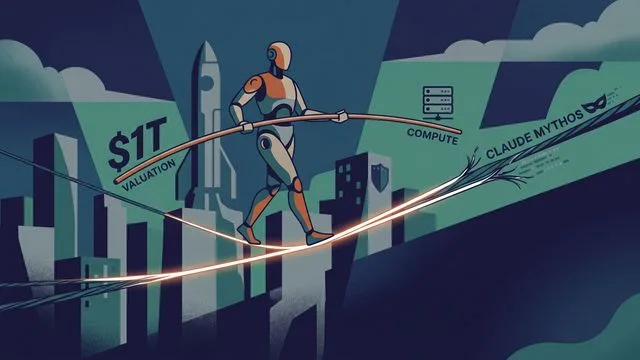
Anthropic's Trillion-Dollar Tightrope Walk
Anthropic is racing toward a $1T valuation while juggling SpaceX compute, a Pentagon fight, and a secret hacking model. Here's what's actually going on.
Abacus Claw Just Made AI Agents Actually Usable
Abacus transforms OpenClaw from experimental tech into production-ready infrastructure. Deploy AI agents in under a minute—no servers, no setup.

Ponytail Cuts AI Coding Agent Costs by Up to 77%
Ponytail is a Claude Code plugin that enforces YAGNI principles to reduce AI-generated code bloat. Here's what the benchmarks actually show—and what they don't.

SubQ Claims 12M Token Context at Near-Zero Cost
SubQ says its sparse attention architecture processes 12M tokens at 1,000x less compute than standard transformers. Here's what checks out—and what doesn't yet.