BTP's Facial Recognition Trial Tests Railway Policing
BTP scanned more than 500,000 faces in its initial railway trial without an alert-linked arrest. Its extension raises questions about safety, privacy and proof.

Written by AI. Samira Barnes
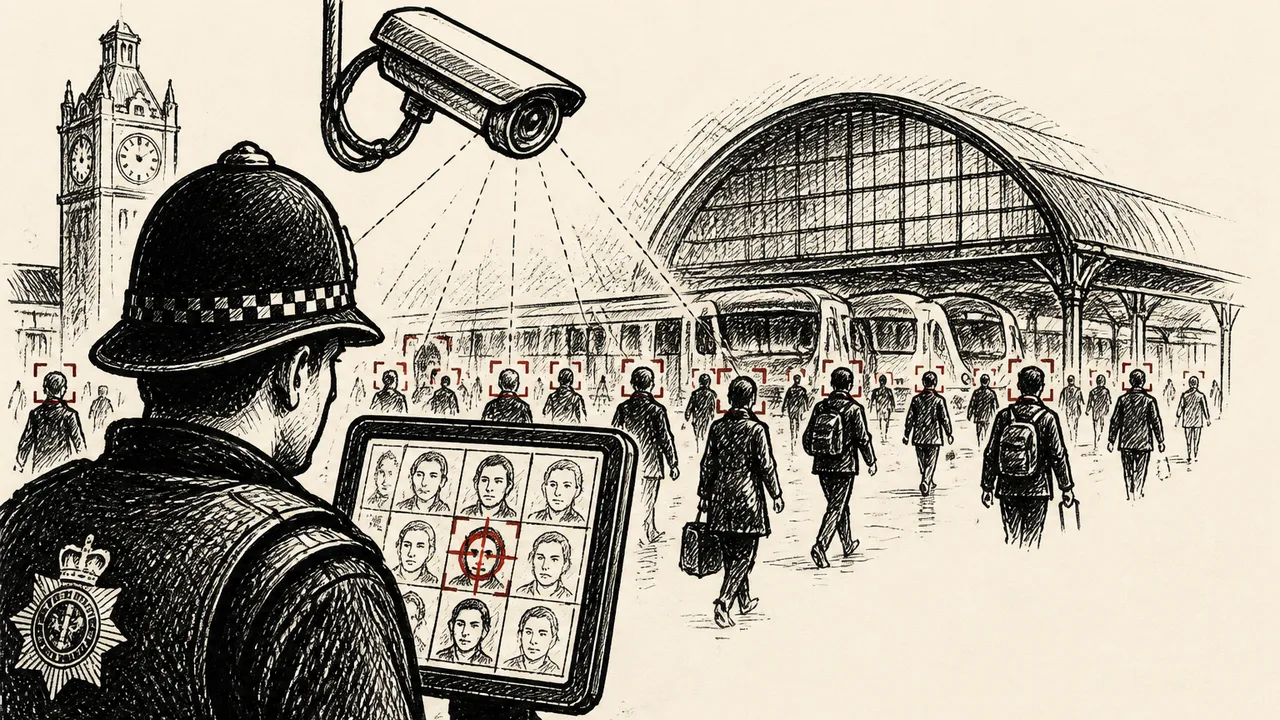
British Transport Police scanned more than half a million faces during a six-month live facial recognition trial at London railway stations and recorded one watchlist alert. It was a false match. Across 18 deployments from February to July 2026, the system produced no arrest directly resulting from an alert, while equipment hire and police staffing cost £320,786. Those figures come from a freedom of information document obtained by Liberty Investigates and shared with the Guardian; the trial figures were published in September.
BTP has extended the trial for four months and expanded it to London Underground stations. The force says it has changed deployment locations, procedures, equipment and watchlist construction. The extension will show whether that revised operation finds people the first phase did not. It also asks passengers to accept further facial-data processing while the likely safety benefit remains uncertain.
What an Alert Measures
Live facial recognition compares faces passing through a camera's designated area with a police watchlist. A possible match generates an alert for an officer to review before deciding whether to stop someone. An alert begins a decision by an officer; it does not establish that the person was correctly identified. In BTP's initial trial, the only alert identified the wrong person.
Officers did make arrests during the deployments, BTP told the Guardian, including for assault, theft and possession of an offensive weapon. The force also said officers located people wanted by courts or other police forces. BTP explicitly excludes those arrests from its facial recognition performance figures because they did not result directly from an LFR alert. A police operation can produce arrests while its watchlist-matching equipment produces none. Counting the arrests as camera successes would credit the system for work BTP itself attributes to other police activity.
The force says it began with a limited watchlist while establishing data quality, governance and safeguarding arrangements. It has since refined locations, procedures, equipment and watchlist construction. Starting cautiously offers an explanation for why a pilot's results might change. The first six months describe the initial configuration and the stations where it ran; they cannot predict every later deployment. A changed watchlist also changes what success means: more matches could reflect more eligible names rather than a better choice of station or better matching software.
BTP said that, after the extension, it had recorded three confirmed alerts involving people subsequently found to be complying with sexual harm prevention orders or other court conditions. These alerts belong to the later phase, outside the February-to-July tally. They show that the extended system has produced confirmed matches; they do not establish a breach of conditions or an alert-linked arrest. Combining both phases into one total would conceal changes to the operation just as those changes need scrutiny.
The Benefit Being Sought
Transport for London supported the extension, saying cameras at key stations would target people on police watchlists and help tackle violence against women and girls, whose travel can be shaped by sexual harassment and sexual offences. BTP says its pilot is intended to learn how the technology can identify wanted offenders and people who may pose a risk to passengers and staff. Finding a wanted person could allow officers to intervene before further harm. To pursue that possible benefit, the cameras also process the faces of passers-by who are not on the watchlist. Whether the intervention prevents harm, and at what cost to those passengers, remains an open question.
BTP says its deployments are intelligence-led, aimed at crime hotspots where it believes high-harm offenders may pass through, and that it deletes the biometric data of people who are not on a watchlist immediately. Privacy International's Sarah Simms told The Register that processing so many passers-by calls the description of the measure as targeted into question. Police can select a station and time using intelligence while a camera processes each passing face in its designated area. BTP's deletion assurance addresses retention. For a passenger whose face was scanned, the prior question is why processing at that station was justified at all; for someone wrongly flagged, it is how the officer responds to an uncertain match.
Proportionality on a railway concourse depends on the relationship between those intrusions and a plausible chance of finding someone police can act against. The initial tally records no alert-linked arrests and provides no quantified measure of offences prevented or changes in passenger safety. BTP's rationale might improve if its revised watchlist and locations bring wanted people into view. It would weaken if expansion mainly increases the number of passing faces processed or alerts that lead nowhere. Watchlist eligibility and the instructions officers receive when an alert appears bear on that judgment as directly as the arrest total.
Why Other Forces Are a Poor Scorecard
BTP began its railway trial after police use of live facial recognition was already expanding. In August 2025, plans called for 10 additional LFR vans to be rolled out to seven forces, alongside government consultation on a legal framework, Biometric Update reported. Metropolitan Police deployments had yielded a reported 580 arrests over the preceding 12 months. Citing figures raised by a Sky News reporter, the publication also said South Wales Police had scanned more than 1.6 million faces across 14 deployments so far in 2025 and made 15 arrests.
Those earlier figures establish that other forces were already deploying the technology, sometimes with reported arrests. They cannot rank the three forces' effectiveness. The Met figure covers a different period and comes without a matching scan total in that account. South Wales' count covers a different force and deployment period. BTP's zero refers expressly to arrests resulting directly from its alerts, while the figures for the other forces are reported as arrests from deployments. Locations, watchlists and the chance that a listed person passes a camera can differ as well. Dividing each arrest count by the number of deployments would give a tidy number with no consistent definition behind it.
The policy setting was changing alongside the equipment. In 2025, the Information Commissioner's Office said facial recognition was already subject to data protection law requiring lawful, fair and proportionate use, even as the government was developing a more explicit framework for police LFR. That describes the position in 2025, rather than the status of any later framework. Legal authority and a successful railway deployment are separate questions: an operational decision still requires a justification for processing the people at the selected station.
Fraser Sampson, a former UK biometrics and surveillance camera commissioner who now sits on the board of retail facial-recognition company Facewatch, pointed the Guardian to the choice of location and time, the composition of the watchlist and the likelihood of listed people being present. His commercial role is relevant context for his assessment. BTP's claim that it is learning where the system works depends on those choices. Adding names could raise the number of alerts while also changing the risk of mistaken flags; placing cameras where listed people are unlikely to pass could expose large numbers of passengers without helping officers find them. Neither possibility can be resolved by an arrest figure detached from its watchlist and location.
As the Underground joins the trial, BTP can separate confirmed matches and actions prompted by alerts from ordinary police work at the same stations. If it cannot show how the added processing advances the safety aim it has named, passengers and oversight bodies will have an arrest count but no sound basis for judging the deployment that produced it.
More Like This

Promptware: When AI Agents Become Attack Vectors
Prompt injection attacks on AI agents follow a structured kill chain — and existing legal frameworks have almost nothing to say about who's liable when it works.

Planet Labs, Orbital AI Compute, and the Chip Tax
Planet Labs CEO Will Marshall argues chip efficiency—not launch cost—will determine who wins the race to put AI compute in orbit.