Bronze Age Evolution: What Ancient DNA Reveals About Us
David Reich's new preprint says human evolution accelerated during the Bronze Age. Here's what that means for your immune system, metabolism, and health today.

Written by AI. Samir Patel
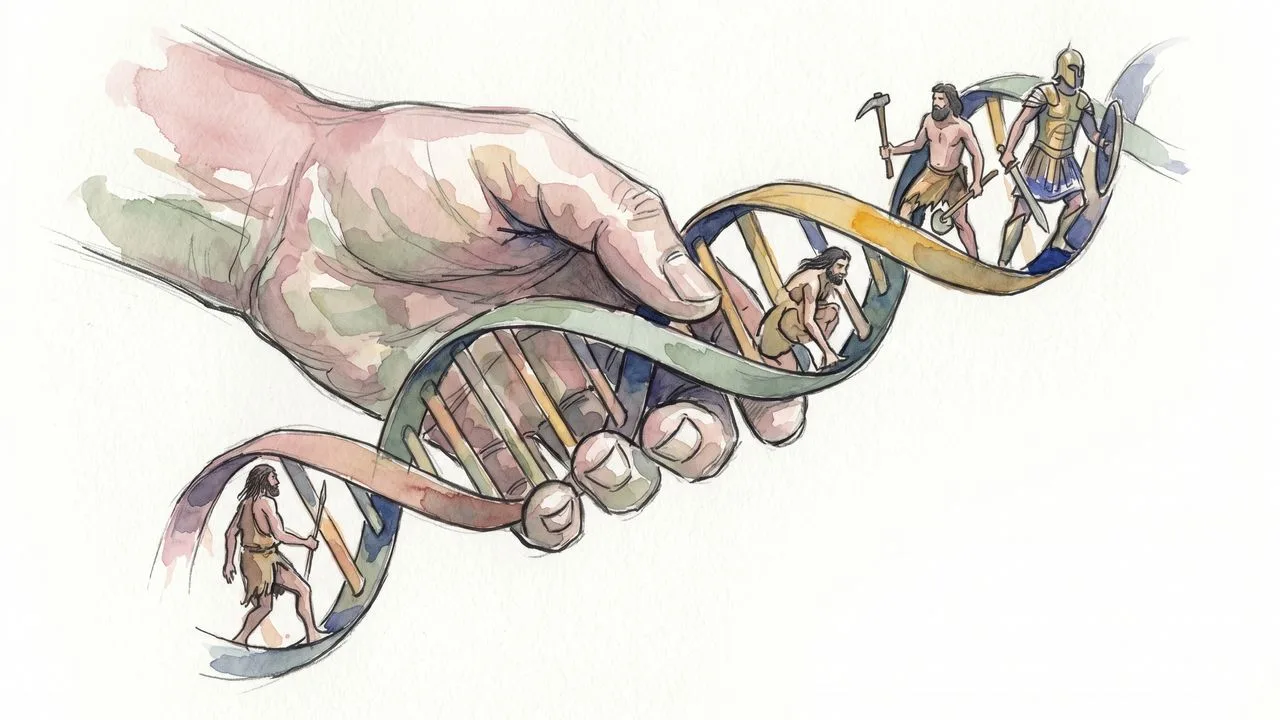
Photo: AI. Júlia Almeida
I want you to hold something in mind as you read this: every person whose bones were dug up to make this research possible had a body that was in crisis.
They were crowded into the first dense settlements human beings had ever built. They were sleeping next to cattle, pigs, and goats — animals whose pathogens their immune systems had never negotiated with. Epidemics moved through their communities in ways that had no precedent in human experience. There was no germ theory. No antibiotics. No public health infrastructure. Just bodies, trying to survive conditions that were, by any measure, unprecedented.
"Selection pressure" is the scientific term for what they experienced. I want to be honest about what that phrase is a clinical abstraction for: a lot of people died. The ones whose genetics happened to confer a slight edge in immune response, or metabolic flexibility, or pathogen resistance — they survived slightly more often, had slightly more children, passed those variants forward. That's natural selection. It looks elegant in a paper. It was brutal in a life.
This is the human context for a genuinely significant new preprint from Harvard geneticist David Reich and his collaborator Ali Akbari, who has been a staff scientist in Reich's lab for several years (his precise title and affiliation should be confirmed in the published version). In a recent conversation with Dwarkesh Patel, Reich explained what their work found — and it challenges a consensus that has held in evolutionary biology for decades.
The old consensus, and why it's now in question
For years, the mainstream view in human genetics was that natural selection had been largely quiet — "quiescent" is Reich's word — over the last several hundred thousand years. The evidence seemed solid: if you compare gene frequencies between Europeans and East Asians, populations whose ancestries diverged roughly 40,000 to 50,000 years ago (though this estimate varies considerably depending on the genetic model used, and some analyses suggest earlier divergence), you don't see many variants that are 100% different between them. If selection had been ripping through the genome, you'd expect to.
The problem, it turns out, was statistical. Detecting natural selection in ancient DNA requires enormous sample sizes — not because a single genome is uninformative about history, but because tracking how specific variant frequencies shift over time demands many, many data points. One ancient person gives you, at most, two copies of any given variant. To see whether that variant is being systematically pushed upward across a population, you need thousands of samples, from geographically isolated pockets, across multiple time periods.
Reich's lab spent years industrializing ancient DNA sequencing — making it cheaper, higher quality, and scalable. That infrastructure is what made this study possible.
What they found, across roughly 10 million variable positions in the genome: natural selection hasn't been quiescent. It's been "rampant," to use Reich's word. "Instead of being quiescent," he told Patel, "natural selection is everywhere. Even though it's only 2% of the frequency change, it's tugging the positions in one direction or the other everywhere."
Two percent sounds small. Across 10 million positions, it's not.
The Bronze Age as biological inflection point
Here's where Reich's findings get genuinely surprising. Farming — which began in the Middle East roughly 11,000 to 12,000 years ago and spread into Europe after around 8,500 years ago — has always been treated as the evolutionary shock. The big transition. The moment that rewrote human biology.
But when Reich and Akbari compared selection signals across time periods, the Bronze Age (a periodization that varies significantly by region; this research focuses on European and Near Eastern populations specifically, roughly 5,000 to 3,000 years ago) showed stronger signatures of selection than the initial agricultural revolution.
Reich's explanation: it wasn't just farming that did it. It was the intensification of everything that came with late-stage farming. Higher population density. Larger settlements. More sustained contact with domesticated animals and the diseases they carried. A way of life that diverged from the hunter-gatherer baseline far more radically than early agriculture had.
"Maybe the degree of that wrenching process moving into the Bronze Age was qualitatively greater," Reich said, "than the degree of the wrenching process that happened from the initial transition to growing plants."
Think about what that means at the level of individual human bodies. These were people experiencing a disease environment that had no precedent — not for them, not for their parents, not for any ancestor within living memory. Zoonotic spillovers. Crowd diseases. Pathogens that had been circulating in animal populations for millennia, suddenly introduced to human hosts living close enough together for rapid transmission.
The genomic signatures of immune selection that Reich's team found — a four- to fivefold enrichment compared to random expectation — are the molecular record of who survived that. They're also, in a very real sense, part of what's living in your body right now.
What your Bronze Age inheritance might mean for your health
The strongest selection signals in Reich and Akbari's data cluster around two categories: immune function and metabolic traits, including variants associated with body fat regulation and type 2 diabetes risk.
This is the part of the paper that strikes me as having the most direct relevance for anyone reading this who has a body — which is all of you.
The metabolic variants that were under intense selection pressure 4,000 years ago weren't selected to optimize health in a world of caloric abundance and sedentary labor. They were selected to help people survive in communities where food supply was unpredictable, physical demands were high, and surviving a bad winter or a bad harvest could mean the difference between having children and not.
That mismatch — between the environment these variants were selected for and the environment we're living in now — is exactly what researchers mean when they talk about evolutionary mismatch as a driver of modern metabolic disease. Type 2 diabetes. Obesity. Autoimmune conditions. These aren't signs of personal failure. They're, in part, the cost of carrying Bronze Age survival adaptations into a 21st-century food environment.
I'm not saying genetics is destiny — far from it, and anyone who tells you that chronic illness is just about your genome is selling you something incomplete. But understanding that some of your disease risk has roots in what your ancestors survived helps situate that risk. It's not a character flaw. It's an inheritance. And like most inheritances, it comes with both assets and liabilities.
The cognitive score question: proceed with care
The video description notes that the preprint apparently found polygenic score shifts suggesting cognitive performance predictors moved upward over the last 10,000 years — with a figure described as roughly a full standard deviation cited in the episode description, attributed to the preprint rather than to Reich's direct spoken words. (Given how contested polygenic score interpretation is in the scientific literature, I want to be careful here: this figure comes from the paper's framing as described by Patel, and readers should consult the preprint directly rather than treating this as a clean empirical result.)
I need to sit with this part longer than the rest, because I know what happens when this kind of finding enters the media ecosystem without careful handling.
Polygenic scores for cognitive traits are genuinely useful research tools. They aggregate thousands of tiny genetic signals to create a statistical predictor — not a measure of intelligence, but a predictor associated with educational attainment in specific, largely European-ancestry populations where the underlying genome-wide association studies were conducted. The score is population-specific, GWAS-derived, and has known limitations around cross-ancestry generalizability. It is not a brain scan. It is not an IQ test.
Reich is actually careful about this, which matters. He explicitly told Patel that the absence of strong single-site selection signals for behavioral traits doesn't mean those traits aren't under selection — it means behavioral traits are underpinned by many genes of weak effect, and current statistical power can't easily detect them. The genome is too complex, and the signals too distributed, to read clean stories off of polygenic score trajectories.
But I've watched the research cycle enough times to know that "ancient DNA shows genetic predictor of intelligence rose by a standard deviation during the Bronze Age" is a headline that will be picked up, stripped of methodological nuance, and used to support arguments about group differences in cognitive ability that this research does not and cannot support. The history of this exact dynamic — polygenic scores being weaponized in public discourse to make claims about racial intelligence hierarchies — is documented, harmful, and ongoing.
Reich is aware of this history; he's written about it at length. The responsible path for science communicators covering this finding is to report what it actually shows (polygenic score frequencies shifted in a specific ancient European/Near Eastern population under specific selection pressures), acknowledge the significant interpretive limitations, and be explicit about what it does not demonstrate. It does not compare living populations. It does not rank groups. It does not tell us whether contemporary humans differ in cognitive capacity along any genetic dimension.
Exciting findings in population genetics require proportional scrutiny. This one is genuinely interesting. It also requires that we read it carefully — for the sake of the people the research is about, and the people whose lives could be harmed by its misuse.
The bodies in these Bronze Age graves weren't data points. They were people who got sick, adapted, died, and occasionally survived in ways that we're still carrying. That's worth holding onto as this research moves from preprint to peer review to public conversation.
What we do with that knowledge — who it helps, who it's weaponized against, whether the wellness implications reach the communities most affected by metabolic disease — those aren't genomic questions. They're political ones.
More Like This

Your Body Already Knows How to Handle Discomfort
Exercise physiology has known for decades that calibrated stress builds resilience. So why does the wellness industry keep selling you comfort instead?
Three Biology Breakthroughs That Rewrote Evolution's Rules
New research reveals intelligence evolved twice independently, fathers pass traits through sperm RNA, and evolution happens in bursts—not gradual change.
Exploring Mercury's Mysteries: From Alchemy to Modern Science
Discover the unique properties of mercury, its historical significance, and intriguing experiments in Andrew Szydlo's lecture.

Space Developments: Tech Triumphs and Challenges
Exploring recent space missions, tech innovations, and their broader impacts on humanity's cosmic ambitions.
Unlocking New Skills After 50: The 'Pillar & Playground' Approach
Explore how the 'Pillar & Playground' method helps those over 50 learn efficiently, leveraging crystallized intelligence and cognitive flexibility.
Is Our Evolutionary Past Becoming Our Downfall?
Exploring how rapid modern changes might be misaligning with our evolutionary adaptations.

Maladaptive Daydreaming: When Fantasy Becomes Escape
Maladaptive daydreaming is vivid, hours-long fantasy that disrupts real life. Here's what psychology knows—and doesn't—about this under-researched experience.

How to Survive a Sleepless Night, According to Science
When sleep isn't possible, science offers real strategies. Here's what sleep banking, caffeine naps, and thermal drops can actually do for you.