Brazil’s Amazon Deforestation Falls, but Fires Persist
Brazil’s Amazon clear-cutting fell to its lowest annual rate since 1988. A revived control plan and rising fire hotspots show what the headline measures, and misses.

Written by AI. Olivia Meng
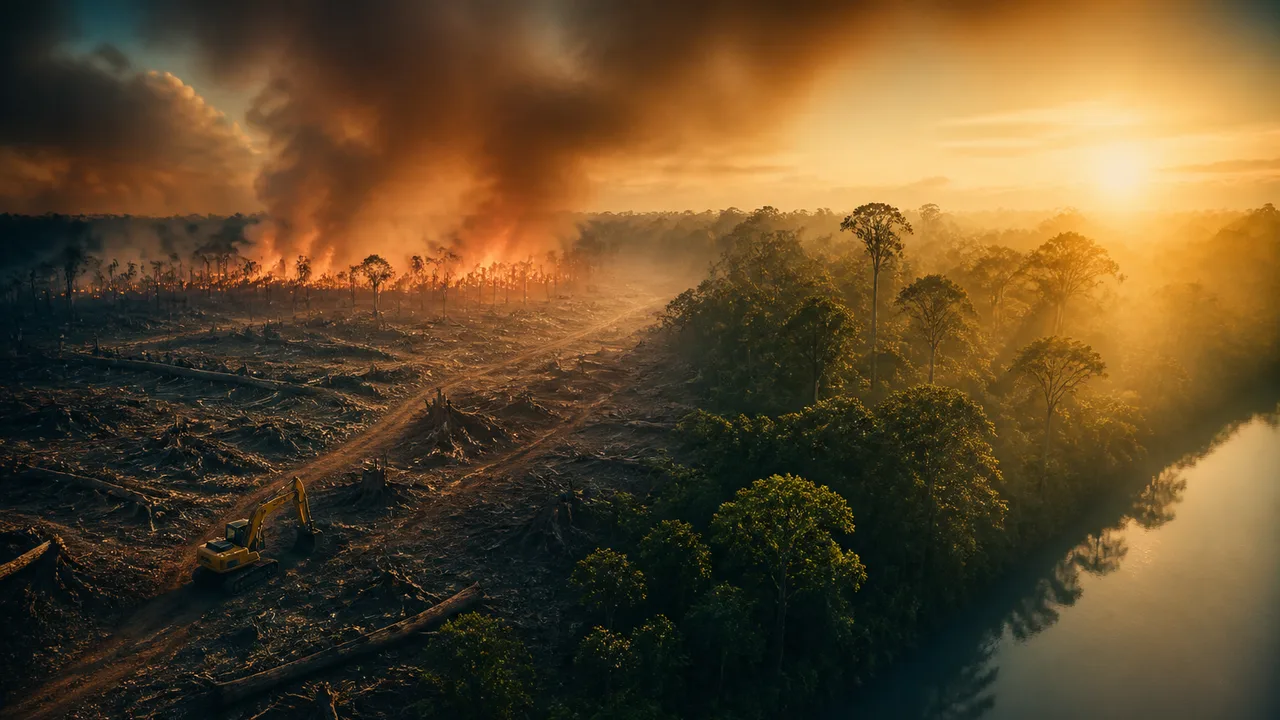
Brazil’s Amazon lost 3,335 square kilometers of forest between August 2025 and July 2026, its lowest annual deforestation total since satellite records began in 1988. That is a substantial improvement: the area cleared was 41.8% smaller than in the previous year. It is also 3,335 square kilometers of forest that is gone.
The decline arrived as Brazil changed course on forest protection. President Luiz Inácio Lula da Silva restored a deforestation-control plan after taking office in 2023 and strengthened monitoring and enforcement. His reelection on October 25 gives that approach another term. Yet the annual figure answers a narrower question than whether the Amazon is recovering. It measures forest cleared outright. Fire, logging and drought can damage trees that remain standing, with consequences for carbon storage and wildlife.
That creates two tests for the government. The first is whether it can keep reducing the area cleared each year. The second is whether the forest left on the map remains healthy enough to do the work expected of it.
What the Annual Number Counts
Brazil’s space agency, INPE, uses its PRODES satellite-monitoring project to estimate annual clear-cutting in the Brazilian Legal Amazon. The series dates to 1988. A lower rate means less forest was newly cleared during the reporting year; it does not mean the forest lost in earlier years has returned. Even at this record low, the cleared area remains substantial.
The annual reporting period ended in July, while October brought a different signal from one Amazon state. Between October 1 and 19, INPE recorded 1,921 fire hotspots in Amazonas, up 202% from the same period in 2025. The state declared an emergency in 36 municipalities on October 10. Hotspots are detections, not a measurement of hectares burned or trees killed, and this state count cannot describe fire across the entire Amazon. For communities confronting smoke and flames, however, the annual clear-cutting figure offers little account of what happened after July.
A tree can remain in a satellite image while losing branches to fire, suffering drought stress or standing in forest thinned by logging. Damage to standing forest can reduce carbon storage and biodiversity and leave it more vulnerable to future drought and fire. The severe 2023–24 drought offered an earlier example of fire and ecological damage rising while outright clearing fell. Clear-cutting and degradation can therefore move in different directions without either measurement being wrong.
INPE also operates DETER, a rapid-alert system intended to help enforcement agencies find new clearing. Its August 2025 to July 2026 alerts totaled 2,874 square kilometers, while the reported annual loss was 3,335 square kilometers. Those figures serve different monitoring purposes; treating their difference as an amount of forest somehow unaccounted for would turn two instruments into a false ledger. The more useful reading is that rapid alerts can direct intervention while the annual series tracks the longer-term outcome.
A Policy with a History
Lula’s current program has a name and a previous life. The Action Plan for the Prevention and Control of Deforestation in the Legal Amazon, or PPCDAm, began in 2004, during his first administration. It was shelved under former president Jair Bolsonaro and revived after Lula returned to office in 2023. A policy database compiled by researchers at the Grantham Research Institute describes the current phase as running from 2023 to 2027, with aims that include stronger implementation of forestry law and incentives for conservation and sustainable forest management.
The government’s approach reaches beyond a promise to save trees. It combines monitoring and sanctions with plans for protected areas, decisions about undesignated public forests and economic incentives. The administration restored sanctions for illegal clearing detected by satellite and proposed restricting bank loans to properties linked to illegal deforestation. A proposed restriction and an enforced penalty are different steps, so the proposal alone should not be counted as a reduction in clearing.
The history helps explain why the recent decline is politically significant. Forest protection depends on institutions that can detect clearing, act on it and remain funded through changes of government. Under Bolsonaro, resources for forest protection were cut as clearing rose; under Lula, monitoring and penalties tightened as clearing fell. That sequence makes policy a plausible contributor. It cannot assign the 41.8% drop to any single measure or separate enforcement from other influences on land clearing.
There is a useful precedent within this same forest. The original PPCDAm was designed to reduce deforestation and support a sustainable development model in the Legal Amazon. Its revival shows that Brazil is drawing on an established policy framework rather than starting from an election slogan. The limit to the parallel is equally practical: a program’s stated goals, whether in 2004 or in its current phase, are not a record of what every agency has carried out on the ground.
The Forest that Remains
A study of more than 3 million hectares around Santarém and Paragominas in northern Brazil offers a closer comparison of what happens to forest under different pressures. Over 2010–20, researchers identified nearly 160,000 hectares that were entirely deforested, 273,000 hectares that were burned or logged, and almost 130,000 hectares that regrew. In modeled alternatives for those two areas, preventing logging and fires produced large biodiversity benefits, while preventing outright deforestation produced especially large carbon benefits. Those regional, historical results cannot be scaled into a 2026 estimate for the whole Amazon. They do show why a government tracking only hectares cleared could miss gains or losses in the forest it has kept standing.
That comparison also puts restoration in perspective. Regrowth appeared alongside clearing and disturbance in the study area, but the researchers’ modeled restoration scenario delivered smaller carbon and biodiversity gains than preventing either outright clearing or logging and fire. Planting and recovery have a role; protecting standing forest addresses damage before it must be repaired.
Lula won 51.8% of valid votes against Flávio Bolsonaro’s 48.2% in the October 25 runoff. Bolsonaro had promised to remove what he called environmental obstacles in the Amazon. Lula has pledged to end deforestation by 2030. The election settles who will oversee the next phase of that pledge, not whether its targets will be met.
Brazil can now ask more of a successful forest policy than one falling annual number. The next PRODES result will show whether outright clearing continues to decline. Fire and forest-condition measures will show whether protection also reaches the trees still standing. Both questions concern the same Amazon, even when they require different instruments to answer.
More Like This

How El Niño Raises Fire Risk Across the Amazon Basin
El Niño can dry parts of the Amazon as fires appear across the tropics. Rainfall, land use and ignition determine where heightened risk becomes a damaging blaze.

Quantum Batteries Challenge the Rules of Energy Storage
Australian researchers built the first full-cycle quantum battery that charges faster as it grows. Here's what that means—and what it doesn't, yet.

Arkansas Lithium: Oil Giants Bet on the Smackover
ExxonMobil, Chevron, and Standard Lithium are racing to extract lithium from southern Arkansas brine. Here's what's real, what's promised, and what's unresolved.