Arq's $1.4M Quantum Bet and the Workers Inside It
Arq raised $1.4M to build quantum internet hardware. The funding story is easy. The labor story—who takes that job—is the one worth reading.

Written by AI. Carmen Rodriguez
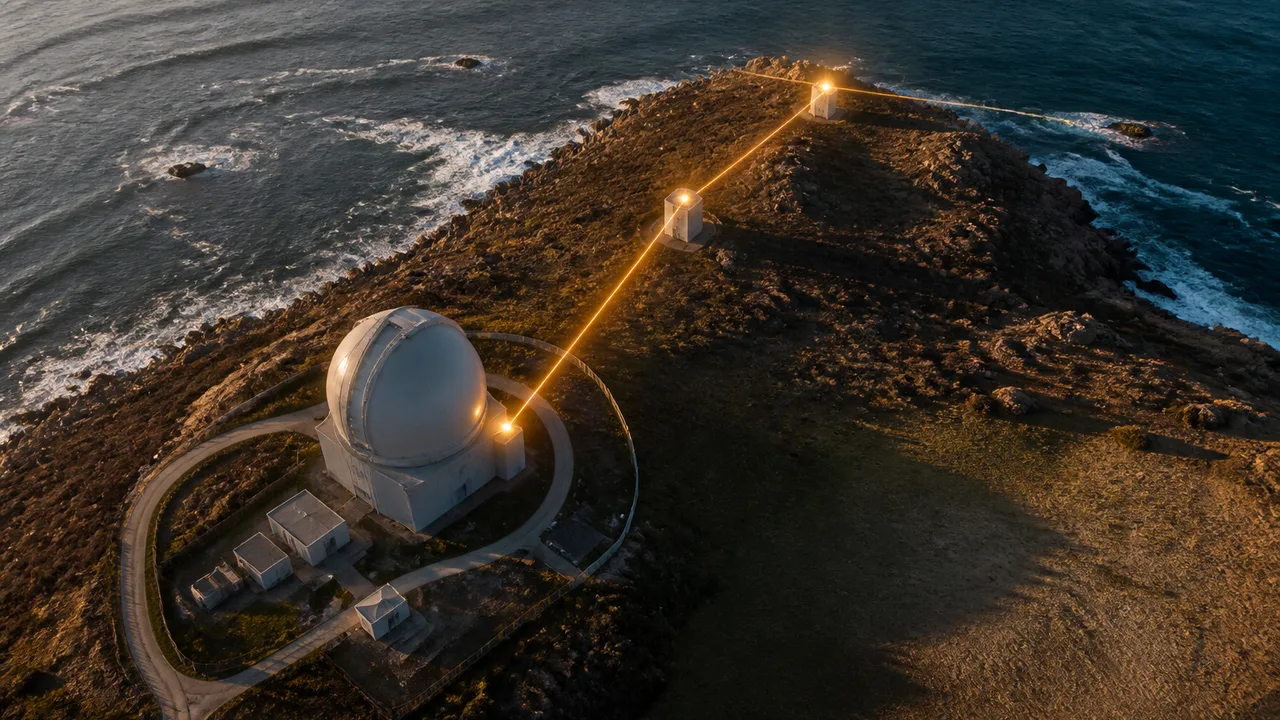
Somewhere in Spain, a small group of engineers just took a job that asks them to solve one of the hardest open problems in physics before a pre-seed runway runs out. That's not a knock on Arq. It's just what it means to be the humans inside a bet this large.
The funding headline is easy enough to read: Arq, a Spanish quantum technology startup building networking hardware for what its backers are calling the quantum internet, has raised $1.4 million in a pre-seed round, according to Tech.eu. The round was led by Ground State Ventures, with participation from Big Sur Ventures, and it's pointed squarely at accelerating development of quantum repeater technology, per The Quantum Insider. That's the round. Now let's talk about what's actually being asked of the people who showed up to do the work.
What $1.4 Million Buys You in Quantum Hardware
Pre-seed money in deep tech is a specific kind of proposition. It's not "build the product." It's "prove enough of the physics that someone will give you more money to keep going." In software, you can iterate fast on a shoestring. In quantum hardware — where you're manipulating individual photons, trying to maintain quantum coherence over physical distance, designing and fabricating components that don't exist as commercial off-the-shelf parts — $1.4 million is a very compressed window.
The core technical challenge Arq is attacking is quantum repeaters. The reason this matters: quantum signals can't simply be amplified the way classical internet signals can. Amplification destroys the quantum state. Repeaters work differently — they use quantum entanglement to extend the range of quantum communication without collapsing the information being carried. It's elegant in theory. In practice, Post Quantum's technical overview of the space describes functional long-distance quantum repeater networks as a decades-in-the-making research challenge still working through foundational hurdles. The people at Arq are not walking into a well-paved road. They're walking into the frontier.
What does it mean to take that job? "Team formation" is how venture capitalists describe the next phase of a funded startup. What it actually means is that engineers — likely specialists in quantum optics, photonics, cryogenic systems, or quantum error correction — are being recruited into a company whose entire value proposition rests on a race between two clocks: how fast the science moves, and how fast the money runs out. That's a real labor condition, not an abstraction. These are people making career bets, potentially relocating, certainly foregoing other options, on the premise that this particular startup will be the one to crack it — or at least crack enough of it to stay alive long enough to raise a seed round.
That implied contract deserves some scrutiny, because it's almost never made explicit.
The State-Backed Competition Nobody at Arq Can Ignore
Here's the structural tension that doesn't appear in funding announcements: the people competing with Arq for quantum networking breakthroughs include national labs and government-backed research programs that are not on any commercial clock at all. They don't have investors waiting for returns. They don't have runway. They have budgets that renew regardless of milestones. Their researchers have tenure, institutional support, and time horizons measured in careers rather than funding rounds.
What does that mean for the engineers at Arq? It means they are working in a race where some of the other runners aren't racing. The national programs aren't trying to get to market — they're trying to understand the physics. The commercial startups are trying to get to market fast enough to matter before larger players absorb the problem or the public funding crowds out the commercial opportunity.
That's not a reason to dismiss what Arq is doing. Commercial pressure sometimes produces focus that a lab environment can't replicate. But the people doing this work carry that asymmetry in their bodies every day, even if nobody names it in the press release.
What the Quantum Internet Actually Is — And Who Would Own It
The quantum internet, if it arrives, is infrastructure. That word should land with some weight, because infrastructure is never neutral. Infrastructure encodes power relationships. Who builds it, who owns it, who sets the terms of access, and who simply runs on top of it — these are not technical questions. They're political and economic ones, and they're decided early, often before most people are paying attention.
The classical internet's architecture — built on protocols developed largely in publicly funded academic and government settings — eventually became the substrate for enormous private extraction. The companies that didn't build the roads came to collect enormous tolls on them. Quantum communication infrastructure, if it develops along similar lines, will determine which organizations can operate with genuine cryptographic security, which governments can assert sovereignty over sensitive communications, and which players get locked into dependency relationships with whoever controls the hardware layer.
Arq's specific focus on quantum repeater hardware puts them in a foundational position — the plumbing, not the applications. That's a high-risk, high-leverage place to be. The value of owning the plumbing, if the plumbing works, is enormous. The risk is that someone else's plumbing wins, or that the plumbing problem turns out to take longer than the money allows.
The Larger Players Already Moving
The quantum security space adjacent to what Arq is building is already seeing commercial momentum at more mature companies. Arqit, a London-based quantum security firm, announced a collaboration with RAD to develop a joint quantum-safe encryption solution for telecom networks, according to RAD's press release. Separately, Fabric Networks purchased a commercial license from Arqit to deploy quantum-safe networks at scale, per a GlobeNewswire announcement. And Tomorrow Street — a joint venture between Vodafone and a Luxembourg technology incubator — selected Arqit as the first quantum security company to join its portfolio, according to GlobeNewswire.
Arqit and Arq are distinct companies — Arqit is a publicly traded firm working on quantum-safe encryption software, while Arq is a pre-seed hardware startup working on the physical network layer. But together they illustrate the shape of a market that's beginning to stratify: some players already have commercial contracts, telecom partnerships, and institutional backing, while others are still at the stage of proving the physics.
The workers at Arq are in that second category. They're working on something harder, earlier, with less certainty, and with a funding cushion that leaves almost no margin for the kind of slow, iterative failure that scientific breakthroughs typically require.
The Question the Funding Round Doesn't Answer
Investor money flowing into quantum networking is a real signal. Ground State Ventures and Big Sur Ventures making this bet together means people with technical judgment looked at Arq's approach and thought it worth funding. That's not nothing.
But the funding round answers the question investors needed answered. It doesn't answer the questions the engineers should be asking: What happens to this team if the seed round doesn't close? What does the IP assignment look like — who owns the breakthroughs these workers produce? What's the equity structure, and does it actually reflect the technical risk being absorbed by the people doing the work rather than the people writing the checks?
These are questions I can't answer from a funding announcement, because funding announcements aren't designed to surface them. The venture capital press release is optimized for a particular audience, and that audience isn't the engineers.
If the quantum internet arrives — and I'm not predicting it will, or when — the people who built its foundational hardware layer will have produced something of extraordinary public value. Whether they'll share equitably in that value, or whether they'll look back on a pre-seed paycheck while someone else owns the infrastructure of the future, is a question that gets answered now, in the terms being set before most people are watching.
More Like This

Anthropic Engineers Have No Consensus on Claude Code
Ray Amjad attended a Claude Code event in Tokyo and found Anthropic engineers running wildly different workflows. What that non-consensus actually means for developers.
Business Rules 2026: Impact on Labor and AI
Explore how emerging business rules and AI technology reshape labor dynamics and worker dignity by 2026.

Microsoft Majorana 2: Bold Claims, Thin Evidence
Microsoft's Majorana 2 chip promises a 1,000x reliability leap and a 2029 quantum computer. Scientists say the paper doesn't back any of it up.

Financial Crises Follow Patterns — But Not for Everyone
Kuran Francis maps four recurring patterns behind every major financial crisis. The framework is solid. What it leaves out is the story of who pays when the system breaks.

Wall Street Knew the Crash Was Coming. Saying So Got You Fired.
Jeremy Grantham's famous poll revealed 398 analysts knew the dot-com crash was guaranteed. A 2003 study shows why none of them said so publicly: accuracy cost careers.

Q-Day: What Quantum Computing Means for Encryption
Quantum computers may crack modern encryption within five years. Here's what Q-Day actually means, how close we are, and what can be done about it.

Apollo's EasyJet Buyout: What It Means for Workers
Apollo's £5.7bn EasyJet takeover is a win for shareholders. For cabin crew and ground staff across Europe, the calculus is far more complicated.

China's Robotaxi Push and the Workers in Its Path
China's robotaxi companies are expanding globally on EV supply chain strength—but what does that mean for the drivers whose livelihoods disappear in the process?