Anthropic's Wet Lab Points to an AI Infrastructure Play
Anthropic's Bay Area biology lab reveals a broader strategy spanning scientific software, robot standards, pharma customers and controlled AI access.

Written by AI. Marcus Chen-Ramirez
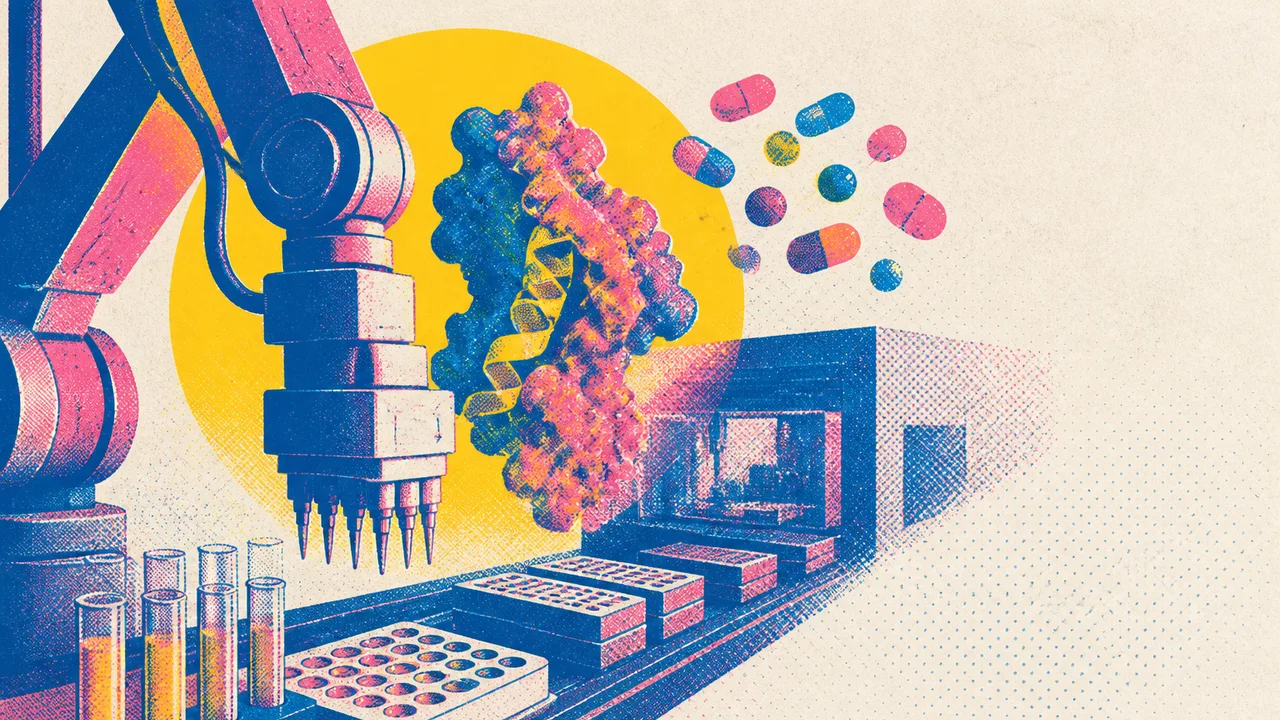
Anthropic has built a wet lab in the San Francisco Bay Area, giving the maker of Claude its own facility for experiments involving biological materials.
Reuters reported on September 18 that two people familiar with the operation disclosed the lab, whose existence was then confirmed by Anthropic life-sciences chief Eric Kauderer-Abrams. He said some experiments occur inside company facilities and others involve outside partners.
The company has disclosed little about what occupies the benches. An Anthropic spokesperson told Reuters the facility was not specifically for drug discovery. Engadget's account likewise emphasized that the lab's work remains unclear. Anthropic has said it wants to pursue preclinical research involving diseases that drugmakers may neglect because the commercial incentives are weak, but it has not identified the diseases or disclosed its progress.
That ambiguity makes the lab easy to inflate into a miniature pharmaceutical company or dismiss as an expensive demo room. Anthropic's other moves suggest a more useful interpretation: the company is assembling the software, equipment connections, experimental capacity and customer relationships required to make Claude an operating layer for biological research.
That is an inference, not a strategy Anthropic has publicly laid out in those terms. It follows from the pieces the company has placed around the lab, and from the boundaries it has drawn around the work.
From Research Assistant to Equipment Operator
Anthropic's 2026 expansion into life sciences has unfolded as a stack.
In April, Novartis CEO Vas Narasimhan joined Anthropic's board. In June, the company introduced Claude Science, a workbench combining scientific databases, software packages and computing tools for literature searches, data analysis and computational research. Anthropic also acquired Coefficient Bio, whose team had worked on planning drug research, regulatory strategy and identifying drug opportunities.
The company moved closer to physical machinery in August with its Model Hardware Standard. The specification allows AI agents to communicate with equipment including microscopes, liquid handlers and robotic arms. The wet lab adds a place where Anthropic can encounter the stubborn details that software demonstrations edit out: inconsistent samples, incompatible instruments and experiments that fail despite a model's beautifully formatted confidence.
Anthropic has already claimed encouraging results from a narrower protein-design exercise. According to a detailed account of the company's announcements, Claude designed protein binders against 15 targets and produced successful binders for 14. Anthropic reported success rates of 22% to 35% for individual designs, compared with what it described as typical campaign rates of 10% to 15%.
Those numbers come from Anthropic and lack independent validation in the available reporting. Protein binders that work in an experiment also remain many steps removed from medicines proven safe and effective in people. The results show why Anthropic wants physical testing capacity, but they cannot establish that Claude will shorten drug development overall.
The sequence still matters. A scientific workbench helps Claude reason across research tools. A hardware standard lets it issue instructions to machines. A wet lab lets Anthropic test where those instructions break. Relationships with Novo Nordisk, Roche's Genentech and Bristol Myers Squibb provide potential routes into working pharmaceutical environments.
Taken together, those assets could position Anthropic as infrastructure beneath many drug programs rather than the owner of one pipeline. The analogy is closer to selling the laboratory's operating system than selling the medicine. That position could spread Claude across the industry without forcing Anthropic to absorb every cost and regulatory obligation attached to clinical development.
The evidence also supports a simpler explanation. Kauderer-Abrams said real laboratory work remains the final test in biology, and biotech companies commonly divide experiments between internal facilities and external partners. Anthropic may need a lab simply to evaluate its models under realistic conditions. The infrastructure interpretation becomes stronger if the company expands access to its hardware standard, publishes evidence that laboratory automation improves research productivity, or embeds the system across customer facilities. Those outcomes have yet to be shown.
The Clinical Boundary is Also a Commercial Boundary
Anthropic says it will not run clinical trials for now. Kauderer-Abrams said the company does not want to compete with pharmaceutical and biotechnology businesses that bring drugs to market.
That boundary leaves partners in control of the most expensive and consequential stages: human testing, regulatory approval, manufacturing and sales. It also addresses a trust problem reported by Reuters. Drugmakers may hesitate to give an AI supplier access to sensitive programs if that supplier could become a rival developing its own medicines. Anthropic says customer data are walled off, but customers must decide whether those protections satisfy them.
Avoiding trials therefore serves two functions. It limits Anthropic's exposure to a long, failure-prone process, and it reassures prospective customers that the software vendor does not plan to meet them later as a competing drug owner. The arrangement could benefit both parties if Claude improves early research. It could also concentrate influence over laboratory workflows inside an AI company whose models, access policies and commercial terms remain under its control.
Alphabet's Isomorphic Labs provides a useful comparison. Isomorphic has spent years trying to advance AI-designed drugs toward the clinic and delayed that goal until the end of 2026, Reuters reported. Its experience illustrates the gap between identifying a promising molecule and producing a medicine ready for human testing.
Anthropic is stopping before that gap, at least under its current policy. Isomorphic's progress cannot predict Anthropic's because the companies have different models, programs and commercial arrangements. The comparison clarifies where the risk sits: Isomorphic is pursuing more of the drug-development chain, while Anthropic is building tools that pharmaceutical customers could use across their own chains.
Capability and Control Grow Together
The wet lab arrives as Anthropic tightens access to advanced AI for biological work. The company has acknowledged that capable models can provide information relevant to biological-weapons development. It has restricted some models for professional biology and drug-development queries, while biology and chemistry researchers remain limited to Opus-class systems as Anthropic works with the US government on controlled access to more capable models.
At the same time, Reuters reported that Anthropic wants Claude to direct robotic units performing experiments with limited human intervention. The company says human oversight remains essential, and Kauderer-Abrams described automated lab execution as being in its early stages.
Expansion and restriction can coexist as a governance model: broader capability inside controlled facilities, narrower access outside them. Whether that model works depends on details Anthropic has not disclosed, including who authorizes experiments, how robot instructions are reviewed, what biological materials the lab handles and how failures or misuse are reported. A promise of human oversight says little until the humans, authority and intervention points are defined.
For researchers and drugmakers, the useful questions now concern control rather than spectacle. Who owns the experimental data? Can a customer move its workflows to another model or hardware system? Who audits the safeguards when Claude crosses from proposing an experiment to operating the pipette?
Anthropic's lab may eventually help produce a medicine. Its nearer-term significance lies in something more prosaic and potentially more powerful: deciding whose software sits between a biological idea and the machine that tests it.
More Like This

Anthropic's AI Evaluator Tests Claims of Independence
Anthropic and Accenture are building an embedded AI safety regime, but undefined access, reporting and funding rules complicate its independence.
Is Anthropic's Claude Quietly Dominating AI?
Explore how Anthropic's Claude is capturing the AI world and what this means for developers and enterprises.
Claude Fable 5 Launches With Tight Safety Guardrails
Anthropic's Claude Fable 5 is out, but safety restrictions, a data retention shift, and subscription changes make the launch more complicated than the benchmarks suggest.
Zosurabalpin: A New Antibiotic Class Enters Phase 3 Trials
Zosurabalpin could be the first new antibiotic class targeting gram-negative superbugs in 50 years. Here's how it works—and how AI helped build it.
AI Voice Cloning and the Accountability Gap
Voice cloning already passes in casual listening. The harder question isn't whether AI was used—it's who's accountable for what gets said with it.

AI Agents in Production: What Actually Works
IBM's Shailaja Patel-Pranav breaks down why AI agents fail in production—and the coordination patterns that make them actually reliable in enterprise workflows.