Anduril's BlueChip Laptop Tests US Supply Chain Plans
Anduril and Qualcomm plan BlueChip laptops built in the US. A prototype sourcing metric and an assembly-first cost model show what domestic production still needs.

Written by AI. Mike Sullivan
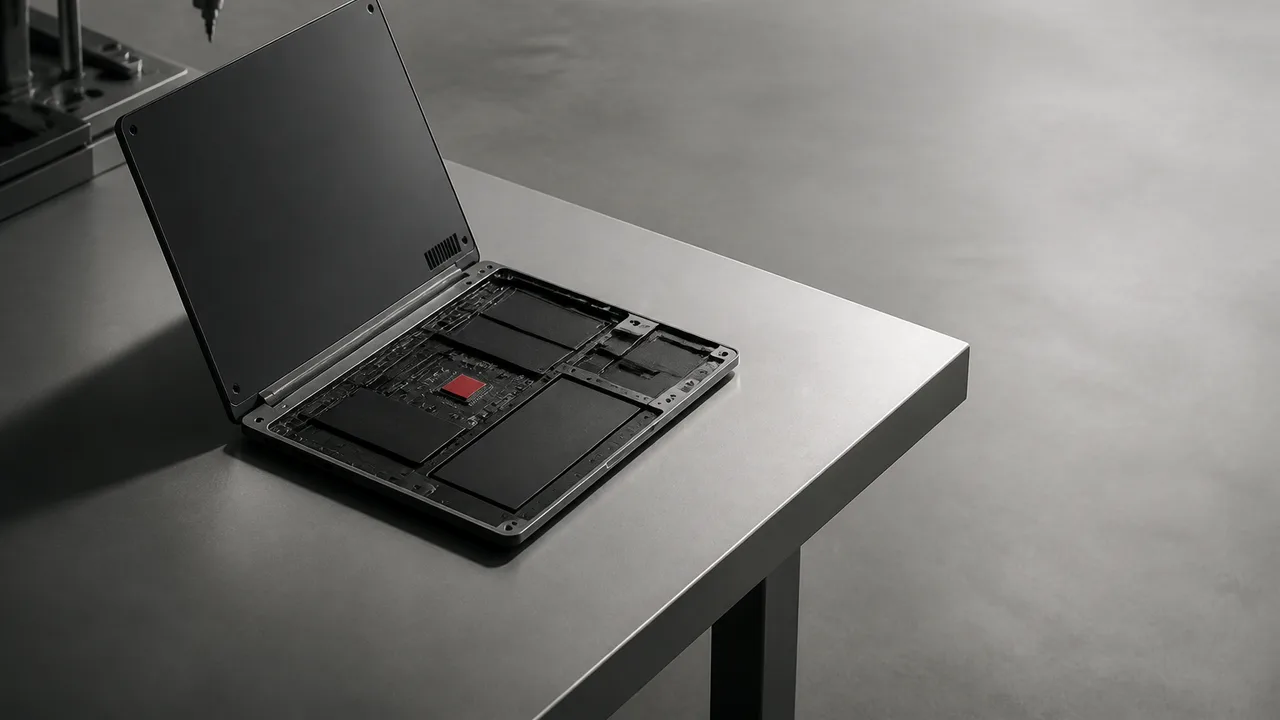
Anduril and Qualcomm announced BlueChip on October 27, a plan to build laptops in the United States for government, defense, emergency services and other critical users. The first model will use a Snapdragon X Series processor. Anduril says it has working prototypes, plans to assemble circuit boards at its Arsenal-1 facility in Ohio, and expects to begin taking orders in 2027. That gives the project a product, a place to do some of the work and a date. It does not yet give it a domestic computer supply chain.
Anduril and Qualcomm say components bought from US and allied-country suppliers account for more than 90% of the prototypes' component procurement cost. Read that figure carefully. It measures spending on components for prototypes, grouped by the location of suppliers. It does not say that more than 90% of the components were manufactured in America, or disclose how much of that spending went to US suppliers rather than allied-country suppliers. A company could improve the figure by changing which components it buys without creating a new US factory. The number describes a sourcing choice; Anduril's larger ambition requires production capacity.
The distinction is practical. A laptop assembled in Ohio might still depend on a foreign-made display or battery. A part bought through a US supplier might contain inputs made elsewhere. Allied sourcing can be a sensible way to reduce dependence on one manufacturing region, especially for customers concerned about disruption. It serves a different aim from making every component domestically. Anduril has set out both aims at different stages: expand US sourcing and manufacturing first, then work toward an end-to-end American supply chain.
The planned circuit-board work offers a way to see those stages separately. Assembling a board in Ohio would put a manufacturing step there; it would not, by itself, locate production of every part mounted on the board. A procurement-cost percentage cannot answer that question either. Expensive components have more weight in a spending measure than inexpensive ones, regardless of how many parts of each type a laptop uses. A customer trying to judge supply continuity would need to know which components are difficult to replace, as well as where they come from. A high aggregate percentage cannot identify a single vulnerable component.
From an X Poll to an Assembly Plan
Palmer Luckey floated the US-made computer idea more than a year before the BlueChip announcement. He asked followers on X whether they would buy one from Anduril at a proposed 20% premium over a Chinese-manufactured Apple alternative. That was a hypothetical question to self-selected respondents, not a price for BlueChip or a measure of demand from government buyers. The change since then is concrete: Anduril and Qualcomm have a named product line, functional prototypes and a plan to accept orders.
The project also arrives after substantial attention to building chip factories in the US. Intel and TSMC have factories there, but a processor is only one item on a laptop's shopping list. Circuit boards, displays and batteries remain major domestic manufacturing challenges, Anduril has acknowledged. A new semiconductor fab cannot make a screen by sheer force of national enthusiasm. The earlier push to produce chips helps explain why a laptop maker can now talk about US hardware production; the missing component industries explain why BlueChip needs a phased plan.
Anduril is trying to adapt the machine to the factories it can use, rather than simply ordering a familiar laptop design and changing the final assembly address. It chose metals that American factories can machine at scale and designed its battery system around US battery technology. It is also working on incorporating US-made display glass. Those are product-design decisions with supply-chain consequences. Glass, though, is only part of a display. A design accommodating domestic glass does not settle where the finished screen will be made.
The customer choice follows the same logic. Government agencies, defense organizations and emergency services may weigh continuity of supply differently from a shopper comparing two laptops at a retailer. Anduril already makes military hardware, and it says it is developing US production capabilities for enclosures and battery components while qualifying suppliers. Those capabilities could give BlueChip a starting point. Whether specialized orders can sustain component manufacturing that also serves a much wider computer market remains an open commercial question. Neither a prototype nor an order-taking date supplies production volumes.
Luckey has put the security case starkly: “Any country that can't build its own computers, can't secure them,” he said in an Anduril video. The concern is understandable if a supply interruption could prevent critical users from replacing equipment. Domestic manufacture alone would not settle every question about a laptop's security, however. BlueChip's manufacturing plan addresses where hardware can come from; buyers will still have to assess the finished computer for their own security requirements.
The Cheaper First Step Has a Cost, Too
The Consumer Technology Association offers a useful alternative sequence. In an October reshoring model covering 10 consumer-product categories, including laptops, the trade group estimated that full US production by 2031 would require $185 billion to $230 billion in capital spending. Its proposed assembly-first scenario, which keeps access to components from trading partners and allies, put estimated costs at $16 billion to $19 billion. Even then, the CTA estimated that laptop manufacturing costs would rise 50%.
Those are modeled scenarios for broad product categories, not a price forecast for BlueChip. The CTA includes products with very different buyers and production volumes; Anduril is starting with a laptop aimed at critical users. The comparison instead clarifies the choices. Domestic assembly can move some work to the US while retaining overseas component production. An end-to-end supply chain asks firms to build or support the component makers as well. BlueChip proposes to start nearer the first option and keep moving toward the second. The distance between them is where the investment problem lives.
The CTA represents technology businesses that would face the costs in its model, so its assembly-first proposal reflects an industry preference as well as a possible manufacturing path. Anduril's defense-oriented customers have a different reason to consider paying more: access to equipment during a disruption could carry value beyond the purchase price. Both arguments turn on details that a broad label like “US-made” conceals. Which components must remain obtainable in a crisis? Which allied suppliers are acceptable? How much domestic capacity would customers pay to keep running?
For BlueChip, the next useful markers are less photogenic than a laptop prototype. They include the location where components are actually manufactured, the US share separated from the allied-country share, the number of machines Anduril can produce and the price customers will pay. The prototype shows that Anduril can assemble its chosen parts into a working laptop. Its larger claim will be tested by whether the factories behind those parts can keep making them when orders arrive.
More Like This

US Foreign Robot Ban: Who Gains and Who Pays
The US has banned foreign-made humanoid and quadruped robots, targeting China on security grounds. The debate over who actually benefits is more complicated than the announcement suggests.
3D DRAM: The Memory Scaling Challenge Explained
DRAM scaling is hitting a wall around 2029. Here's what true 3D DRAM actually involves—and why it's harder than 3D NAND made it look.