AI and Scientific Photography: Where Ethics Draws the Line
MIT science photographer Felice Frankel explains why AI can generate images but can't replicate the curiosity and ethical judgment behind scientific photography.
Written by AI. Marcus Chen-Ramirez
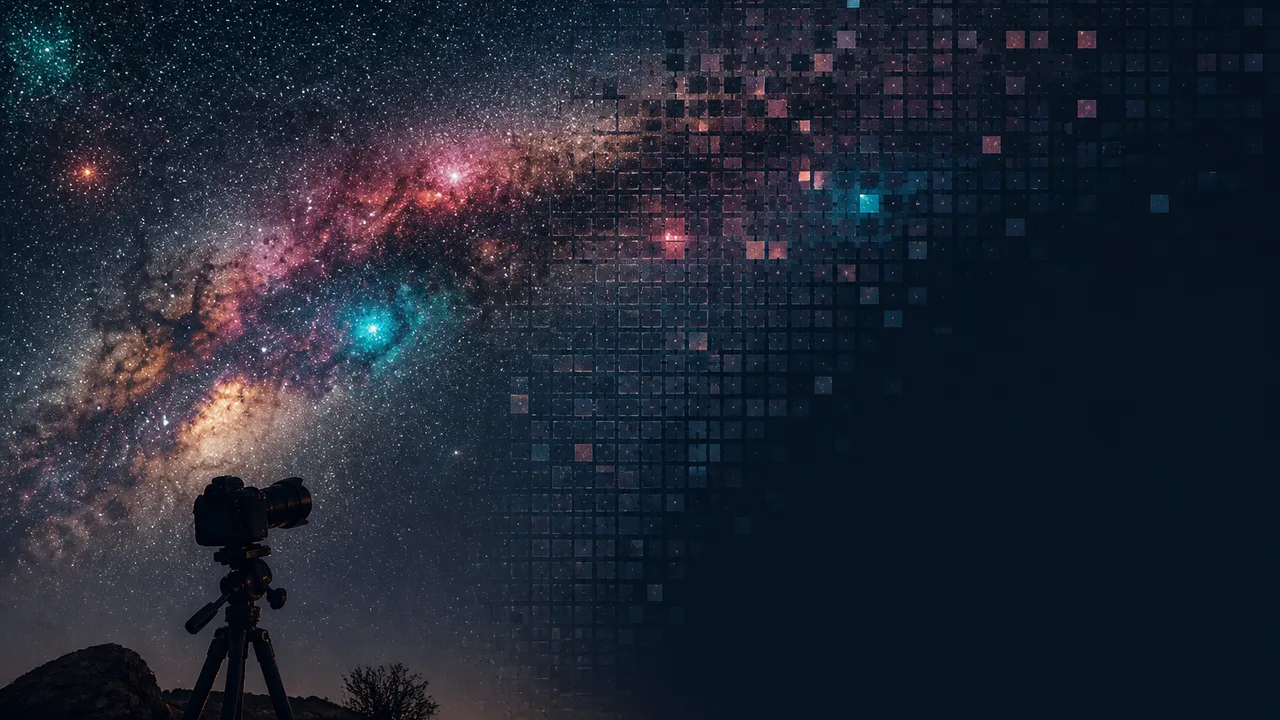
Photo: AI. Castor Belov
Somewhere in Felice Frankel's office at MIT, there's a photograph of a ferrofluid droplet—about 2 centimeters across, sitting on a glass slide over a yellow Post-it note, with seven circular magnets underneath it—that looks almost nothing like what it is. It looks like a flower. People have been drawn to it for decades without quite knowing why.
That gap between "what it looks like" and "what it is" turns out to be the entire argument.
Frankel, a science photographer who has spent her career at the intersection of visual communication and hard science, sat down recently with MIT OpenCourseWare to talk about her work. The conversation was ostensibly about photography. It ended up being, quietly and precisely, about one of the more useful framings I've encountered for thinking about what AI-generated imagery can and cannot do in scientific contexts.
The video's title promises that AI "can never" do something. That's a big claim—the kind tech journalists learn to treat with the same wariness we give to press releases announcing "revolutionary breakthroughs." But Frankel doesn't actually make an absolutist argument. What she makes is something more interesting: a structural argument about the difference between two types of images, and why that difference is going to get harder to honor as generative AI gets better at collapsing it.
The Distinction That Actually Matters
Frankel draws a line between documentation and illustration, and she uses the ferrofluid photograph to anchor the difference.
The ferrofluid image is documentation. Iron particles in oil are responding to a magnetic field. She added a green card for color reflection—"which didn't change anything really"—but the behavior being recorded is exactly what it claims to be. The physics is the photograph. As she puts it: "If we're only looking at the way the particles are responding to the magnetic field, I am not manipulating that at all. It's—this is exactly what this is about."
Illustration is different. Frankel describes building composite images for magazine covers—assembling pieces of real photographs into arrangements that have never physically existed, specifically to explain a scientific concept. She's clear-eyed about what this is: "I take pieces of pictures and put it together to create an image that doesn't exist, but it's explaining the science." That's illustration. It serves a communicative purpose, but it's not a record of an observed phenomenon.
The distinction isn't new. Science journals have wrestled with it for as long as image editing software has existed. The Office of Research Integrity at the U.S. Department of Health and Human Services has specific guidelines about what constitutes acceptable image adjustment in published research—adjusting brightness and contrast uniformly is generally fine; selectively enhancing or obscuring features to support a conclusion is not. The line between "making the real more visible" and "making the unreal look real" has always been the pressure point.
What Frankel adds to this conversation is the role of intent—and the process that shapes intent. "It was always about my curiosity," she says about her early work. "Why is this happening? What is it about this thing that is showing this and that?" She works by learning the science first, asking researchers to explain phenomena until she understands them well enough to think about how to represent them honestly. That iterative epistemic process—what is actually happening here, and how do I show it faithfully—is the ethical engine underneath the image-making.
Where AI Enters the Frame
Generative AI systems produce images through a fundamentally different process. They don't ask "what is happening here and how do I show it faithfully?" They produce outputs that are statistically consistent with their training distributions. A diffusion model generating an image of a ferrofluid doesn't know what a ferrofluid is—it knows what ferrofluid images look like. That's a different kind of knowledge, and it matters enormously in scientific contexts.
This isn't a knock against generative AI as a general-purpose tool. For illustration—for building explanatory composites, for visualizing theoretical constructs, for making the abstract legible—AI image generation has genuine and arguably expanding utility. Some science communicators are already using it this way. The question is whether the documentation/illustration distinction holds up under that kind of adoption pressure.
Frankel's concern, stated plainly near the end of the conversation, is that AI is precisely the context where the documentation/illustration line becomes most fraught: "That is the issue that we're going to have to deal with when we look at AI."
She's right that it's an issue. But it's worth being specific about the mechanism. The problem isn't that AI-generated images are inherently deceptive—it's that they're unlabeled. A composite illustration assembled by a science photographer comes with that photographer's understanding of the science, their editorial judgment, and their professional accountability. An AI-generated image has none of those provenance trails. When a research figure or a science magazine cover contains an AI-generated element, readers typically have no way to know whether they're looking at documentation, illustration, or something that has no referent in reality at all.
This is a solvable problem in principle—metadata standards, disclosure requirements, peer review processes adapted to catch AI-generated content. It's a much harder problem in practice, because the incentive structure of scientific publishing (publish or perish, visually striking figures get cited more) doesn't naturally reward the friction that honest labeling adds.
The Flower That Isn't a Flower
There's something worth sitting with in the ferrofluid story beyond its usefulness as a case study.
Frankel describes people being drawn to the image—drawn to ask "what is this?"—and says that's the point. The aesthetic pull is a mechanism for creating scientific curiosity. "They want to say, what is this? That's what I'm trying to do. And then that leads them into the science."
That's a surprisingly sophisticated theory of science communication, and it's one that AI-generated imagery could theoretically serve just as well. A beautiful AI-generated visualization of a protein folding or a quantum field could draw people into biology or physics the same way Frankel's ferrofluid photograph drew people into materials science. The beauty doesn't have to be a lie to work.
But here's where Frankel's framing holds. If the pathway from aesthetic pull to scientific understanding depends on the image being trustworthy—if the visual curiosity is supposed to open a door to reality, not to a simulation of reality—then the documentation/illustration distinction isn't just an ethical nicety. It's structural. An illustration that people mistake for documentation doesn't draw them into the science; it draws them into a false version of it.
At MIT, Frankel notes, "you never fake what you don't know." That's an institutional norm, but it's also a description of how genuine inquiry works. You acknowledge the limits of your knowledge so you can push against them productively. AI systems, by their nature, don't know what they don't know—they generate confident outputs at the edge of their training distributions without flagging uncertainty.
The human curiosity Frankel describes—that iterative "why is this happening?"—is what creates the conditions for honest scientific imagery. Whether AI can be built into workflows that preserve rather than erode those conditions is an open design question, not a settled one.
The ferrofluid photograph is still circulating, still drawing people in, still looking like a flower while being, precisely and verifiably, something else entirely. That gap—held open by a photographer who understood exactly what she was doing and why—is the thing worth protecting.
More Like This
ChatGPT Images 2.0 vs. Midjourney: Where Text Finally Works
ChatGPT's new image generator excels at text accuracy where competitors fail. A deep dive into what works, what doesn't, and what it means for AI images.
OpenAI's Image Gen 2.0 Thinks Before It Draws
ChatGPT Images 2.0 introduces 'thinking mode' for AI image generation—creating multi-page manga, error-free text in any language, and production-ready visuals.

Black Forest Labs FLUX: Visual AI's Open Source Gambit
Black Forest Labs is building toward 'visual intelligence' with FLUX. The open-source framing is real—but so are the questions about consent, deepfakes, and enterprise data.

Building Secure AI Agents With Bigtable and ADK
Google's Bora Beran demos a healthcare AI agent built on Bigtable and ADK—and the security layers that make it worth taking seriously.
OpenAI Images 2.0: What Changed and Why It Matters
OpenAI's Images 2.0 is generating 1.5B images a week. Here's what the team says changed, what's still open, and what users are actually doing with it.
OpenAI's Codex Is Growing Up Fast—And Getting Weird
OpenAI's latest Codex updates add browser control, AI-reviewed approvals, and... animated pets? A look at where AI coding tools are actually heading.
Hugging Face ML Intern Automates AI Development
Hugging Face's ml-intern is an open-source agent that automates the full ML research loop. Here's what it does, what it can't, and what it signals.
Small Language Models Are Reshaping Agentic AI
Small language models are outperforming larger rivals on key AI agent benchmarks. Here's what the efficiency shift means for how AI gets built and deployed.