AI Parkour Research Solves the Imitation Problem
A new NVIDIA-backed AI system learns to navigate parkour obstacles by combining human movement imitation with adaptive problem-solving — trained on just 30 seconds of footage.

Written by AI. Bob Reynolds
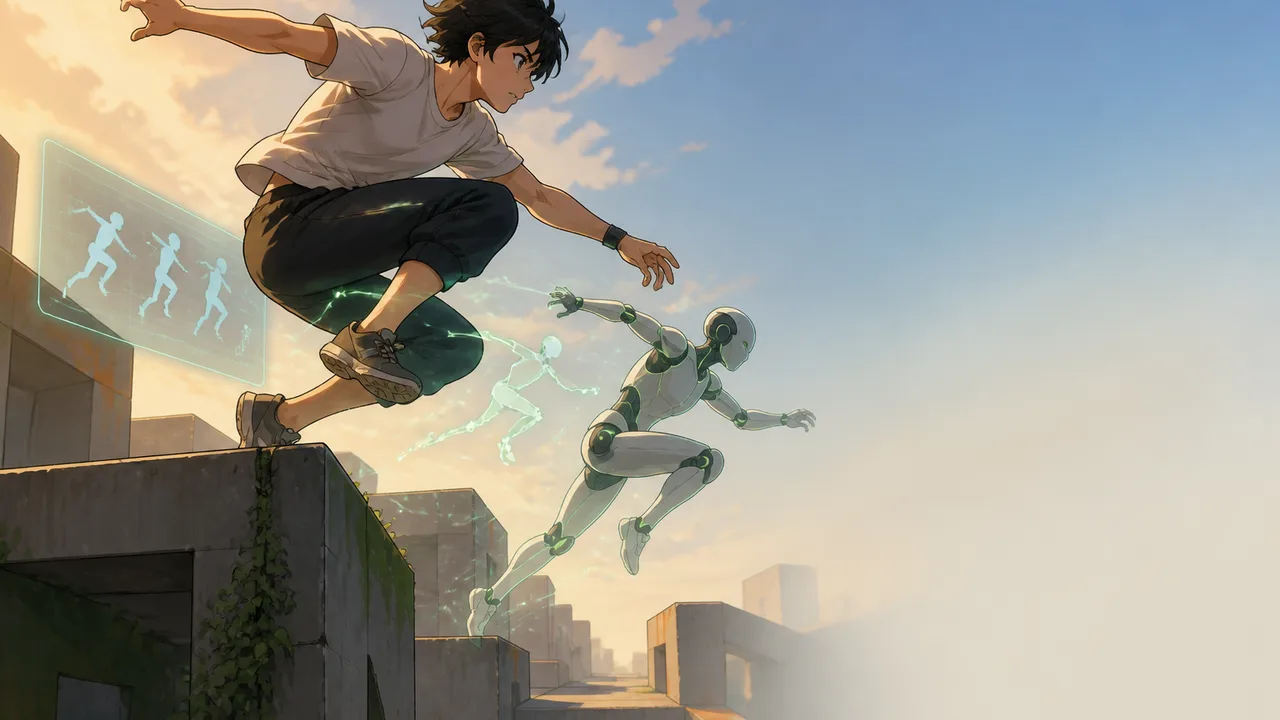
Photo: AI. Mei Fujimoto
There's a tension at the heart of AI motion research that doesn't get talked about enough outside the field, and a new paper from NVIDIA researchers puts it in unusually sharp relief.
The tension is this: the two approaches that currently dominate the field pull in opposite directions. Systems trained to imitate human movement produce animations that look natural — fluid, convincing, the kind of thing that makes you forget you're watching a simulation. But they're fragile. They can replicate what they've seen. Put them in a novel situation, move the obstacle, change the layout, and they either fail or produce something that looks wrong. Motion-capture-driven AI is, in the Two Minute Papers video covering this research, described precisely: "Systems that copy us are beautiful, but brittle, repetitive."
Goal-driven systems go the other way. Train an AI to reach a destination by any means necessary and it will find a path — but the path often looks nothing like how a human would move. The AI figures out that certain contortions technically satisfy the objective, and it produces them without embarrassment. The result clears the level and offends the eye.
This new paper, covered in a recent Two Minute Papers episode, proposes a way out of that bind. The architecture runs the same AI controller through two concurrent training processes — one that teaches it to replicate human movement, one that teaches it to solve novel obstacle courses. Neither process takes priority. Both run simultaneously, and the controller has to satisfy both.
What makes this more than a clever trick is the mechanism used to enforce the human-likeness requirement. The researchers train a separate "judge" — a discriminator, in the technical vocabulary — whose sole job is to distinguish real human movement from AI-generated movement. The AI athlete then trains against this judge. Károly Zsolnai-Fehér, host of Two Minute Papers, describes the loop cleanly: "The athlete gets better at fooling the judge while the judge gets better at spotting artificial movements."
That adversarial structure will be familiar to anyone who followed the GAN literature from the past decade. What's notable here is the specific application and the grounding constraint: the judge evaluates movement not just in isolation but in the context of the surrounding obstacles. A move that looks human-like on flat ground might look wrong on a platform edge. The judge is supposed to know the difference, and the stability term in the training objective ensures that small variations in movement don't cause it to wildly flip its verdict.
The training data figure is the one that makes you stop and re-read the sentence. The system was trained on 19 clips totaling 30 seconds of parkour footage pulled from the internet. Not hours of motion-capture data from a professional facility. Thirty seconds of clips. The Two Minute Papers video is candid about how this sounds: "That, fellow scholars, sounds impossible."
On novel levels — obstacle arrangements the system hadn't encountered during training — the results shown in the video are genuinely striking. The virtual character vaults, rolls, and transitions in ways that read as athletic rather than mechanical. It composes movements in sequence rather than retrieving a cached animation. The system generalizes.
The trade-offs are real and the paper reports them plainly. By the researchers' own metrics, the system achieves lower tracking error than prior approaches — meaning its movements stay closer to human reference motion — but this comes at a cost to success rate. Longer levels succeed roughly 40 percent of the time. The Two Minute Papers video notes the other limitation without softening it: "unnatural recovery motions are also possible." When the character stumbles or gets into an awkward position, the recovery can look like something a human body wouldn't actually do.
That combination of acknowledged trade-offs matters more than it might seem. A lot of AI motion research produces results that are impressive in the demo reel and murky in the failure analysis. The failures are hard to categorize, which makes them hard to fix. Here, the failure modes are specific: success rate degrades on longer levels, recovery from unusual states can look wrong. Those are tractable problems. Longer-level performance is likely a training distribution issue. Unnatural recovery is a case where the judge's coverage of edge-case body positions is probably insufficient. Neither failure requires rethinking the architecture.
The dual-classroom framing — Zsolnai-Fehér's term — is a useful way to think about why the approach is composable. The controller isn't just pattern-matching against stored clips. It's learning the structure of human movement well enough to apply it in contexts the training data never covered. That's the architectural bet the researchers are making, and the novel-obstacle results suggest it's at least partially paying off.
There is, of course, a gap between a simulation that looks good in a research demo and a system that runs reliably in production. The 40 percent success rate on longer levels is the number that would give a robotics or game-animation engineer pause. Impressive as the vault sequences are, a system that completes longer tasks less than half the time needs significant improvement before it earns a place in a production pipeline.
The paper is publicly available. The architecture is composable and the failure modes are bounded and specific — which means the next team to work with this research will know exactly where to push. That's not a hedge about what happens next. Research with legible failure modes gets built on. This one will.
More Like This

Anthropic's Claude Routines Targets No-Code Automation Market
Claude Routines lets users automate workflows with natural language instead of drag-and-drop builders. Is this the end of traditional no-code platforms?
NVIDIA Lyra 2.0 Builds 3D Worlds From One Photo
NVIDIA's Lyra 2.0 generates persistent 3D worlds from a single image. Here's the technical trick that finally keeps them from breaking down.

Netflix's VOID AI Erases Actors—and Their Physics Impact
Netflix's open-source VOID model doesn't just remove objects from video—it understands cause and effect. We tested it on iconic movie scenes.
How Magnus Carlsen's App Taught AI to Explain Chess
Play Magnus engineers reveal how they built an AI chess coach by keeping LLMs in their lane—translating insights, not generating them. Here's what that means for AI apps.

Kimi K3's Post-Training Techniques Examined
Hugging Face researchers dissect the Kimi K3 technical report, revealing frontier AI's shift from research breakthroughs to engineering precision.

Why AI Training Data Quality Beats Raw Compute
Bespoke Labs' Mahesh Sathiamoorthy argues data curation—not algorithms or compute—is the real bottleneck in building reliable AI agents. The evidence is hard to dismiss.

A Custom GPU Cooling Mod Built Without Zip Ties
A PC builder refused the easy fix and designed a custom GPU fan bracket and PCB splitter instead. Here's what that obsession looks like in practice.

Python Backtesting Tools Promise a Lot. Know the Limits.
Zipline can simulate stock trading strategies in Python — but the leverage trap and survivorship bias can make bad strategies look brilliant. Here's what to watch.