Agent OS Is Reshaping Automation, but n8n Isn't Dead
Agent OS dashboards promise simpler AI automation, but n8n is growing. What the shift means for workflows, permissions, pricing and user control in practice.

Written by AI. Yuki Okonkwo
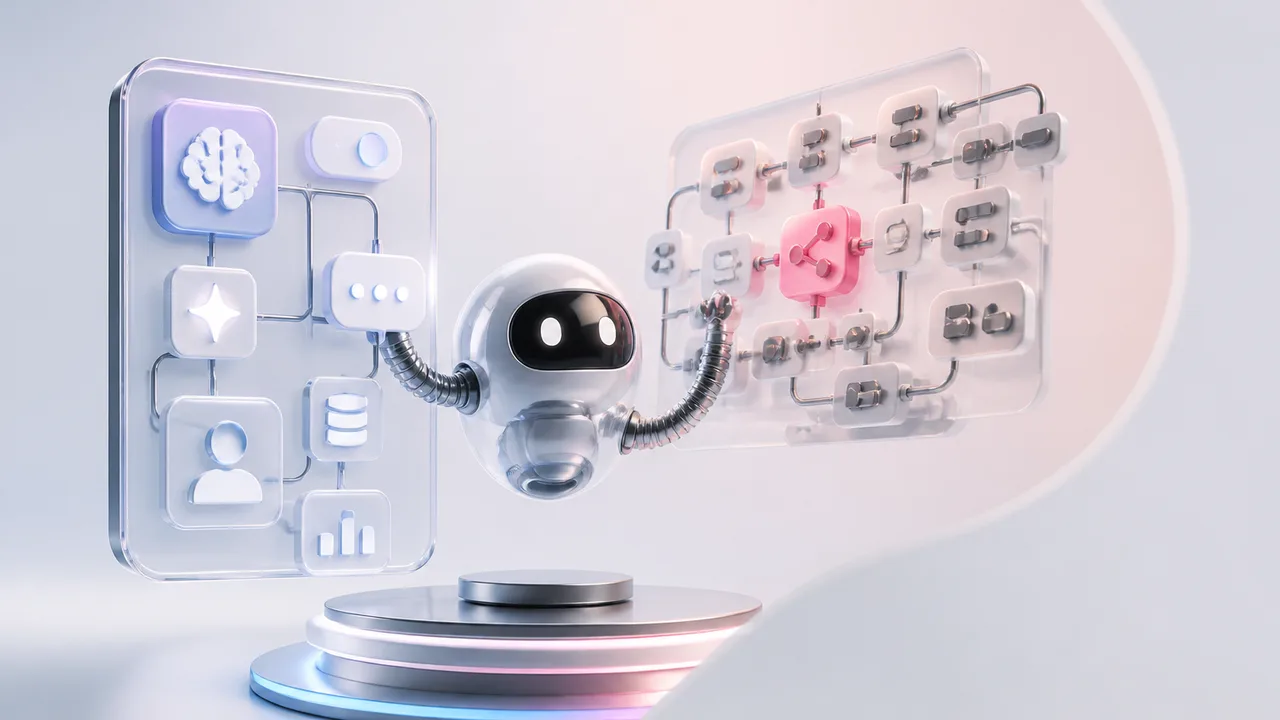
Julian Goldie said on September 21 that his custom Agent OS had replaced n8n in his work over the previous three to six months.
His video makes a punchy case: visual workflows can take hours to configure, integrations break, and a dashboard controlled through natural-language prompts feels easier than a thicket of boxes and connecting lines. Goldie says one n8n tutorial workflow could take him one or two hours to prepare, while he could add some Agent OS tools in minutes.
That is useful testimony about one creator’s workflow. It is also a sales pitch. Goldie distributes his Agent OS zip file through the paid AI Profit Boardroom community, alongside training and coaching. The available documentation does not include an independent review of the package, its security model or the reliability comparisons in the video.
So, has Agent OS replaced n8n? For Goldie, yes. Across the automation market, the evidence supports a narrower and more interesting change: AI is moving the interface from diagrams toward prompts, shared context and control-room dashboards. n8n is participating in that shift rather than watching from the software graveyard.
N8n Already Survived One Identity Change
Jan Oberhauser launched n8n in Berlin in 2019 as a visual workflow builder. Users connect nodes representing apps, services or operations, then add JavaScript or Python when the canvas cannot express what they need. The project uses a source-available “fair-code” licence that permits self-hosting and modification while restricting competing commercial hosting.
From 2022, with a more visible push from 2024, n8n reoriented around AI agents and prompt-built workflows. That history changes how Goldie’s claim should be read. Agent OS is challenging the interface n8n became known for, while n8n itself has been adding the same broad ingredients: models, tool use, natural-language building and agent orchestration.
The company’s current repository advertises more than 1,500 integrations and 9,000 workflow templates, plus multi-step agents, human approvals, audit trails and observability. Those are vendor claims, but they describe an actively developed platform whose product scope now extends beyond manual node wiring.
The surrounding indicators also point toward expansion. n8n raised $180 million at a $2.5 billion valuation in October 2025, then received an SAP investment in May 2026 that reportedly roughly doubled its valuation. It added more than 112,000 GitHub stars during 2025 and entered a Deutsche Telekom partnership in 2026.
Funding, stars and partnerships do not prove that an automation will run flawlessly at 3 a.m. They do make “n8n has been replaced” a poor market-wide conclusion. Goldie’s switch is better understood as a report from one edge of the market, where users want agents to hide the workflow graph entirely.
The Clean Dashboard Still Has a Basement
Goldie describes Agent OS as one dashboard containing Claude, Hermes and other agents, with an Obsidian vault of Markdown files supplying shared memory. Users ask an agent to add a tool or workflow, and the agent handles the back-end construction. In another video, he recommends avoiding stacks of duplicate models, rotating API keys and multiple competing memory systems because each component creates another failure point.
The strongest version of this idea is straightforward: most people care about the task and its result, not the wiring diagram between them. Asking for “a weekly report using these files” resembles delegating work to a colleague. Manually connecting triggers, parsers, model calls and output nodes resembles assembling the colleague from Lego before every meeting.
Yet Goldie explicitly acknowledges that the complexity moves to the back end. That move can reduce cognitive load without reducing operational risk. An agent still needs credentials, permissions, error handling, memory boundaries and rules governing actions with side effects. A beautiful dashboard can make those mechanisms easier to operate, or merely harder to see. The screenshots cannot settle which outcome Agent OS delivers.
This is where comparable projects help clarify the category. AgenticOS, an open-source self-hosted control plane, also gathers agents, context files, scheduled automations and MCP tools into one console. MCP, or Model Context Protocol, is a standard for connecting models to external tools and data. AgenticOS foregrounds controls including encrypted organizational secrets, human approval for side-effecting tools and budgets that can stop a run before a model call.
AWS’s open-source Pizza Bot takes an inbox approach. Agents work in the background, then return completed tasks or requests for approval. Its policies can pause a workflow until a user approves or edits a proposed tool action. Earlier internal versions were used by more than 2,000 Amazon employees, according to AWS, although the public version was rebuilt and excludes Amazon-specific integrations. It also comes without AWS support or a service-level agreement.
Agent OS, AgenticOS and Pizza Bot share a design instinct: put many agents behind one legible surface and let work continue outside a live chat. Their limits differ. Goldie’s package has community support but lacks independently inspectable documentation in the available record. AgenticOS exposes its code and governance mechanisms, although that alone establishes neither broad adoption nor production reliability. Pizza Bot has an internal-use precedent, but outside users must supply integrations and operate the software themselves.
The comparison suggests that the emerging product category is a control plane for agents. The crucial contest will concern what that control plane reveals: permissions, costs, approvals and failures, or just a very clean home screen.
Subscription Access is Where the Pitch Gets Risky
Goldie’s setup advice introduces a more immediate issue. In a multi-agent tutorial, he says Claude inside an agent OS “should run from a subscription, not an API key.” A later video claims an official Hermes plugin can use a Claude Code subscription inside Hermes.
Anthropic’s Agent SDK documentation gives developers different instructions. It says third-party developers may not offer claude.ai login or rate limits in their products unless Anthropic has approved them, and it directs developers to API-key authentication. No inspected public documentation establishes that the Hermes route shown by Goldie has received that approval.
That gap matters because subscription and API access use different commercial models. A pricing tracker updated September 12 lists Claude Pro at $20 month to month and Max tiers at $100 or $200, while API access is billed according to token usage. Heavy users can see why routing work through a fixed subscription looks attractive. Economic appeal does not establish platform permission, and a plugin functioning during a demo does not answer whether Anthropic authorizes the integration.
Anyone evaluating an Agent OS should ask four gloriously unsexy questions before migrating workflows: How are credentials authenticated and stored? Which tool calls require approval? Can runs, costs and failures be audited? Can the workflows and memory be exported if the dashboard disappears?
Those checks also expose the false simplicity hiding in many automation demos. Prompts can replace boxes on a canvas, but they cannot repeal permissions, billing or debugging. The next generation of automation may look less like n8n’s Lego board and more like mission control. Mission control still needs warning lights.
More Like This
OpenAI's Workspace Agents: The Governance Question No One Asked
OpenAI's new Workspace Agents automate team workflows—but the real product isn't the AI. It's the permission model enterprises can actually live with.
How Agent Operating Systems Handle Always-On AI Tasks
Julian Goldie's Agent OS community session reveals how scheduled tasks, token management, and model orchestration work—and where the friction actually lives.
The No-Code AI Agent Promise: What Toolhouse Actually Delivers
A tech veteran examines Toolhouse's claim that anyone can build AI agents in minutes without coding. What works, what's hype, and what you should know.

Grok Bot as a Personal AI Agent: What It Can Do
Matthew Berman demos Grok Bot handling email, meetings, food orders, and file cleanup. Here's what the workflow actually looks like — and where the limits are.
Meta Muse’s Download Boom Meets Platform Gatekeepers
Meta’s Muse raced up download charts, but Amazon’s block and Shopify’s welcome show why platform access, user trust and retention will decide its future.
GitHub Trending: Agents Get Memory, Ledgers, and a Price Tag
GitHub Trending Today #48 surfaces 35 projects on agent trust, memory, cost, and quality gates. Here's what developers are actually building, and why it matters.

Claude Code Design Skills That Escape Generic AI Output
AI Labs breaks down the Claude Code skill stack that moves AI-generated websites past purple gradients and scroll reveals into something with a real design point of view.
Building a Personal Agent OS: One Dashboard for AI
Julian Goldie's custom Agent OS centralizes AI agents, shared memory, and autonomous loops. A look at what it does, how it works, and what it can't yet promise.