BuzzRAG Daily Digest — 2026-09-18

Curated by AI. Callum Pierce
Today’s strongest currents run from intimate stories of survival and political confinement to the increasingly public reach of military power in orbit. Culture provides a counterpoint, with new work revisiting authorship, musical identity, dance-comedy formulas and electronic sound, while football and games keep the spectacle moving.
A Survivor’s Story, Refracted Through Film
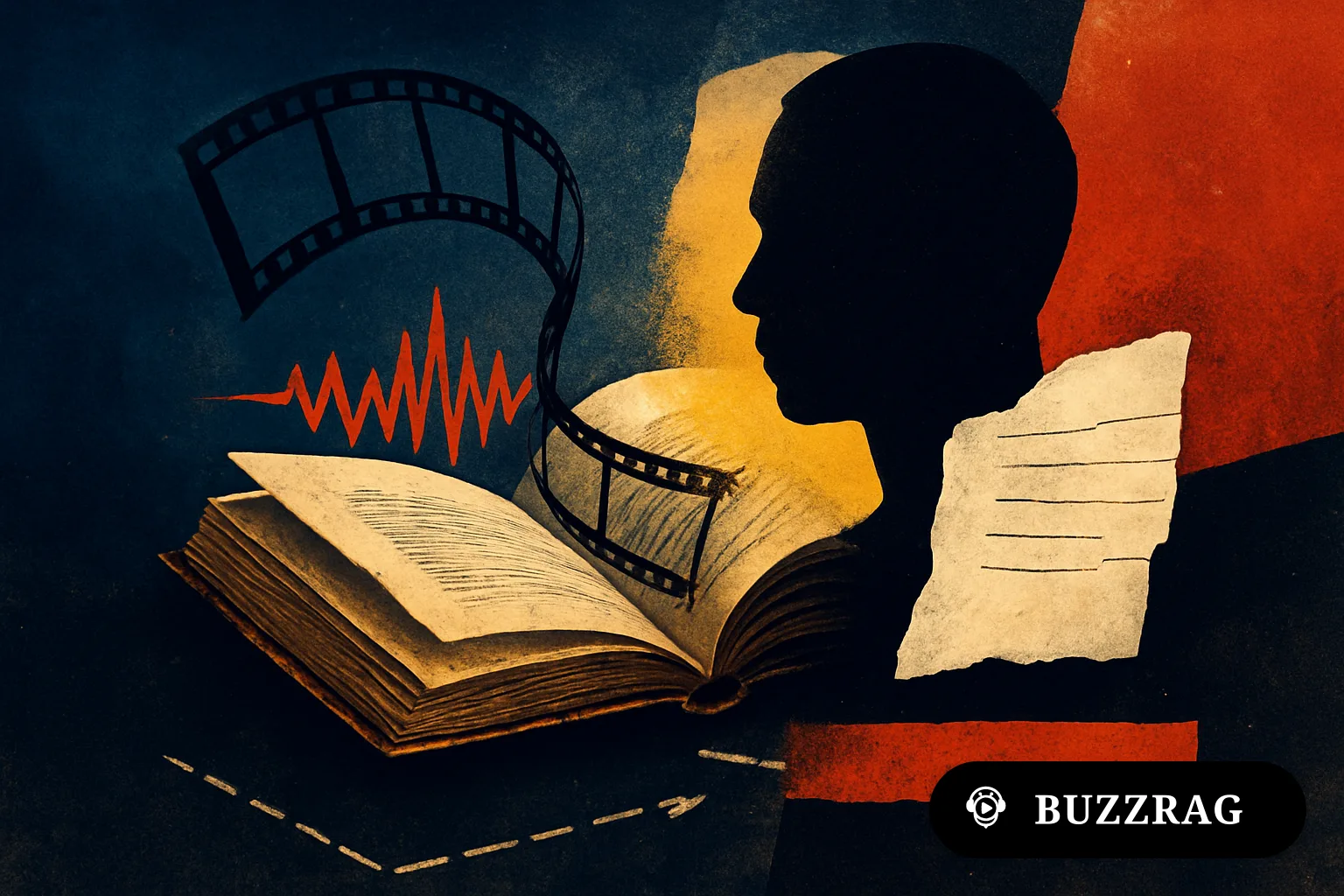
A new documentary revisits Salman Rushdie’s recovery after the 2022 stabbing attack, drawing on a video diary made by his wife, Eliza Griffiths. The footage offers an unusually close view of the physical and emotional aftermath, placing private moments of fear, exhaustion and determination alongside the public story of a celebrated writer confronting violence.
The film’s approach, shaped by director Alex Gibney and influenced by the dramatic sensibility of Dennis Potter, appears to reach beyond a conventional account of an assault. It examines Rushdie’s wider life, his long entanglement with controversy and the stubborn persistence required to return to creative work after trauma. The result is less a simple portrait of recovery than an exploration of how memory, love and art can help rebuild a life whose apparent solidity has been shattered.
Writing from Inside the Machinery of Detention
Mahmoud Khalil’s No Land to Stand On recounts the Columbia University student’s arrest by plain-clothed immigration officers in March 2025 and his subsequent detention. The review presents the book as a controlled but forceful account of an ordeal marked by uncertainty, bureaucratic power and the disorienting experience of being treated as a problem to be processed rather than a person with rights.
Its quiet fury is central to the book’s impact. Rather than relying only on outrage, Khalil documents the Kafkaesque logic of immigration detention and the vulnerability created when legal status becomes the lens through which every aspect of a life is judged. The account arrives amid continuing arguments over protest, state authority and the boundaries of political expression, giving its testimony significance beyond the individual case. Its force lies in making institutional abstraction personal.
Rewriting the Mythology of the Greatest Hits
French novelist Michel Bussi’s new book asks a deliberately provocative question: what if a woman had written the songs associated with one of Britain’s most influential bands? The premise uses an alternate history of popular music to examine who gets remembered as a genius, who is pushed into the background and how cultural myths are built around familiar names.
Bussi frames the idea as a form of revenge, but the novel also taps into a broader argument about authorship and recognition. The appeal of the conceit is not simply the fantasy of swapping identities; it is the chance to expose how thoroughly music history has been shaped by assumptions about gender, authority and public visibility. With relations between France and England providing an unlikely cultural backdrop, the book turns a playful counterfactual into a debate about who is allowed to occupy the centre of the canon.
A Familiar College Comedy Finds Its Rhythm
Best of the Best places two close friends in the competitive world of campus dance groups, where rivalries, ambition and performance drive a well-worn comedy structure. The story offers few genuine surprises, but the review argues that its energy comes from speed: the film moves briskly through recognisable beats while giving its choreography enough room to become the main attraction.
That balance is important. A predictable plot can still work when the execution is confident, the friendships feel lively and the spectacle has genuine visual invention. Here, the Bollywood dance setting gives a familiar American college formula a fresh physical language, even if the character arcs and reversals remain conventional. The film’s success therefore depends less on reinvention than on precision—how quickly it tells the story, how sharply it stages the dances and how much pleasure it can extract from a formula audiences already know.
A New Trophy Reopens the Messi-Ronaldo Debate
Lionel Messi has added the 2026 Campeones Cup to his collection, giving him an official trophy for the calendar year and allowing Inter Miami to celebrate another high-profile success. The victory has immediately revived comparisons with Cristiano Ronaldo, the long-running rival whose career has supplied the frame for so many arguments about longevity, output and the meaning of late-career achievement.
The debate is less about settling an unanswerable ranking than about how football measures greatness after its biggest stars have moved beyond their peak years. Each new medal changes the conversation for a moment, while the broader record remains shaped by different leagues, teams and stages. For Miami, the result is more concrete: another piece of silverware strengthens the club’s status as a major attraction and keeps expectations high. The next challenge will be sustaining that momentum once the headlines fade.
The Military Contest Above the Atmosphere Becomes Explicit
The United States has acknowledged that its Space Force operates “on-orbit weapons,” describing them as part of a defensive response to space-enabled attacks. The statement marks a notable shift in public language around military activity beyond Earth, where governments have long discussed threats, surveillance and defensive capabilities without always clearly describing what hardware is already deployed.
Officials have stressed disciplined and responsible decision-making, but the admission still raises difficult questions about escalation and transparency. Space infrastructure supports communications, navigation, weather monitoring and military operations, making it both strategically essential and unusually vulnerable. Weapons designed to protect those systems could also intensify suspicion among rival powers or create debris and miscalculation risks if used. The disclosure is therefore significant not because it proves that conflict in orbit is imminent, but because it makes the military contest there harder to describe as hypothetical.
The Tip Screen Becomes a Cultural Flashpoint
A conversation among New Yorkers and Londoners about restaurant tipping captures a frustration now familiar to diners on both sides of the Atlantic: the feeling that customary generosity has become a social test. Some people report tipping as much as 30 percent, while others question why customers are being asked to absorb costs that might once have been reflected in menu prices or wages.
The disagreement is shaped by local habits but increasingly amplified by digital payment systems, which present tip options before a transaction is complete and can make declining feel conspicuous. Supporters argue that gratuities remain essential to workers whose pay depends on them; critics see an opaque system that shifts responsibility from employers to customers. The tension is unlikely to disappear while restaurants face higher costs and workers face insecure incomes. For diners, every bill becomes a small referendum on who should carry the burden.
Electronic Music Pushes Against Its Own Edges
The latest release from Actress, Radical Frame, is being received as another investigation into the unstable border between rhythm, texture and noise. Rather than treating electronic music as a vehicle for clean propulsion, the record appears to foreground distortion, fractured movement and the uneasy beauty that can emerge when familiar structures begin to break apart.
That approach places the album in a tradition of club music that values atmosphere as much as function. Its interest lies in suggestion: loops that feel unfinished, sounds that seem to decay in real time and arrangements that resist settling into easy resolution. For listeners, the challenge is also the reward, demanding attention to small shifts instead of offering immediate hooks. Radical Frame’s appeal is consequently less about delivering a polished destination than constructing a volatile space where dance music, abstraction and emotional unease can coexist.
A Cult Zombie Comedy Returns for a New Generation
A new sequel unveiled at Tokyo Game Show is bringing back a stylised zombie-slaying action series, with a playable demo shown ahead of its planned 2027 release. The announcement revives a property known for deliberately exaggerated violence, comic-book presentation and a campy heroine at the centre of its chaos.
The return reflects the games industry’s continuing appetite for recognisable catalogue names, but nostalgia alone will not determine whether the sequel lands. A revival has to preserve the eccentric tone that made the original distinctive while adapting its combat, pacing and visual design for a new hardware generation. The playable demonstration offers an early sign that the project is being positioned as more than a logo on a release schedule. The longer question is whether its provocative style still feels knowingly fun—or simply dated—in a market crowded with louder spectacles.
The day’s stories point toward a common question: who controls the frame, whether in a detention centre, a recording studio, a restaurant or orbit above Earth? As new films, books, albums and games recast old narratives, the next phase will test which reinterpretations deepen the conversation and which merely recycle familiar symbols.