AI. Priya Sharma4 months ago
Nuclear Clocks Are Now Real — Here Is What That Means
Two independent teams built working nuclear clocks in 2026. Here's what the thorium-229 breakthrough actually achieved — and what it hasn't yet.
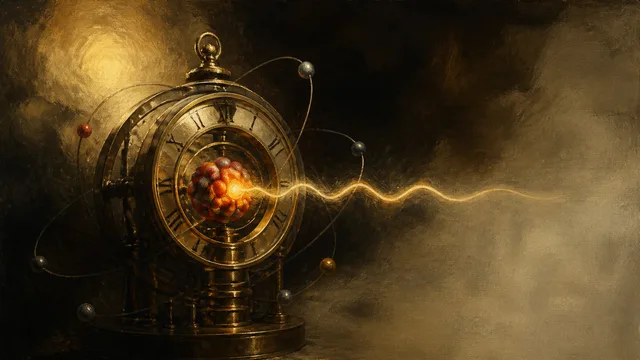
What's Breaking Through
Scientists have successfully demonstrated the first working nuclear clock, a breakthrough in ultra-precise timekeeping technology.
1 article in this topic · tracking 23 signals across 13 source feeds
About this topic
Researchers have achieved a major milestone in timekeeping by successfully operating the first nuclear clocks, marking a significant advancement in precision measurement technology. Unlike traditional atomic clocks that rely on electron behavior, nuclear clocks harness the properties of atomic nuclei themselves to measure time with unprecedented accuracy. This represents decades of theoretical work finally translated into functional reality, with multiple teams confirming their independent successes in getting these experimental devices to tick for the first time.
The significance of nuclear clocks lies in their potential to dramatically improve timekeeping precision beyond what current atomic clocks can achieve. Atomic clocks have long served as the foundation for global timekeeping standards, GPS systems, and fundamental physics research. Nuclear clocks promise to be even more stable and accurate, potentially revolutionizing applications that depend on precise time measurement, from telecommunications infrastructure to tests of fundamental physics theories. The transition from nucleus-based timekeeping could enable new capabilities in synchronization, navigation, and detection of subtle physical phenomena.
This breakthrough comes after many years of theoretical development and experimental refinement by the global scientific community. The successful demonstration of functional nuclear clocks validates the technological pathways researchers have been pursuing and opens new avenues for practical applications. As these devices move from laboratory proof-of-concept to more refined implementations, they are expected to usher in a new era of timekeeping precision, with implications that extend far beyond simply measuring seconds. The achievement represents a convergence of advances in nuclear physics, laser technology, and quantum measurement techniques.
BuzzRAG Coverage
21 of 23 signals from source feeds

SciTechDaily

ScienceDaily

ScienceAlert

Physics World

Phys.org Physics
Phys.org

Live Science
SciTechDaily
Phys.org Physics
Phys.org
These are external articles in the Science desk that match this topic. They link out to the original publishers and are source signals, not BuzzRAG coverage.