AI. Priya Sharma2 months ago
How a 1.1-Degree Twist Rewrites Graphene's Physics
A 1.1-degree twist lets bilayer graphene host insulating, magnetic and superconducting phases, but fabrication and practical uses remain unsettled today.
What's Breaking Through
Studies probe unconventional superconductivity and controllable electronic phases in twisted bilayer graphene.
1 article in this topic · tracking 3 signals across 3 source feeds
About this topic
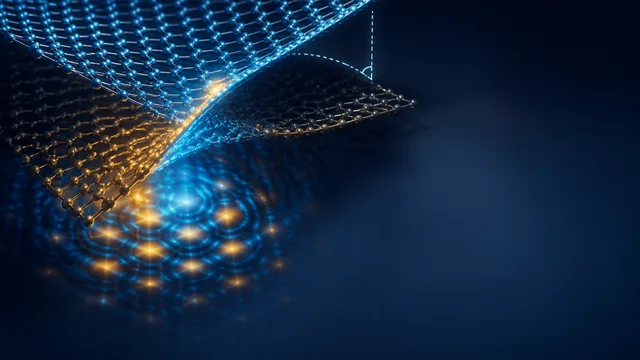
Magic-angle graphene refers to two atomically thin graphene sheets stacked with a slight rotational twist. Near a critical angle, the resulting moiré pattern dramatically slows the motion of electrons and creates unusually flat electronic bands. Because interactions become more important in these bands, the material can display correlated phases, including superconductivity, without the conventional ingredients found in many established superconductors.
The articles focus on growing evidence that superconductivity in twisted bilayer graphene may arise through an unconventional mechanism. Experiments examine how superconducting behavior changes with carrier density, temperature, magnetic fields, and other controls, helping researchers distinguish it from ordinary phonon-mediated superconductivity. A related result shows that superconductivity can be switched off by tuning the system, demonstrating how sensitive the phase is to its electronic environment and offering a way to compare it with neighboring correlated states.
Research groups are using these findings to clarify the microscopic origin of pairing and to map the broader phase diagram of moiré materials. The work could deepen understanding of high-temperature and unconventional superconductors while advancing a platform in which quantum phases are adjustable through angle, gating, and electrostatic control. Significant questions remain, including precisely what binds electrons into pairs and how universal the observed behavior is across devices.
BuzzRAG Coverage
3 signals from source feeds

Knowridge Science Report

Phys.org
Phys.org Physics
These are external articles in the Science desk that match this topic. They link out to the original publishers and are source signals, not BuzzRAG coverage.