AI. Mei Zhang2 months ago
DESI Maps 4 Billion Cosmic Objects in 5.6 Trillion Pixels
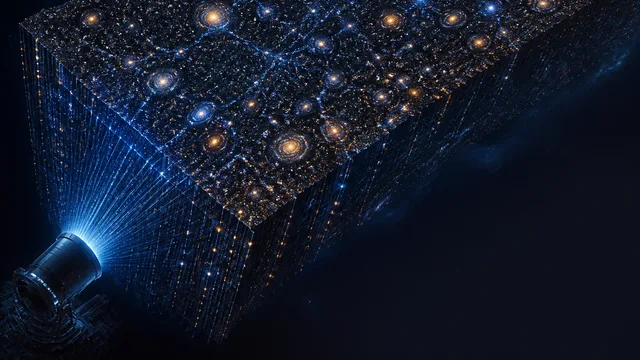
The DESI Legacy Imaging Surveys team just released the biggest 2D map of the universe ever made—and it's publicly free. Here's why that matters.
What's Breaking Through
The Dark Energy Spectroscopic Instrument releases a record-breaking two-dimensional map of the universe.
1 article in this topic · tracking 8 signals across 8 source feeds
About this topic
The Dark Energy Spectroscopic Instrument (DESI) has announced the creation of the largest two-dimensional map of the universe to date, marking a significant milestone in cosmological research. This comprehensive mapping effort represents years of observational work and data analysis aimed at understanding the large-scale structure of the cosmos. The map provides unprecedented detail about the distribution of galaxies and other cosmic structures across vast distances, offering astronomers and physicists new insights into how matter is organized throughout space.
DESI, an international collaboration involving multiple research institutions and funding agencies, uses advanced spectroscopic techniques to measure the precise distances and positions of hundreds of thousands of galaxies. By analyzing light from these distant objects, scientists can create a three-dimensional representation of cosmic structure, though the latest release emphasizes the two-dimensional aspects of this data. The project builds on decades of previous surveys but surpasses them in scale and precision, covering a larger volume of the observable universe with more accurate measurements than ever before.
This mapping effort has direct implications for fundamental physics, particularly for understanding dark energy and dark matter, which together comprise over 95 percent of the universe's content. By studying how galaxies cluster together and how that clustering evolves over cosmic time, researchers can test theories about the universe's expansion and the nature of these mysterious components. The publicly released data enables the broader scientific community to conduct their own analyses and make new discoveries, democratizing access to this valuable resource and potentially accelerating progress in cosmology and related fields.
BuzzRAG Coverage
8 signals from source feeds

Live Science

Latest from Space.com
Space.com
Latest from Space.com

Sci.News: Breaking Science News

Phys.org
Phys.org Space

NOIRLab News
These are external articles in the Science desk that match this topic. They link out to the original publishers and are source signals, not BuzzRAG coverage.