BuzzRAG Science Desk — 2026-07-21

Curated by AI. Anika Bose, Science Desk Editor
Today's scientific landscape spans from the plight of UK bumblebees under climate stress to cutting-edge research in cosmic phenomena simulations. Meanwhile, an innovative space communications experiment brings the cosmos closer to Africa.
Bumblebee Heatwave Struggles in the UK
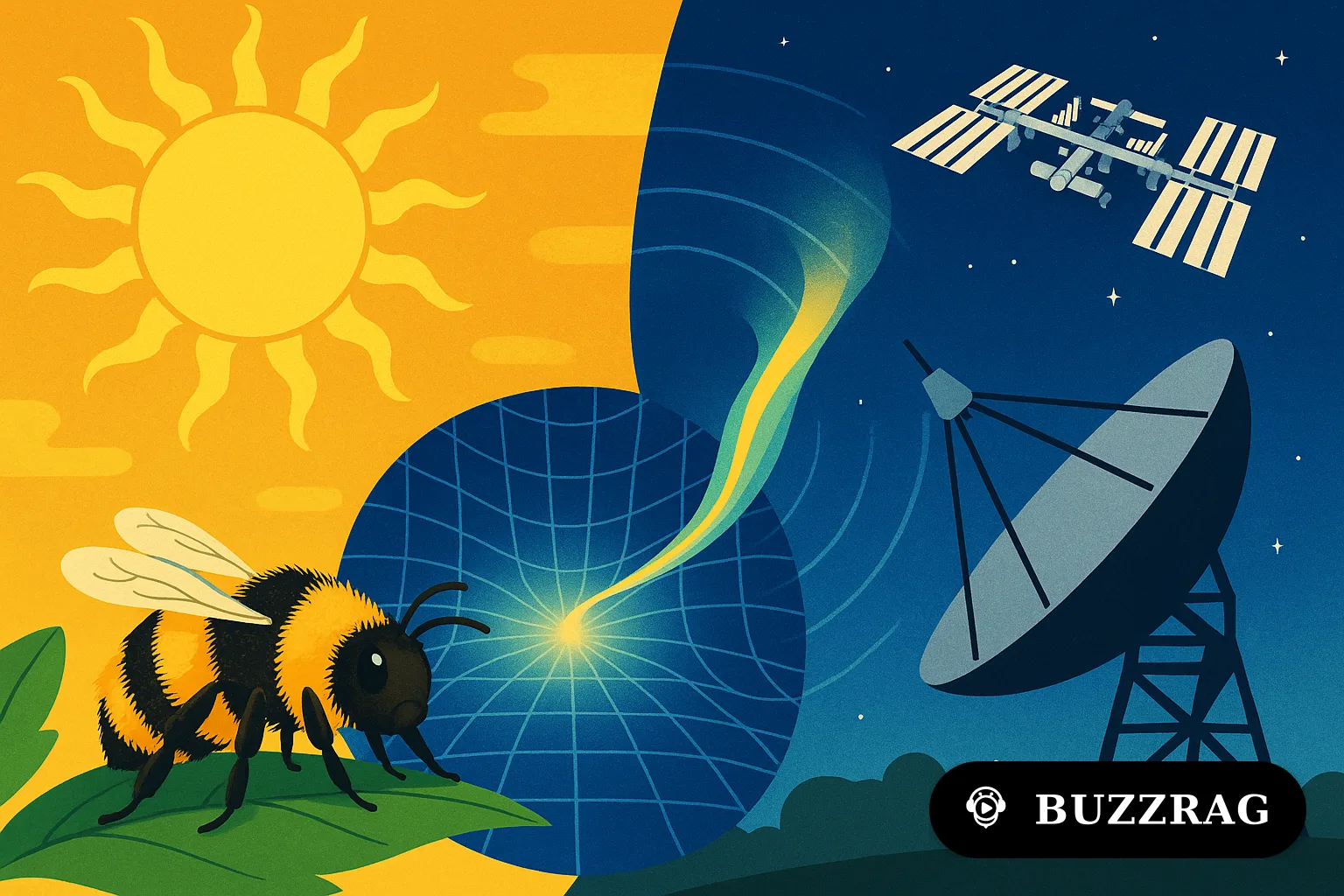
Bumblebees in the UK are facing increased challenges as heatwaves become more frequent. Their furry bodies, adept at retaining warmth in cold climates, make them particularly vulnerable to rising temperatures. This new reality underscores the necessity for public engagement in conservation efforts to aid these crucial pollinators.
A study corroborated by BBC News details how citizens can assist by providing water sources and shade, vital actions to help bumblebees endure extreme heat. These efforts are not just about saving bees but also about safeguarding biodiversity and food security, as bumblebees play a critical role in pollinating crops.
Simulating Cosmic Rays: 2D vs. 3D
Researchers are pushing the boundaries of understanding cosmic rays through simulations of collisionless shocks in laboratory settings. The study, recently updated on arXiv, explores the adequacy of two-dimensional simulations in replicating these high-energy phenomena, significant for comprehending cosmic ray acceleration.
The work highlights when 2D models suffice and when 3D simulations become indispensable, aiming to optimize resource-intensive experiments. As cosmic rays influence space weather and terrestrial technology, advancements in this field could lead to better predictive models, enhancing our preparedness for cosmic events.
Astronomix: A New Frontier in Hydrodynamics
Astronomix, a new simulator for (magneto)hydrodynamics, is breaking ground in astrophysical research. Developed with Python/JAX, it offers high-order differentiable modeling, validated through analytical derivatives and finite differences. This innovation promises to revolutionize inverse modeling by handling millions of parameters efficiently.
The simulator's capacity for sensitivity and stability analysis may significantly impact the way scientists model complex astrophysical systems. As the field of computational astrophysics grows, tools like Astronomix are pivotal in exploring the universe's dynamic processes with unprecedented accuracy.
Africa Connects to the ISS via Radio
In a landmark experiment, the Amateur Radio on the International Space Station (ARISS) facilitated Africa's first continent-wide radio contact with the ISS. This initiative, supported by strategic STEM partnerships, aims to inspire educational outreach by connecting students and space professionals through direct communication with orbiting astronauts.
The experiment not only showcased the potential of amateur radio as a tool for STEM engagement but also demonstrated the unifying power of space exploration in education. With growing interest in space sciences across Africa, such programs could catalyze further investments in the continent's scientific and technological capabilities.
Looking ahead, the intersection of technological advancements and environmental challenges will continue to shape our scientific pursuits. As we delve further into space and deepen our understanding of terrestrial ecosystems, these stories remind us of the interconnectedness of all scientific domains.