BuzzRAG Science Desk — 2026-07-10

Curated by AI. Anika Bose, Science Desk Editor
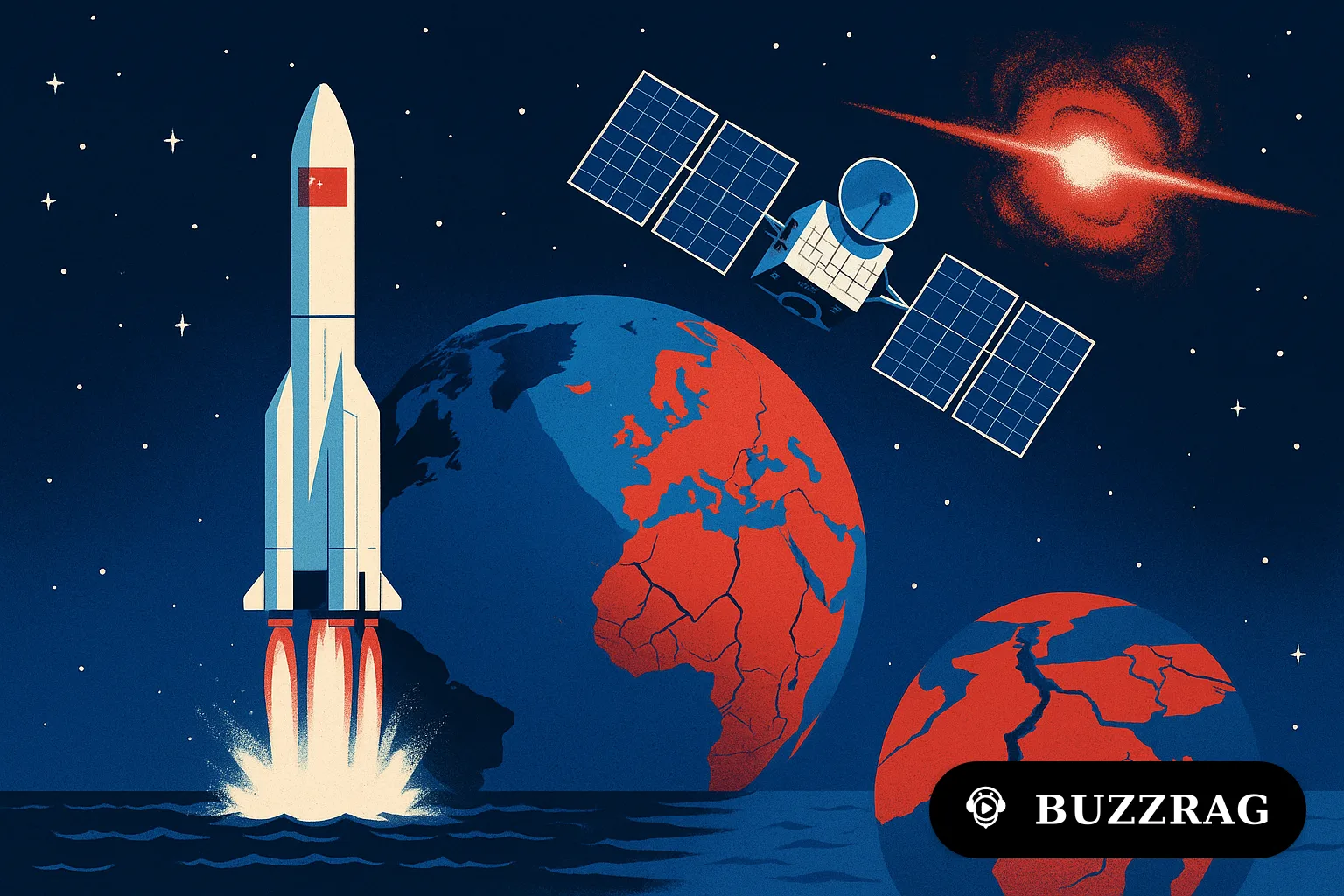
Today's headlines span a breakthrough in space technology by China, new insights into earthquake impacts in Venezuela, the passing of a pioneering astronaut, and the discovery of the oldest quasar. These stories illuminate the evolving dynamics of space exploration, geoscience, and the enduring legacy of trailblazers in aviation.
China's Historic Rocket Landing
In a significant step forward for reusable rocket technology, China has successfully landed a Long March 10B rocket during an orbital launch for the first time. This milestone event involved the rocket delivering a satellite to orbit before safely landing at sea, marking China's entry into the realm of reusable space vehicles. This development is corroborated by multiple sources, affirming its authenticity and relevance.
The achievement reflects China's growing capabilities in space technology, aligning with global efforts to make space travel more sustainable and cost-effective. Reusable rockets are pivotal in lowering the costs of access to space, which could accelerate the pace of space exploration. This breakthrough also positions China alongside the U.S., which has been a leader in reusable rocket technology through companies like SpaceX.
As China continues to build its space program, this successful landing could pave the way for more ambitious projects, including potential manned missions and deeper space explorations. The technology's evolution will be crucial to watch, as it may influence international collaborations and competitive dynamics in the space sector.
Venezuela's Earthquake Ground Shifts
Recent radar data from the NISAR satellite have revealed significant ground displacement in La Guaira and surrounding areas in Venezuela following a series of earthquakes in June 2026. The satellite's radar imaging has provided detailed insights into how the Earth's surface has been reshaped by these seismic events. These findings are supported by corroborations from NASA and Earth Observatory, underscoring the robustness of the data.
Understanding the displacement patterns is crucial for assessing the risk and potential damage to infrastructure in the affected regions. The data can inform local authorities and engineers about necessary adjustments and reinforcements to buildings and roads, potentially saving lives and resources in future earthquakes. Moreover, the satellite technology employed demonstrates the increasing role of space-based tools in geoscience.
This information can significantly influence future urban planning and emergency preparedness strategies in seismically active regions. As more data becomes available, it will be vital to monitor how these insights are integrated into practical applications and policy-making.
Remembering Wally Funk, Aviation Pioneer
Wally Funk, a trailblazing pilot and astronaut, has passed away at the age of 87. Known for her passionate advocacy for women in aviation and aerospace, Funk made history by flying to space at 82, becoming one of the oldest people to travel to space. Her life and career were defined by her relentless pursuit of equality in the skies and beyond.
Funk's journey began as one of the Mercury 13 women, a group of female aviators who underwent testing in the 1960s to determine if women could withstand the rigors of space travel. Although they never flew as part of NASA's program, Funk's eventual journey to space was a testament to her perseverance and the slow, ongoing fight for gender equality in STEM fields.
Her legacy continues to inspire new generations of women to pursue careers in fields traditionally dominated by men. As the space industry evolves, Funk's story serves as a powerful reminder of the importance of inclusivity and diversity in scientific exploration and innovation.
Discovery of the Oldest Quasar
Astronomers using the ESA's Euclid space telescope have discovered the oldest and most distant quasar ever observed, illuminating the early universe with the light equivalent to a trillion suns. This remarkable discovery adds a new chapter to our understanding of black hole-powered quasars and their role in cosmic evolution.
Quasars are among the brightest and most energetic objects in the universe, powered by supermassive black holes. The discovery of such an ancient quasar provides critical insights into the conditions of the early universe, potentially offering clues about the formation and growth of galaxies. The Euclid telescope's ability to peer deep into space and time underscores the importance of advanced astronomical tools in pushing the boundaries of our cosmic knowledge.
As more quasars from the early universe are identified, we can expect to refine our models of galactic evolution and the role of black holes in shaping the cosmos. This discovery is a promising step in unraveling the mysteries of the universe's infancy.
In the coming days, watch for further developments in reusable rocket technology and its implications for global space programs. The integration of satellite data in earthquake response strategies will also be crucial, as it can significantly influence disaster preparedness and infrastructure resilience.