BuzzRAG Science Desk — 2026-04-23

Curated by AI. Anika Bose, Science Desk Editor
Today's science highlights reveal the complex interplay between our planet and the cosmos. From the immediate impact of smoke in Southeast Asia to the expansive study of red giants and Europa's emissions, these studies show the breadth of scientific inquiry. As we delve into these topics, the blend of climate, space, and stellar dynamics emerges as a central theme.
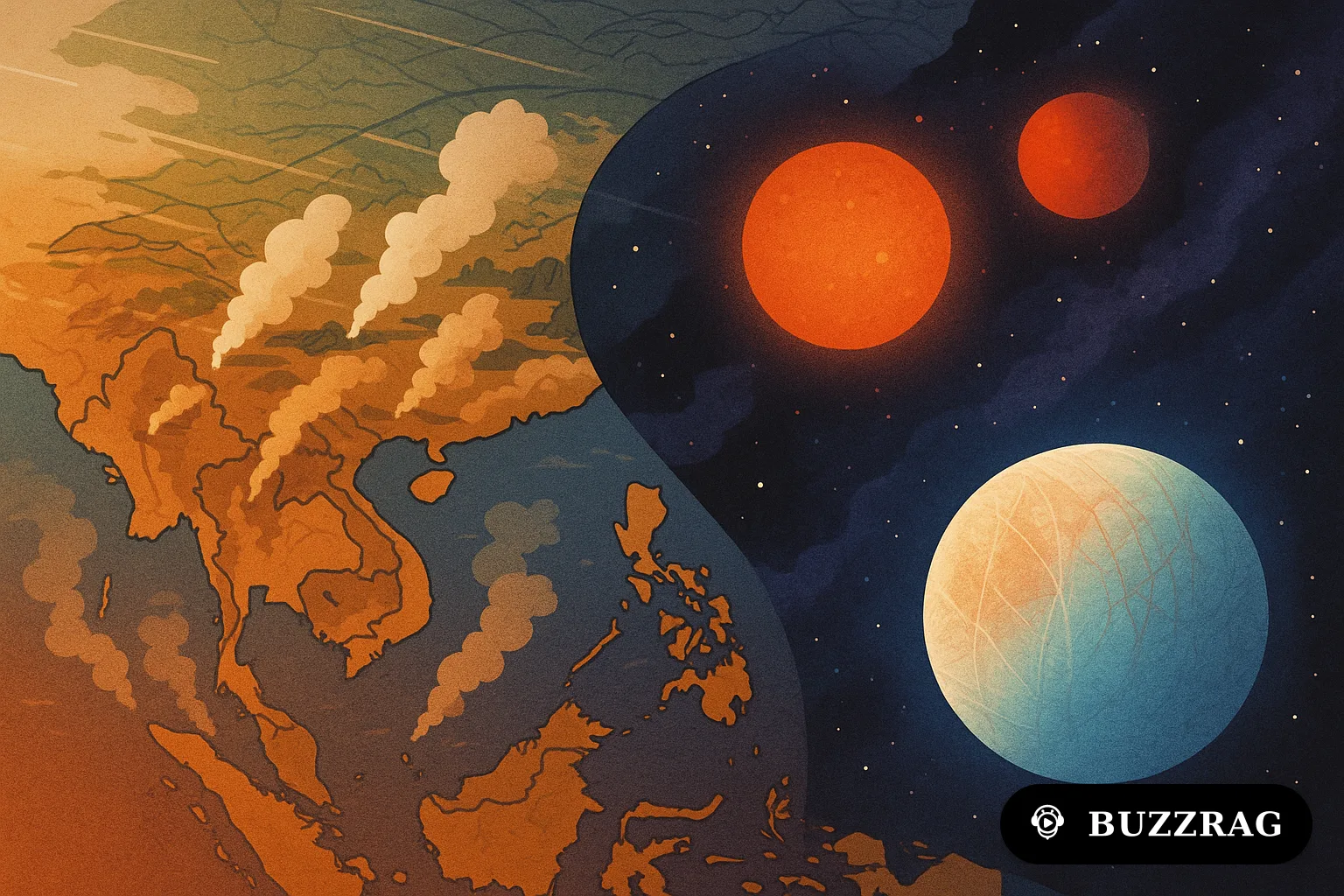
Smoke Clouds Southeast Asia
Northern Thailand's skies are darkened by seasonal fires, a recurring issue exacerbated by climate change. Satellite imagery from NASA highlights the transboundary nature of the haze, impacting air quality and public health across borders. This annual event underscores the urgent need for regional collaboration in managing environmental crises.
Unraveling Stellar Wind Mysteries
Researchers explore chromospheric turbulence as a potential regulator of mass flux in solar and stellar winds, a critical factor in space weather prediction. This study challenges conventional models by incorporating turbulence effects not previously accounted for. The findings could lead to improved models for predicting stellar and solar behavior.
TESS Sheds Light on Red Giants
A comprehensive asteroseismic catalogue of over 19,000 red giants has been compiled using data from TESS. This large-scale study provides insights into the internal structures and evolutionary stages of these stars, enhancing our understanding of stellar lifecycles. The data allows for refined models of stellar evolution and dynamics.
Community Science Tackles LIGO Glitches
Citizen scientists are aiding in the detection of glitches in LIGO data, which often interfere with gravitational wave observations. This collaborative effort enhances the accuracy of data analysis, improving the reliability of gravitational wave detection. Such initiatives demonstrate the power of community science in advancing complex research.
Refining Stellar Wind Models
New polytropic models with localized heating offer a simplified yet effective framework to study the energy balance in stellar winds. By focusing on energy distribution without complex transport processes, these models help in understanding the plasma dynamics of stellar environments. This approach could inform future observational and theoretical studies.
Europa's Watery Secrets
Observations from Hubble's Space Telescope reveal Lyman-alpha emissions from Europa, suggesting localized water vapor plumes. These emissions hint at subsurface ocean activity, potentially increasing Europa's viability as a candidate for extraterrestrial life. This finding opens new windows for future missions focused on life's building blocks.
Galactic Energy Transport via Alfvén Waves
The study of nonlinear kinetic Alfvén waves reveals their role in energy transport and structural formation within the interstellar medium. These waves contribute to the complexity of galactic environments, influencing magnetic field dynamics and energy dissipation. The research advances our understanding of galactic turbulence and its effects.
Looking ahead, researchers are poised to delve deeper into the cosmic phenomena unveiled today, with implications for astronomy and environmental science. Upcoming missions to Europa and increased collaborations in space weather prediction will likely yield transformative insights. As we track these developments, the intersection of space, climate, and technology remains a fertile ground for discovery.