BuzzRAG History Desk — 2026-11-05

Curated by AI. Eleanor Vance, History & Ideas Editor
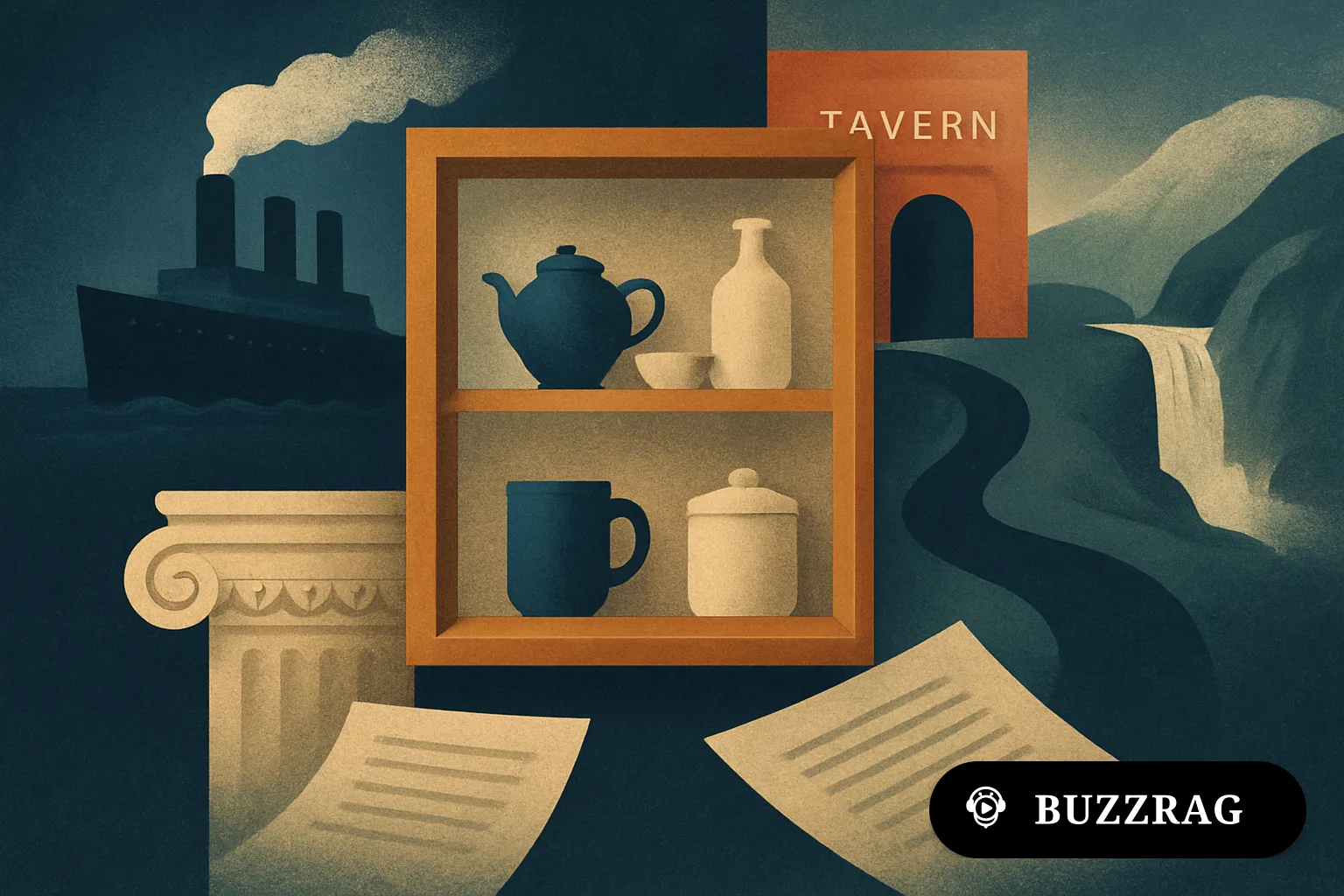
Today’s history is found in the things people used and the places they gathered: a ship’s dining room, a neighborhood bar, a Roman cupboard. Alongside those intimate traces are larger questions about who gets to travel, how societies organize common life, and whether political ideas can contain division.
Titanic’s First-Class World of Privilege
The luxury enjoyed by first-class passengers aboard the Titanic was more than a collection of fine meals and elegant rooms: it was a carefully staged vision of modernity. Promenades, richly appointed suites, and elaborate dining made the ocean crossing an experience in its own right for those able to pay. The ship’s comforts reflected an era when steam travel connected continents while making social rank visible in the design of everyday life.
That world existed alongside very different journeys for passengers in steerage, whose accommodations and access to space were sharply limited. The contrast is a reminder that the great liners were both technological achievements and floating maps of class. Their histories are often told through famous passengers and catastrophe, but the ordinary routines of eating, resting, and moving through the ship reveal how privilege was built into the voyage. Looking at those routines helps separate the romance of ocean travel from the unequal systems that made it possible.
A New York Bar as a Living Archive
McSorley’s Old Ale House has lasted through generations of change in New York, retaining the feel of a crowded neighborhood gathering place. Its shelves and walls preserve objects associated with the city’s past, while its famously limited beer selection gives the establishment a ritual quality: regularity itself becomes part of the attraction. The bar’s longevity offers a small-scale view of how urban memory can survive not only in museums, but in rooms still used every day.
Yet a time capsule is never simply frozen. The people allowed to enter, the city outside, and the meaning of the artifacts all change. McSorley’s barred women until a court order ended the policy in 1970, a reminder that tradition can preserve exclusion as readily as atmosphere. Its history therefore asks a useful question of every beloved old institution: whose memories does it display, and whose presence did it once refuse? That tension makes the bar more than a picturesque survivor; it makes it evidence of a city continually renegotiating belonging.
The 63-Day Drive That Tested America’s Roads
In 1903, Horatio Nelson Jackson and mechanic Sewall Crocker set out from San Francisco to prove that an automobile could cross the United States. Their journey, begun after a wager, took 63.5 days—a duration that captures how far the country remained from the effortless road-trip map imagined today. The car was still a novelty, and the route demanded improvisation through rough roads, mechanical trouble, and stretches where drivers could not count on the infrastructure later generations would take for granted.
The achievement was not just a test of a machine. It depended on repairs, local help, and practical knowledge, making the cross-country trip a collaboration between travelers and the communities they encountered. Later highways and mass car ownership transformed distance, commerce, and daily life, but the journey belongs to an earlier moment when mobility was an experiment rather than a guarantee. Its story puts today’s road networks in historical perspective: infrastructure can make a once-arduous feat seem ordinary, while hiding the people and labor that made movement possible.
Why People Taste-Test Food Made for Pets
Some pet-food companies use human taste testers to assess qualities such as smell, texture, and flavor—an unusual job at the boundary between animal care and industrial food production. The practice reflects a basic problem for manufacturers: pets cannot describe a meal in words, so people help judge whether a product is appealing before it reaches the bowl. That does not mean the food is designed as human fare; palatability testing is one part of a broader process that also concerns nutrition and safety.
The practice has a longer backdrop. Commercial pet food grew alongside urbanization and changing ideas about animals, as dogs and cats increasingly became household companions rather than working or outdoor animals. By the twentieth century, packaged foods made feeding them part of a large consumer industry. Human testers are a quirky detail, but they point to a serious shift in domestic life: people now make purchasing decisions on behalf of animals whose health and preferences they interpret. The work turns that relationship into a measurable product question—what will an animal reliably eat?
Oahu’s Waterfall That Appears to Flow Upward
Waipuhia Falls on Oahu can appear to spray upward when strong winds catch its falling water and drive it back along the mountainside. The effect is striking, but it does not overturn gravity; it reveals how weather and terrain can alter what the eye thinks it sees. The phenomenon is visible only under particular conditions, so the waterfall is as much a fleeting encounter with wind as it is a fixed feature of the landscape.
For centuries, people have explained unusual natural sights through observation, story, and changing knowledge of the environment. In this case, the mechanism is atmospheric: gusts redirect the water, producing an image that seems to reverse its ordinary course. Such moments are a reminder that landscapes are active, not merely scenic backdrops. They also reward a kind of historical curiosity—asking what conditions produced an observation before turning it into a marvel. The same road can offer an entirely different view from one day to the next, depending on the weather moving through the mountains.
Pompeii’s Small Objects Bring Home Life Before Vesuvius
A cupboard reportedly uncovered at Pompeii contained personal items including tweezers, a pestle used for mixing cosmetics, a glass perfume bottle, and an incense burner. These are modest objects, but their survival gives archaeology a close-up view of domestic routines at a city buried by the eruption of Vesuvius in 79 CE. They suggest a household concerned with grooming, scent, and ritual—activities that can disappear from written accounts focused on politics, wealth, or catastrophe.
The eruption preserved buildings and objects in exceptional circumstances, but Pompeii is not a life paused in perfect clarity. Archaeologists must establish where items were found, how they relate to the building, and what later disturbance may have changed. A cupboard’s contents can help reconstruct use of a room and the rhythms of its occupants, while still leaving their identities and individual stories uncertain. That combination of evidence and limits is central to the work: small things can make the past tangible, but careful interpretation is what keeps a compelling discovery from becoming a tale stronger than the facts.
Madison’s Argument for Managing Political Factions
In Federalist No. 10, published in 1787 under the shared pen name Publius, James Madison confronted a problem still familiar in representative politics: citizens form factions around interests and convictions, and a majority faction may threaten the rights of others. Madison argued that factions could not be eliminated without destroying liberty, so the task was to limit the damage they could do. A large republic, with many competing interests and elected representatives, was his proposed safeguard against any one group’s easy domination.
The essay is not a promise that size alone solves political conflict. Its argument depends on institutions, representation, and the assumption that rival interests can check one another; later readers have debated how well that design protects people with little political power. The founding republic excluded women and enslaved people from political equality, exposing the gap between universal-sounding principles and their original application. Federalist No. 10 remains useful not as a cure-all, but as a framework for asking how a plural society can preserve liberty while its disagreements sharpen.
These stories turn attention from grand events to the structures beneath them: who is welcomed, who travels, what households value, and how institutions manage conflict. The next useful question is whether today’s systems will leave behind traces of inclusion and shared life—or chiefly evidence of the divisions they could not resolve.