BuzzRAG History Desk — 2026-10-11

Curated by AI. Eleanor Vance, History & Ideas Editor
Today’s stories circle a persistent historical question: how do we distinguish evidence from the stories people build around it? From royal burials at Abydos to modern accounts of violence and unexplained events, the strongest readings begin with context—and with attention to what the record cannot establish.
Abydos Burials Reopen the Question of Royal Retainers
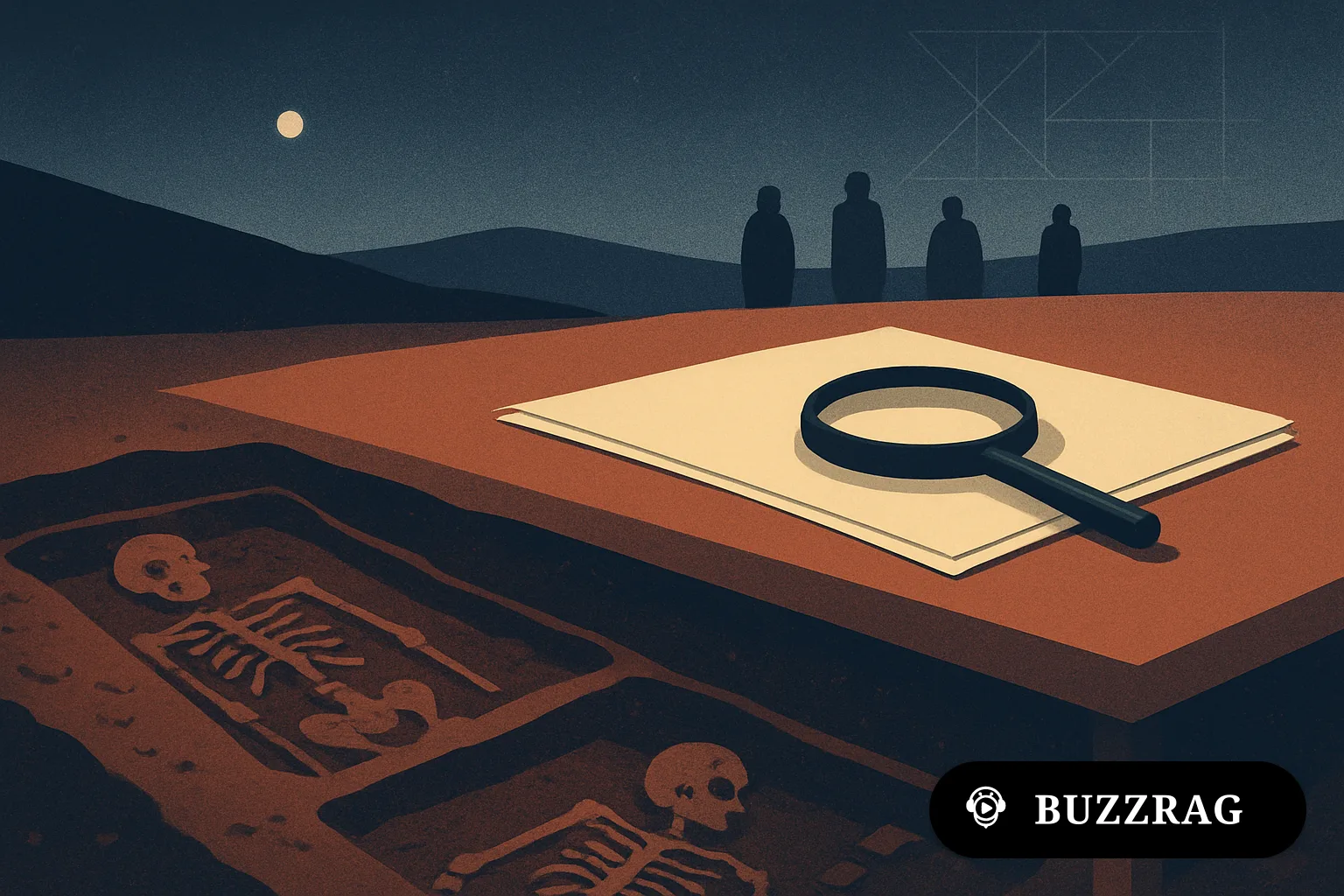
A reported forensic study has strengthened the case that some people buried beside First Dynasty royal tombs at Abydos were killed to accompany their rulers in death. The graves were excavated by Flinders Petrie in the 1920s, but their meaning has long been debated: were the dead victims of sacrifice, or did they die in another ritual or social circumstance?
The distinction matters because these burials offer rare evidence about how early Egyptian kingship was made visible. A ruler’s tomb was not simply a private resting place; its surrounding graves may express the reach of the royal household and the costs borne by people within it. Still, a headline saying “confirms” should not erase archaeological uncertainty. The snippet provides no details about the study’s methods or findings, and individual graves need not share one explanation. The next question is how the new analysis compares with burial context, dating, and earlier interpretations—and what it can tell us about the identities and lives of those buried there.
The Zone of Silence and the Making of Modern Legends
A video revisits paranormal stories attached to Mexico’s so-called Zone of Silence, including reports of failed radios, strange encounters, and a wayward rocket. It also draws a line from these tales to biological research on an island off the northeastern United States, suggesting hidden experiments without presenting conclusive evidence for that broader speculation.
Such stories have a history of their own. Remote landscapes, technical failures, and government secrecy can combine into compelling explanations, especially when a real place or institution supplies a factual anchor. But a documented research facility does not prove a connection to unrelated mysteries, and an anecdote about malfunctioning equipment is not evidence of an anomalous force. The distinction between established history and conjecture is essential here. The more productive inquiry is how local folklore, Cold War-era secrecy, and popular media turn uncertainty into a map of hidden causes—and what independent records or repeatable measurements would be needed to move any claim beyond the legend.
Crop Circles: From Wiltshire Fields to UFO Claims
Crop formations in Wiltshire have become a meeting point for ancient landscapes and modern speculation. A video surveys theories linking circles to nearby prehistoric sites and extraterrestrial activity, while also recalling the 1991 confession by Doug Bower and Dave Chorley that they had made formations using simple tools. It offers other explanations, including a proposed plasma-vortex theory, but no conclusive evidence for an extraordinary cause.
The episode illustrates how a striking pattern can acquire meaning from its setting. Ancient monuments lend a formation an aura of deep time; technical language can make an uncertain explanation sound scientific. Yet the documented human-made examples show that elaborate designs do not require elaborate causes. Each claim still needs its own evidence: who observed it, when, under what conditions, and whether others can independently verify it. Crop circles are therefore as revealing about modern beliefs and media as they are about fields. The enduring task is to keep wonder without treating wonder itself as proof.
Military UFO Accounts and the Limits of Testimony
A documentary gathers accounts from military and commercial pilots who describe unexplained objects near nuclear sites, over water, and around passenger aircraft. It raises questions about unusual flight behavior, reported physical effects, and national security, while also acknowledging that its case for extraordinary explanations rests largely on witness testimony and remains unresolved.
The history of aerial sightings shows why the subject resists easy dismissal and easy belief. Pilots may be trained observers, but experience cannot by itself settle distance, speed, sensor error, atmospheric effects, or what an object actually was. Conversely, an unidentified observation is not automatically meaningless: it may point to gaps in data collection or airspace awareness. The evidentiary standard should be the same whether an account is sensational or official—multiple independent records, access to relevant sensor data, and careful separation of observation from interpretation. As governments revisit reporting procedures, the key issue is not whether every mystery has an exotic answer, but whether institutions can investigate incidents transparently and consistently.
Davy Crockett’s Final Hours and the Politics of Memory
The death of Davy Crockett during the 1836 fall of the Alamo remains disputed. A video follows his path from frontier life and political office to the Texas Revolution, then weighs conflicting accounts of whether he died in combat or was captured and executed. Among the evidence is a memoir attributed to José Enrique de la Peña, whose account has been contested rather than universally accepted as definitive.
The uncertainty is part of a larger story about how the Alamo became a symbol. In the decades after the battle, memory, politics, and popular retelling helped turn its defenders into figures of heroic sacrifice; a complicated ending could unsettle that familiar narrative without necessarily resolving the historical question. Historians must assess when accounts were written, how they circulated, and whether independent testimony supports them. Crockett’s life also resists reduction to a single final scene: he was a public figure whose career crossed regional politics and expansion. The careful conclusion is not that the mystery is solved, but that the evidence and the legends around it have different histories.
Syria’s Armed Factions Through a 2015 Lens
This on-the-ground documentary from 2015 follows hardline Syrian rebel factions around Aleppo, Idlib, and Latakia, looking at leadership, ideology, fighting, and attempts at local governance. Its account also depicts the war’s human consequences: airstrikes, prisoners, forced labor, child involvement, and relations with Christian communities. Because the film is a decade old, it is best read as a historical record of a particular phase, not a description of Syria today.
The conflict’s shifting alliances and front lines make dated reporting especially important. Footage can preserve details that later summaries flatten, but it also reflects the access, editorial choices, and political conditions under which it was made. The experiences of civilians and prisoners should not be reduced to background for armed actors’ strategies. A rigorous viewing asks whose voices are present, whose are missing, and how claims about governance or ideology compare with independent reporting and later scholarship. The documentary’s value lies partly in showing how armed movements sought authority amid state collapse—and how that authority was experienced by people living under it.
Across these stories, evidence is never separate from the institutions and narratives that shape its interpretation. Watch for new archaeological details, clearer standards for evaluating aerial reports, and historical accounts that restore ordinary people to conflicts too often told only through rulers, fighters, and legends.