BuzzRAG History Desk — 2026-09-25

Curated by AI. Eleanor Vance, History & Ideas Editor
Today’s history conversation moves between the excavation trench and the archive, asking how societies preserve—or distort—their pasts. Ancient urban foundations, inherited reputations, wartime memory, and intimate family absences all show history as an argument over evidence, belonging, and power.
The Father Who Stayed Outside the Story
The story of Charles Stanley Gifford, widely identified as Marilyn Monroe’s biological father, is less a tale of celebrity than of abandonment made visible by fame. Gifford’s brief relationship with Monroe’s mother ended before her birth, and accounts say he declined repeated efforts to establish a relationship with the daughter who would later become one of the twentieth century’s most recognizable performers.
The episode also exposes the limits of celebrity biography. Monroe’s childhood was shaped by instability, foster care, and the absence of a dependable parent; public fascination later turned that private wound into part of her mythology. Yet biological connection is not the same as family, and the surviving record cannot fully recover either Gifford’s motives or Monroe’s emotional life. What remains is a pointed reminder that famous people do not escape ordinary vulnerabilities: the desire for acknowledgment, the power of silence, and the ways later fame can illuminate—but never repair—the choices of the past.
The River Island Before Paris
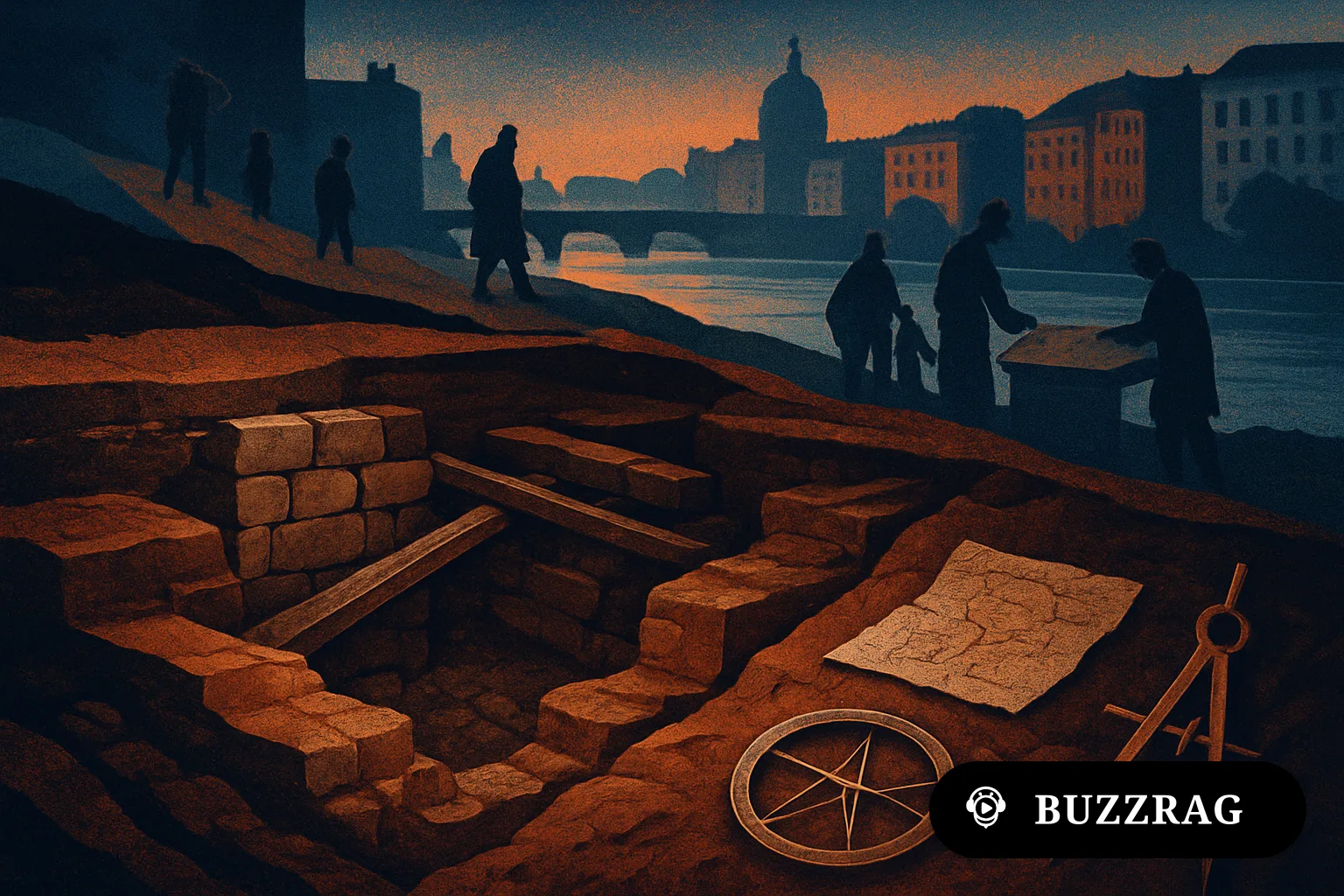
Archaeologists working near Notre Dame on Île de la Cité have uncovered a substantial structure that may belong to the earliest settlement associated with Paris. The stone-and-wood wall, reinforced with thick layers of sand and gravel, suggests deliberate engineering rather than a temporary riverside camp and may help clarify how communities occupied and defended the island more than two millennia ago.
The discovery matters because the origins of Paris are often compressed into a single Roman story, even though the city’s deeper history begins with the Gallic Parisii and a strategic settlement on the Seine. Dating, construction analysis, and comparison with nearby finds will determine whether the wall can be securely linked to that early occupation. Archaeology rarely produces a single dramatic moment of “discovery”; it builds historical certainty through materials, measurements, and competing interpretations. Beneath a modern landmark, the excavation is reopening an older question: when did a river crossing become a city?
Archimedes and the Enduring Power of Useful Thought
Archimedes of Syracuse remains an emblem of ancient scientific ingenuity, but his importance lies in more than the familiar anecdotes attached to his name. Working in the third century BCE, he advanced geometry, mechanics, hydrostatics, and methods for calculating areas and volumes with a precision that would influence mathematics for centuries.
His achievement was also intellectual and civic. Syracuse was a major Mediterranean power, and Archimedes’ work moved between abstract reasoning and practical problems involving machines, water, measurement, and defense. Later writers transformed him into a near-mythic genius, sometimes at the expense of the mathematical texts that made his reputation durable. Modern scholarship has recovered a more interesting figure: a thinker who treated physical reality as something that could be modeled, tested, and explained. His legacy speaks directly to present debates about science, reminding us that breakthroughs often emerge where theoretical curiosity meets urgent material needs.
When a Highland Curse Becomes Evidence
A medieval Scottish story involving forbidden love, violence, and a supposedly cursed skull is now being examined through forensic methods. Researchers hope that the remains and related historical accounts can establish what happened behind a legend preserved for generations in the Scottish Highlands.
Such investigations occupy a productive borderland between folklore and history. A skull may reveal trauma, age, sex, disease, or patterns of burial, but it cannot by itself confirm every detail of a narrative built through oral tradition. The historical task is therefore comparative: scientific findings must be set beside local memory, legal records, genealogies, and the political circumstances in which the story survived. The “curse” may tell us less about supernatural belief than about how communities remember injustice, forbidden relationships, and unresolved violence. As forensic work proceeds, the most valuable result may be a clearer account of how evidence and storytelling cooperate in making a past event meaningful.
The Pacific War Beyond the Island Names
A newly circulating resource collection on the Pacific War gathers material on the conflict’s major campaigns, from Japan’s imperial expansion and the attack on Pearl Harbor to battles at Guadalcanal, Saipan, Guam, Iwo Jima, and Okinawa. Its geographic sweep offers a useful starting point for studying a war often reduced to a sequence of famous operations.
The deeper history is one of empire, occupation, forced labor, civilian displacement, racial ideology, and immense logistical power. Island battles were not isolated episodes: they were connected to colonial rule across Asia, the experiences of Indigenous and local populations, and the strategic choices that culminated in the war’s final months. A sound teaching collection should therefore place military maps beside testimonies, photographs, diplomatic records, and accounts from civilians. The resource’s value will depend on whether it helps readers see the Pacific not as an empty stage for rival armies, but as a densely inhabited region whose people bore the war’s heaviest costs.
Teaching Empire as a System, Not a Roster of Rulers
A curriculum collection for AP World History’s unit on land-based empires, covering roughly 1450 to 1750, brings together articles, definitions, and maps on states, rulers, religions, and systems of expansion. Its organizing premise is useful: students can compare empires across Eurasia, Africa, and the Americas rather than treating each as an isolated chronology.
The period’s central questions remain strikingly contemporary. How did governments justify conquest? How did belief, taxation, military organization, and trade sustain large territories? And how did ordinary farmers, soldiers, merchants, enslaved people, and religious communities experience imperial power? Effective comparative history must avoid flattening those differences into a single model of “empire,” while still identifying recurring patterns of centralization and resistance. Used critically, the collection can move classroom discussion beyond memorizing names toward understanding how political legitimacy is made—and how quickly it can fray when institutions fail to match the societies they rule.
The Capital That Lasted One Day
In September 1777, as British forces advanced on Philadelphia, members of the revolutionary government fled westward to Lancaster, Pennsylvania. They held a single meeting at the local courthouse before moving on to York, making Lancaster one of the shortest-lived capitals in American history.
The episode punctures the polished image of the Revolution as a steadily advancing national project. The government was improvising under military pressure, dependent on roads, couriers, local buildings, and communities that could shelter officials and armies. Lancaster’s brief role also reveals how fragile political geography was before Washington became the permanent seat of government: authority followed safety, and legitimacy had to travel with the people claiming to represent it. The city’s one-day capital status is a small story, but it captures a large truth about state formation. Nations are often assembled not in grand halls, but in borrowed rooms during moments of panic and uncertainty.
The next useful question is not simply what these stories reveal about the past, but who gets to define the evidence: archaeologists, descendants, institutions, teachers, or communities preserving memory outside official archives. Watch for the findings that turn compelling narratives into defensible history—and for the silences that remain after the headlines fade.