BuzzRAG History Desk — 2026-09-19

Curated by AI. Eleanor Vance, History & Ideas Editor
Today's historical currents run from the cloud forests of Bolivia to the ruins of wartime empires, linking the classification of nature with the preservation of texts, the power of journalism, and the afterlives of violence. Alongside genuine discoveries are stories that demand careful skepticism: history is not merely what survives, but what evidence can sustain.
A New Andean Cat—and the Long Work of Recognition
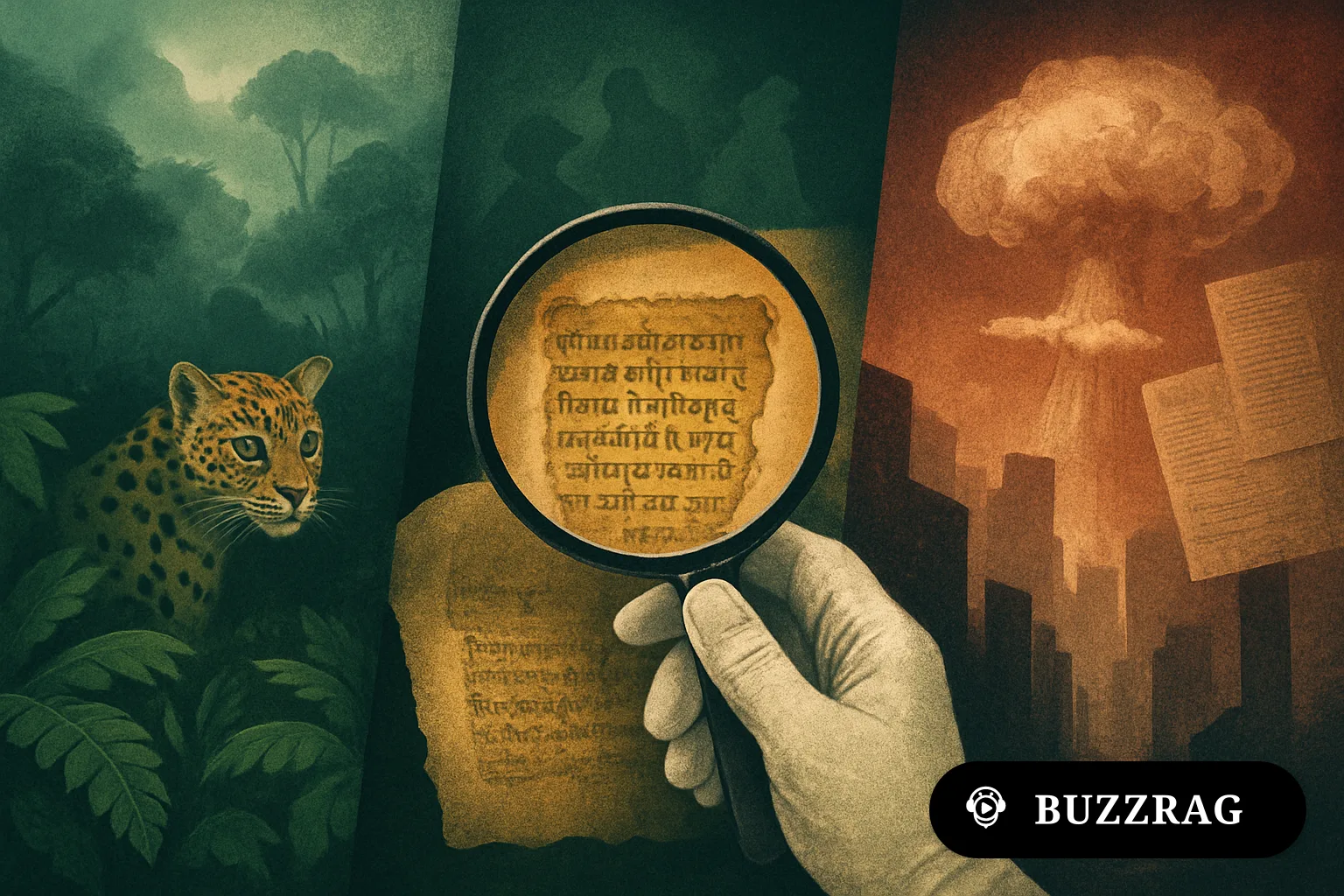
Reports of a small spotted feline identified as Leopardus tilcayo, or the tilcayo tiger, have drawn attention to Bolivia's cloud forests and to the possibility of a newly recognized cat species. The claim is striking partly because large mammals are rarely described as new to science today; more often, modern taxonomy separates populations long overlooked in remote habitats or clarifies relationships through genetics.
That distinction matters. A species does not become scientifically established simply because an animal has a memorable name or an unfamiliar appearance. Researchers must document morphology, genetics, distribution, behavior, and reproductive isolation, while independent taxonomists examine the evidence. If the report withstands that process, it will illuminate both the biological richness of the Andes and the limits of earlier surveying. It would also sharpen a political question: how can conservation protect a creature whose range, population, and threats are only beginning to be understood?
The Newspaper Mission That Outlived Its Founders
The anniversary of the newspaper founded in New York in 1851 invites a useful question: what does a public-information institution owe its readers after 175 years? Its original pledge to cover “every subject of public importance” belonged to a nineteenth-century world of steam presses, partisan papers, expanding cities, and a rapidly enlarging reading public. The language was aspirational, but it expressed a durable civic idea—that journalism should make distant decisions legible to ordinary citizens.
The mission has survived technological revolutions, though never unchanged. Telegraphy accelerated news; radio and television altered authority; digital publishing dissolved the old boundary between morning edition and breaking event. Claims of continuity therefore deserve scrutiny alongside institutional pride. A newspaper's historical importance lies not only in its slogans, but in the choices made about whose testimony counts, which communities receive sustained attention, and how corrections are handled. The anniversary is ultimately a test of whether “public importance” can remain a living standard rather than a piece of inherited branding.
When an Ancient Odyssey Emerges from a Modern Library
A reported fourth-century fragment of the Odyssey found in Utrecht University's special collections is a reminder that the ancient world often reaches us through accidental survival. Manuscripts and papyri were reused, miscatalogued, cut into bindings, or stored for centuries before scholars recognized their significance. The discovery appears to have occurred during close work with collections rather than through an archaeological excavation, underscoring how much evidence remains hidden in libraries already open to researchers.
Such a fragment does not simply add missing lines to a famous poem. Its script, material, provenance, and textual variants can reveal how Greek literature was copied, taught, and read in late antiquity. Even small differences may help scholars map the movement of texts across regions and institutions. The next crucial steps are authentication, high-resolution imaging, comparison with other witnesses, and transparent publication. The larger lesson is methodological: the history of a book is also the history of the hands, schools, markets, and accidents that allowed its words to endure.
The Atomic Decision and the Arguments That Remain
The bombings of Hiroshima and Nagasaki in August 1945 ended the Pacific War with unprecedented destruction, but the decision remains one of modern history's most contested acts. American officials argued that atomic attacks could force Japan's surrender and avoid the immense casualties anticipated from an invasion. Critics have countered that Japan was already militarily weakened, that alternatives were available, and that the second bombing came before the full consequences of the first could be absorbed.
The strategic context was also geopolitical. The United States and Soviet Union were emerging as rival powers, and the new weapon shaped expectations about the postwar order even as Japanese civilians bore its immediate human cost. Historians continue to debate the weight of invasion planning, diplomatic signals, the Soviet declaration of war, and domestic political pressures. A responsible account must resist both a single-cause verdict and moral evasion. The legacy is visible in nuclear deterrence, survivor testimony, arms-control debates, and the persistent question of whether military necessity can ever be separated from the civilian consequences of total war.
The Camorra's Young Recruits and the Economics of Belonging
An investigative documentary about young Camorra figures in Naples examines a phenomenon that is often sensationalized as “baby mafia”: the recruitment of adolescents and young adults into drug distribution, extortion, weapons trafficking, and territorial violence. The story is not simply about unusually violent youth. It is about criminal organizations offering income, identity, protection, and status where legitimate institutions appear absent or inaccessible.
The historical record of the Camorra shows how organized crime adapts to economic change. Networks have survived police campaigns by decentralizing, entering new markets, and exploiting demand from beyond the neighborhoods they control. Youth recruitment exposes the social infrastructure behind that flexibility: family ties, fear, unemployment, consumer culture, and the normalization of coercion. Interviews with victims and former members can make those mechanisms visible, but documentaries must also avoid turning trauma into spectacle. The meaningful measure of such reporting is whether it connects individual choices to the institutions and markets that make those choices profitable—and to the public policies capable of making alternatives real.
Oak Island, Archaeology, and the Seduction of Treasure
New claims about artifacts found on Oak Island—including lead shot, ironwork, glass, pottery, and a hook thought to date to the mid-eighteenth century—revive a mystery that has endured because the island combines real historical material with an exceptionally durable treasure legend. The presence of old objects is not, by itself, evidence of a buried fortune or a lost imperial enterprise. Coastal sites accumulate debris through settlement, shipping, fishing, military activity, and later tourism.
The valuable question is therefore not whether an artifact feels mysterious, but what its archaeological context can establish. Stratigraphy, exact provenience, laboratory dating, manufacturing analysis, and comparison with regional inventories matter more than dramatic association. A hook from the 1700s could illuminate ordinary maritime work just as readily as an extraordinary expedition. Oak Island offers a broader lesson in public history: popular fascination can fund attention and preserve interest, but it can also reward premature conclusions. The strongest investigation will distinguish documented evidence from narrative momentum and explain uncertainty rather than treating it as a clue.
Haunted Places and the History of Belief
Stories of a tomb associated with a poltergeist, disturbances in a royal palace, and faces appearing on household walls belong to a long tradition in which places become containers for fear, memory, and unexplained events. Their appeal is historical as much as supernatural. Cemeteries, palaces, and domestic interiors acquire reputations through repetition, tourism, journalism, and local storytelling; each retelling adds emotional evidence even when physical evidence remains elusive.
A serious history of haunting does not require accepting every apparition as real. It can examine how witnesses interpret ambiguous images, how fraud and suggestion operate, and why particular episodes become culturally durable. Photography, closed-circuit footage, architectural acoustics, pigment chemistry, and social psychology often provide more illuminating lines of inquiry than paranormal certainty. These narratives also reveal changing attitudes toward institutions: an old prison, court, or palace becomes a stage on which societies project guilt, injustice, and unresolved memory. The enduring question is less whether ghosts have followed anyone home than why communities need certain places to remain haunted.
The next useful developments will be evidentiary: taxonomic confirmation in Bolivia, technical publication of the ancient fragment, and fuller archaeological documentation from Oak Island. In the larger historical frame, debates over journalism, nuclear power, organized crime, and supernatural belief all return to the same demand—separate inherited stories from claims that can withstand scrutiny.