BuzzRAG Culture Desk — 2026-10-01

Curated by AI. Mateo Ruiz, Arts & Culture Editor
Today’s culture runs on contrasts: a landmark political rap album returns to view, while new music and a handmade craft insist on the value of close attention. Meanwhile, a Gaza documentary’s Italian box-office success and a creator’s viral-video empire put questions of audience, ethics and whose stories travel into sharper focus.
Public Enemy’s “Apocalypse 91” at 35
Thirty-five years after its release, Public Enemy’s Apocalypse 91: The Enemy Strikes Black is being revisited as more than a period piece. The album arrived when hip-hop was proving that pop could be both unruly entertainment and direct political argument, bringing urgent commentary into collision with dense, hard-edged production. Its anniversary offers a chance to hear that challenge in its original moment—and to measure how much of its pressure remains familiar.
The record’s force lies partly in refusing to separate style from substance: its sound is built to command attention, while its politics demand that listeners stay with uncomfortable realities. Reappraisal can easily turn a once-confrontational album into a museum object, safely praised for its influence. The more interesting question is what happens when its arguments meet the present, where racial injustice, media power and political polarization still shape public life. The anniversary is a prompt to listen again, not simply to celebrate a legacy.
Curbside Lambsear’s weighty new title
Curbside Lambsear’s Put Rings On All My Fingers To Weigh Down My Hands arrives with a title that makes its own uneasy image: adornment turned into ballast. The Quietus has brought the release into view, though the available listing offers little detail beyond the name. That makes the title itself a useful point of entry—not a substitute for hearing the work, but an invitation to consider how independent music can make an arresting first impression before a listener presses play.
The phrase suggests a tension between display and restraint, between adding something beautiful and feeling its accumulated weight. Whether the music follows that idea or veers somewhere less literal is a question the release must answer on its own terms. In a crowded listening culture, a vivid title can open a door, but it cannot do the work of a song or record; the next step is discovering what Curbside Lambsear has made of the promise. For now, this is a small, intriguing signal from the less-charted edges of contemporary music.
The homemade worlds of Half-Asleep Chris
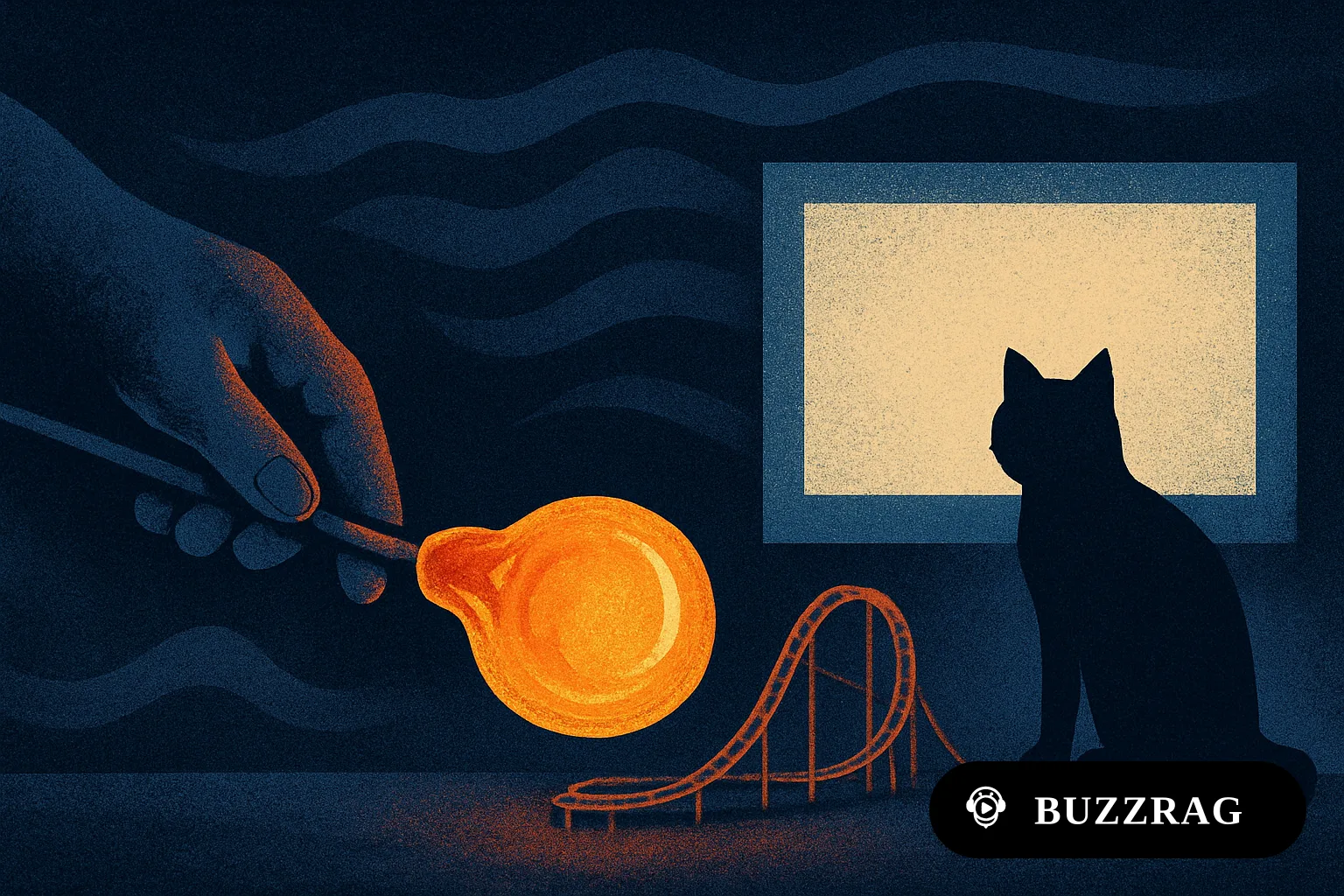
Chris Burton, the creator behind Half-Asleep Chris, has built an enormous online audience with videos of cats, elaborate contraptions and theme-park-style rides, including a rollercoaster sent into space. A profile visits the suburban home where the work takes shape and foregrounds a more personal change: Bella, the cat who became a familiar presence in his videos, recently died at 17. The story links the scale of internet fame to the intimate routines and attachments behind it.
Its headline also points to Burton’s frustration that “immoral videos” can succeed online, raising a question larger than one channel: what does a platform reward, and what does it make creators feel they must compete with? That tension sits beside the ingenuity of building playful spectacle at home and turning it into a shared experience for millions. Bella’s presence—and absence—makes the creator-audience relationship feel less abstract, reminding viewers that viral entertainment is made by people whose lives continue beyond the feed.
A Damascus glassmaker makes time visible
In Damascus, a Syrian glassmaker works through scorching temperatures to shape glass by hand. The report focuses not only on the finished wares but on the reporter’s experience of watching the process: a reminder to slow down and inhabit the moment. In a news cycle that tends to present Syria through crisis and abstraction, the account makes room for a specific act of craft, carried out in a particular city under difficult conditions.
Glassmaking demands patience, heat and attention; its pace offers a counterpoint to the speed with which images and headlines pass across a screen. That doesn’t erase the pressures surrounding daily life in Damascus, and the brief account does not pretend a craft can stand in for the country’s complexity. Instead, it shows how cultural life persists through skilled work and ordinary human concentration. The glassmaker’s practice becomes a way to notice both material resilience and the value of looking carefully at lives that breaking-news coverage can flatten.
A Gaza documentary tops Italy’s box office
NAZA, a documentary about the killing of Palestinian civilians in Gaza, has opened at No. 1 at the Italian box office, ahead of Avengers: Endgame – Encore, according to the report. The Guardian-produced film has extended its run after sold-out screenings, giving an urgent work of documentary journalism a rare position in a commercial landscape usually dominated by familiar entertainment properties. The result is notable not just as a ranking but as a measure of audiences choosing to gather around difficult subject matter.
A box-office placement cannot tell us what every viewer takes away, and it does not settle the arguments surrounding the film or the conflict it documents. But a successful theatrical run creates space for testimony and reporting to reach people beyond the already-convinced, at a moment when images of Gaza are also encountered through feeds, fragments and competing claims. The contrast with a major franchise rerelease is striking without making the films equivalent: one is built on spectacle, the other on witnessing. The continued screenings will show whether this opening translates into a sustained public conversation.
Mogwai and Iggy Pop head “Underground”
Mogwai and Iggy Pop have joined forces on a new track, “Underground,” a meeting between a Scottish band known for expansive instrumental rock and one of punk’s most unmistakable voices. The collaboration has drawn attention across music outlets, suggesting the pairing is more than a novelty crossover. Even before hearing how the track handles the contrast, its premise brings together two different ideas of intensity: atmosphere built over time and a performer whose presence has long been associated with raw immediacy.
Collaborations across generations can flatten into a roll call of reputations, but they can also create productive friction when neither side simply serves as decoration. Here, the interest lies in how Pop’s vocal character meets Mogwai’s capacity for scale and tension, and whether the arrangement gives both room to push against expectation. “Underground” also arrives in a moment when rock’s older histories are continually being reworked rather than sealed off as heritage. The track’s reception will turn on the music itself—on whether this unusual pairing finds a shared pulse rather than merely an impressive guest list.
Vanishing Twin’s “Archives” earns album-of-the-week notice
Vanishing Twin’s Archives has been named Album of the Week, putting the group’s latest record in the spotlight. The available listing gives little detail about the album’s sound or its making, so the designation is best read as an invitation to listen rather than a verdict we can reconstruct from a headline. Still, an album-of-the-week feature offers a useful pause in a music culture that often privileges singles, instant reactions and the churn of release-day coverage.
The word “Archives” carries its own suggestion of collected traces and recovered material, though the title alone cannot tell us how the record uses that idea. What matters editorially is the attention the feature grants to an album as a complete work—to sequencing, atmosphere and the meanings that may emerge across repeated listens. For listeners, that creates a small counterweight to the scroll: a reason to spend time with a record rather than extract one hook and move on. The next measure is how the album’s details hold up beyond the distinction and in the ears of its audience.
The through-line today is attention: to political memory, handmade skill, the ethics of online success and the testimony a documentary carries into a theater. Watch what audiences choose to spend time with next—and whether these works can keep their complexity intact as they travel.