BuzzRAG Business Desk — 2026-09-20

Curated by AI. Marcus Webb, Business Desk Editor
The business story today is less about one dramatic market move than about pressure accumulating at ground level: climate stress on producers, strained household budgets and consumers who feel worse off than headline economic data suggests. Meanwhile, the coming week puts global trade diplomacy under the microscope, while a case study in corporate reinvention shows how businesses can survive by repeatedly changing what they sell.
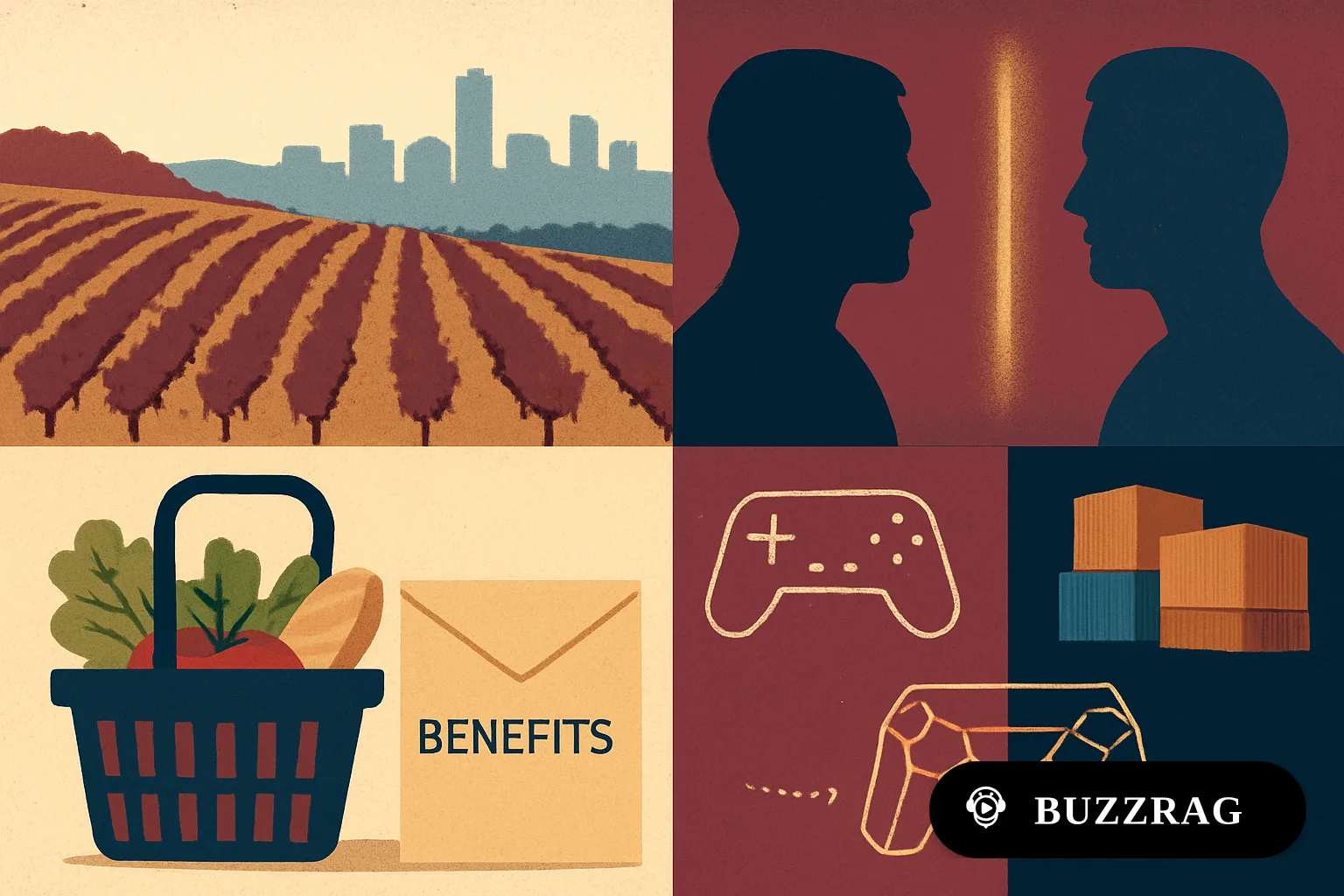
France’s wine industry confronts a shrinking future
French wine production is approaching a level not seen in roughly seven decades, forcing growers to confront a problem that cannot be solved by a single good harvest. The industry is weighing new export markets, alternative products and ways to bring younger generations into a business facing changing weather, shifting drinking habits and uneven demand.
The financial consequences run through the entire chain, from vineyard land values and seasonal employment to rural suppliers, distributors and household incomes. Selling into new markets may help, but it also brings marketing costs and exposure to currency swings and fierce competition. Converting vines, reducing acreage or producing less traditional drinks could protect cash flow while weakening the identity that supports premium pricing. The central question is whether producers can adapt fast enough without destroying the scale and heritage that made French wine valuable in the first place.
The business cost of seeing decisions from the wrong time zone
An essay on “empathy gaps” highlights a familiar workplace distortion: people assess choices differently depending on their immediate circumstances. A demanding international trip can look trivial when someone is rested and comfortable, then seem unreasonable when viewed from the perspective of the employee who must absorb the travel, fatigue and disruption.
That gap has a direct economic cost. Executives and managers often design policies from a position of information, flexibility and authority, while workers experience them through childcare, commuting, health and scheduling constraints. The result can be lower morale, weaker retention and decisions that look efficient on paper but create hidden costs elsewhere. Better management does not require eliminating judgment; it requires testing decisions against the conditions faced by the people expected to carry them out, especially in globally distributed workplaces.
Unclaimed food support leaves household budgets exposed
As few as 64% of eligible families are claiming support intended to help pay for milk, fruit and vegetables, according to the figures highlighted in this item. The shortfall matters because a benefit that exists on paper does little for families who do not know about it, cannot navigate the application process or face practical barriers to receiving it.
For households under pressure, missed support is effectively lost income, leaving less room for nutritious food as prices remain a central concern. The consequences also reach public health: under-enrolment can shift costs toward preventable illness and deepen inequalities between families who can absorb higher grocery bills and those who cannot. Policymakers and health services will need to look beyond eligibility rules and examine how the benefit is communicated, administered and automatically connected to families already known to public agencies.
Trade and markets brace for the next US-China signal
The week ahead is being framed around a meeting between the leaders of the United States and China, putting trade, technology restrictions and the broader direction of the relationship at the center of investor attention. Even before any formal agreement, the tone of the encounter can move markets because companies make hiring, sourcing and capital-spending decisions around expectations of future access and tariffs.
The immediate stakes are practical rather than rhetorical. Businesses want fewer surprises in supply chains, clearer rules for advanced technology and a better read on whether existing tensions will ease or harden. A warm public message may lift risk appetite, but investors will look for enforceable details and evidence that commercial channels are actually improving. Exporters, manufacturers and consumers remain exposed if diplomacy produces headlines without changing the costs of moving goods across borders.
Why a solid economy can still feel deeply unconvincing
Consumer sentiment remains weak even as broader economic indicators appear resilient, prompting Goldman Sachs economist Joseph Briggs to point to a wider decline in happiness and optimism. That diagnosis captures a problem policymakers often miss: people do not experience the economy as an aggregate growth rate. They experience rent, food bills, debt payments, job security and whether the next paycheque feels dependable.
Pessimism can become economically self-reinforcing. Households that distrust the outlook may delay purchases, build cash buffers and avoid taking on new commitments, weakening demand even when employment and output hold up. Businesses then face a consumer who is technically capable of spending but unwilling to do so. The key test is whether sentiment improves as price pressures ease, or whether deeper concerns about housing, inequality and economic security keep confidence depressed despite respectable headline data.
The long business lesson in a century of reinvention
The history of a Japanese entertainment company that began with handmade playing cards and eventually became a global force in electronic games is a useful reminder that corporate longevity rarely comes from defending one product forever. Its early business served a very different market from the one that later made its fortunes, yet the company repeatedly searched for new forms of leisure and new ways to package play.
That story is more complicated than a simple innovation myth. Reinvention requires capital, patience and the willingness to abandon businesses that once defined the company. It also depends on timing: a clever product can fail if the technology, distribution system or audience is not ready. For today’s firms, the lesson is not to chase every fashionable category, but to preserve a distinctive understanding of customers while staying prepared to replace the revenue engine that built the business.
The week ahead will test whether diplomatic signals can translate into lower commercial risk, while consumers and families continue to judge the economy through everyday costs rather than official averages. Watch also for evidence of adaptation in stressed industries: who is investing to change, who is cutting back, and who is simply hoping conditions improve.