Who Really Owns the AI Agent Implementation Layer?
AI agents are creating a trillion-dollar implementation battleground. Here's why frontier labs, PE firms, consultancies, and SaaS giants are all converging on the same turf.

Written by AI. Marcus Chen-Ramirez
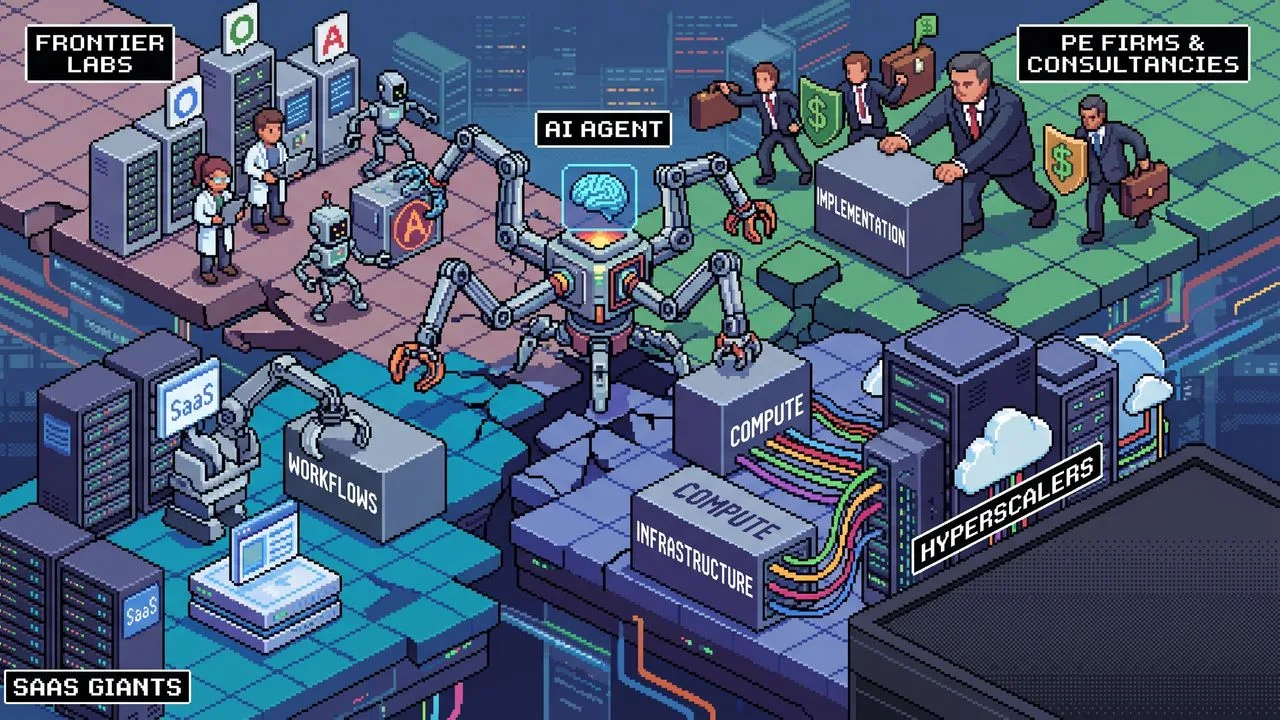
Photo: AI. Cosmo Vega
There's a saying in private equity that SaaS companies all taste like chicken. Uniform growth curves, predictable margins, easy to underwrite. For about a decade, that was a compliment.
It isn't anymore.
AI strategy analyst Nate B. Jones laid out the mechanics of what's happening to that world in a recent video, and the argument is worth sitting with carefully—not because it's complete, but because it maps a real collision that most enterprise AI coverage is still missing.
The common framing is that the AI race is a model quality contest: OpenAI versus Anthropic, benchmark versus benchmark, GPT-whatever versus Claude-whatever. Jones argues that framing is increasingly beside the point. The actual battleground is the implementation layer—the unglamorous stack of workflow design, data permissions, authority scopes, evaluation frameworks, and audit trails that determine whether an AI agent actually does useful work inside a company. That's where the money is, and that's what everyone is suddenly racing to own.
Four Pressures, One Chokepoint
Jones identifies four converging forces creating what he calls a "squeeze" on generic enterprise AI wrappers, and the framing is clarifying even if you'd quibble with some of the conclusions.
Frontier labs moving down the stack. OpenAI and Anthropic used to ship models and let the ecosystem build around them. That's changing fast. Anthropic launched a deployment company backed by Blackstone, Hellman & Friedman, and Goldman Sachs—reportedly $1.5 billion in capital. OpenAI is pursuing something similar, valued near $10 billion. Both companies are hiring the kind of forward-deployed engineers who will sit inside client companies and get their hands dirty. Jones reads their product launch notes and hiring lists as a public signal of where the labs think AI agents can reliably deliver value—a cheat sheet, as he puts it, for the rest of the market.
Consultancies moving up the stack. McKinsey, BCG, Accenture, Capgemini—all are inside OpenAI's Frontier Alliance program. PwC is collaborating with OpenAI on something called the "office of the CFO." These firms aren't doing change management anymore, or not only that. They're building actual agentic practices, training engineers on production deployment, and leveraging decades of C-suite relationships to land in accounts that startups have no realistic path into. As Jones puts it, "they are coming for agentic workflows that they think are held by the decision makers whom they have existing relationships with." For any AI startup with enterprise ambitions, that's a meaningful threat.
Systems of record closing the gap. Salesforce, ServiceNow, Workday, SAP—all have opened APIs and agent frameworks that make it easier to keep agents operating within their ecosystems rather than through a third-party intermediary. SAP's acquisition of Dreamio, paired with Prior Labs, is a governed-data play that effectively cuts out any startup sitting between their data and a customer's agent. The message from these platforms is increasingly: call us directly, with our permissions, on our audit trail.
Private equity as a distribution channel. This is the most underreported angle. PE firms own and influence thousands of mid-market companies—heavy in finance, ops, support, procurement, compliance. They're already squeezed on their SaaS-heavy portfolios. And they have an obvious structural play: standardize one AI deployment partner across an entire portfolio, compare results, iterate fast. That's a fundamentally different distribution shape than the one-to-one enterprise sales motion most AI startups are running. As Jones notes, a PE firm that can deploy a single vendor across 50 portfolio companies doesn't need to be convinced by a pitch deck—they need a partner that can operate at portfolio scale.
The Part That Doesn't Get Said Enough
What Jones is pointing at, beneath the strategic framing, is a question about where durable value actually lives in an AI deployment. His answer: not the model. Not, primarily, the data. In the harness—the implementation layer that wraps the model and tells it what decisions it's allowed to make, which records are authoritative, what it can commit to spending, and how failures get reconstructed and reversed.
He's specific about the components, and the specificity is useful. Workflow design is a defined process where every step has an owner, an input, and an output—not a prompt. Data access is a governance question about which sources are live versus stale, and what permissions apply at the field level. Authority determines the agent's risk profile: reading data is one thing; writing to systems, triggering spend, or executing commitments is categorically different. Evals aren't benchmarks—they're the scoring system for whether a model's outputs comply with specific business rules. And audit trails determine whether a failure can be reconstructed, and by whom.
"When the company shipping the model tells you the bottleneck isn't their model, it's the whole implementation layer," Jones says, "we got to be taking notes." He's referencing OpenAI's own Frontier Alliances post, which argued that the enterprise AI bottleneck is how agents are built and operated inside companies. It's a notable thing to admit when you're the one selling the model.
This framing has real explanatory power. It accounts for why enterprises that have been running Microsoft Copilot for two years still can't point to a workflow that runs end-to-end without human intervention. The model was never the problem. The problem was everything around it.
What's Worth Questioning
Jones is bullish in a way that's probably appropriate given his audience—builders and strategists who need a framework to act on. But there are tensions in the argument worth surfacing.
The claim that "getting to 100% on an entire workflow is a 2026 spring phenomenon" is doing a lot of work. Agents have been getting better, yes. But "reliable, at scale, and repeatable" is a high bar for many enterprise environments, especially regulated industries where the audit trail and authority components are legally load-bearing. The gap between impressive demos and production-grade deployment in, say, financial services or healthcare is still wide.
There's also something a bit circular in the private equity thesis. PE firms are motivated to create AI upgrade stories for portfolio companies they need to sell. That's a real incentive—but it's also a description of a market creating its own demand signal. When the people who need AI to be real are also funding the deployment companies, the enthusiasm for "trillions of dollars" in workflow value should at least be held with one eyebrow raised.
And the consultancy threat to startups, while real, has historical precedent worth noting. Large consultancies have been "moving up the stack" into product territory for fifteen years, and they remain structurally better at landing accounts than actually operating software in production. Their advantage is relationships. Their disadvantage is speed and technical depth. Whether this time is different depends on whether the agentic workflow problem is more of a delivery problem or a relationships problem. The jury is genuinely out.
The Question No One Has Answered
None of the four forces Jones describes has actually won. Frontier labs have capital and model quality but are structurally not equipped for the messy, bespoke work of enterprise deployment. Consultancies have relationships but historically poor track records on technical execution at speed. Systems of record have the data and the relationships but limited incentive to build truly open ecosystems. PE has distribution but needs partners to actually deliver.
What's missing from the landscape Jones describes is a category of company that owns the full implementation layer: workflow design through audit trail, with the technical depth to wire into existing systems and the business acumen to survive inside enterprise procurement. Jones's argument implies that whoever builds that—or assembles it through the PE partnership model he describes—captures a disproportionate share of the value.
Maybe. But it's also possible that the implementation layer stays fragmented for years, with different specialists owning different components, and the "winner" turns out to be whoever can orchestrate across them rather than own them outright.
The trillion-dollar number gets thrown around a lot. What's clearer is that the chokepoint has shifted—from which model you use to whether anyone can actually make it work inside your company. That shift is real, and it changes what questions are worth asking when an AI vendor walks in the door.
More Like This
Why Most Companies Are Using AI Wrong (And How Winners Do It)
75% of AI's economic gains go to just 20% of companies. Here's what the winners understand that everyone else is missing about organizational AI.

Claude's Chrome Extension Turns Busywork Into Autopilot
Anthropic's Claude extension for Chrome can negotiate with customer service, triage email, and extract data across tabs—but the real trick is scheduling it all.
Why Perplexity's $200 AI Tool May Already Be Obsolete
Perplexity Computer showcases brilliant execution on a fragile foundation. As hyperscalers consolidate the AI stack, middleware companies face extinction.

The McKinsey AI Hack Was a Procurement Failure
A $20 autonomous agent breached McKinsey's Lily platform. The real story isn't the SQL injection—it's how enterprise AI buying is structurally broken.

How Andrew Wilkinson Runs Businesses With AI Agents
Andrew Wilkinson replaced headcount with a $40K/month Claude bill. Here's the real stack—and the honest limits—behind his AI-run businesses.
AI Agents Are Building Their Own Social Networks Now
OpenClaw gives AI agents shell access to 150,000+ computers. They're forming communities, religions, and social networks—without corporate oversight.

Hugging Face ML Intern Automates AI Development
Hugging Face's ml-intern is an open-source agent that automates the full ML research loop. Here's what it does, what it can't, and what it signals.

Small Language Models Are Reshaping Agentic AI
Small language models are outperforming larger rivals on key AI agent benchmarks. Here's what the efficiency shift means for how AI gets built and deployed.