Trump's AI Rebrand Collides With Policy and Science
Trump wants AI called “super intelligence” while rejecting global rules. The name could blur procurement rules and an established research term in Washington.
Written by AI. Samira Barnes
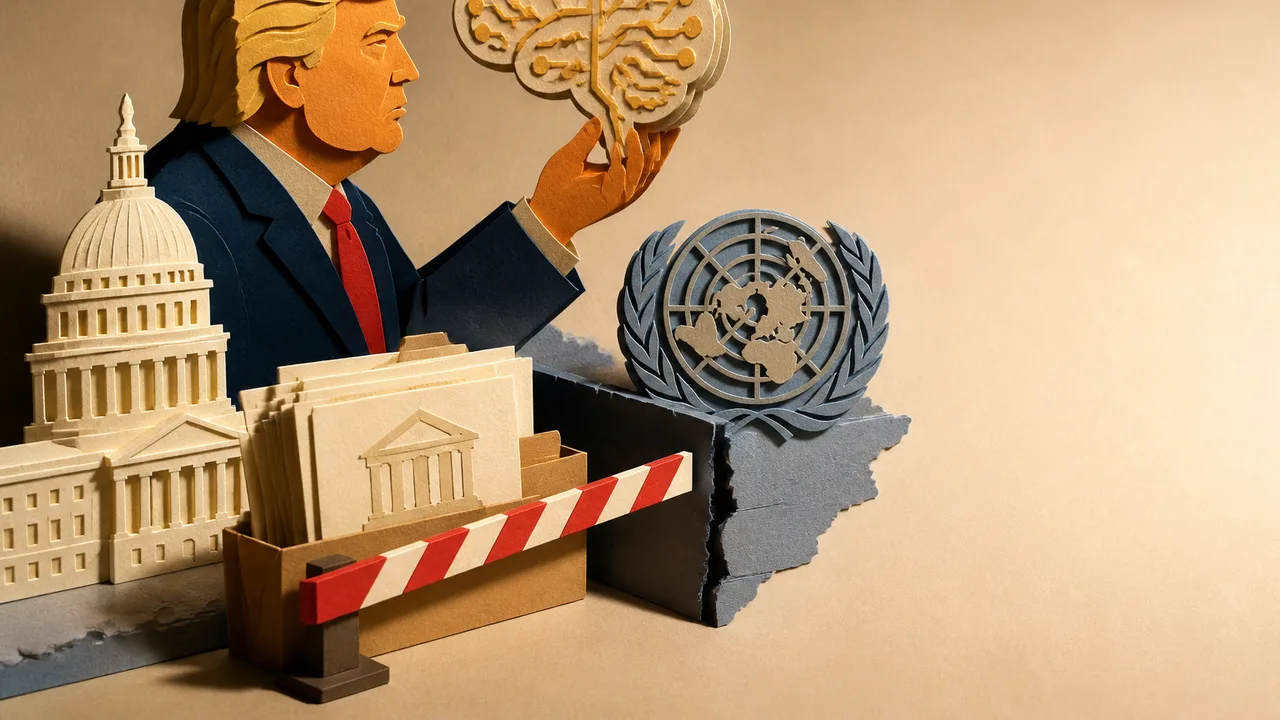
President Donald Trump used his September 22 address to the United Nations General Assembly to reject international AI controls and declare that artificial intelligence should become “super intelligence.” The two moves belong together. One changes the label; the other tells governments what Washington plans to do about the technology behind it.
“The United States ... totally rejects any attempt to construct a globalist scheme to control” AI, Trump said, as Scientific American reported. He argued that “artificial” makes the technology sound fake, welcomed the UN to “the new world of super intelligence” and predicted that the sector would become bigger than the Industrial Revolution.
The speech supplies a clear governing argument. Trump sees AI development as a contest in which restraint could surrender an advantage to China. “Whoever wins AI, wins,” he said, while promising that federal law enforcement could “rein things in” if necessary. In that model, companies receive room to accelerate and the Justice Department acts after conduct crosses an existing legal boundary.
That is a recognizable policy choice, although the speech left its machinery undescribed. Antitrust, fraud, discrimination and consumer-protection laws can reach some uses of AI. They do not automatically provide model evaluations, incident-reporting rules or common international safety standards. Trump may later propose those mechanisms, but no such framework accompanied his UN declaration.
The New Name Was Already Occupied
AI is an umbrella term for systems that perform tasks associated with human intelligence. “Superintelligence” has a narrower place in research: a hypothetical system whose abilities exceed human performance across a broad range of domains. The concept is often associated with philosopher Nick Bostrom’s 2014 book Superintelligence, which defined it as an intellect greatly exceeding human cognitive performance in virtually every domain of interest.
Current AI products do not meet that definition. Simon Coghlan, a digital ethics lecturer at the University of Melbourne, told the BBC that Trump’s term exaggerates present capabilities. Computer scientist Kokil Jaidka said it “borrows the prestige of a term researchers reserve for a much bigger leap.” National University of Singapore lecturer Ben Leong expected professionals to preserve “SI” for a higher level of AI.
That collision creates more than an argument among terminologists. Calling every chatbot, recommendation system and image generator “super intelligence” places ordinary software and a hypothetical human-surpassing system inside the same verbal box. A procurement officer reading “super intelligence services” would need to determine whether the phrase covers common machine-learning tools, frontier models or both. A grant recipient could face the same question. Compliance language becomes harder to follow when Washington and researchers use one phrase for different categories.
The effects remain prospective. CNET found no official order compelling agencies to replace AI with SI, and the White House referred its inquiry back to the speech. Trump himself acknowledged the uncertainty at the UN: “Let’s see if I have any power. Maybe I do and maybe I don’t.” Until an executive order, agency directive or revised rule appears, the declaration carries rhetorical force rather than a settled government-wide definition.
That limitation also identifies what readers should watch. A slogan acquires administrative consequences when agencies insert it into contracts, grant notices, regulations and technical guidance. TechRepublic noted that conflicting terminology could complicate procurement and compliance while companies and international organizations continue using AI. If agencies merely replace the letters without changing definitions, the result may be bureaucratic duplication. If they rewrite definitions, the change could alter which systems receive oversight or qualify for federal programs.
A Rename with Precedents, and Limits
Trump has used federal naming power before. A January 2025 executive order directed agencies to call the Gulf of Mexico the Gulf of America in official documents. His administration subsequently designated Lake Ontario as Lake America. Apple and Google adopted preferred geographic names on their maps, according to Gizmodo’s account of the earlier changes, while “Lake America” has seen less general uptake.
Those cases show how a presidential rename can spread when the federal government controls its own documents and large platforms modify a prominent interface. They also expose the limit of the comparison. A map provider can swap a geographic label without redefining the water. AI terminology sits inside research papers, corporate standards, contracts and policy regimes across many countries. “Superintelligence” also had an established technical meaning before Trump claimed it for current products. Washington can control federal vocabulary more readily than it can make laboratories, companies and foreign governments surrender theirs.
The rebrand followed several online polls rather than a formal definitions process. On September 19, Trump asked users to choose among “superior,” “extreme” and “supreme” intelligence. Later rounds eventually offered “super intelligence,” which won a September 21 Truth Social vote by 65% to 35%. Polling followers can test political appeal. It cannot resolve how a term operates in regulations or computer science.
Climate Policy Provides the Deeper Precedent
Trump linked AI critics to climate advocates, claiming they were “the very same people” who had issued failed warnings about global warming. Scientific American characterized his climate framing as false. It also documented the policy history behind the analogy: Trump has twice withdrawn the United States from the Paris Agreement, while his second administration has rolled back emissions regulations, eliminated climate programs and reduced research funding.
The comparison therefore performs a political function. It portrays warnings about large, uncertain harms as products of a discredited constituency, then casts regulation as an obstacle to American growth. The inference follows from Trump’s own pairing of climate policy with AI controls and from his administration’s record of converting climate skepticism into deregulation. Climate change and AI present different evidence, harms and regulatory tools, so the comparison cannot establish that AI policy will follow every feature of the climate playbook.
Trump also said AI is “amazing” but requires care. His proposed balance places most preventive restraint outside the federal program he described, with the Justice Department and other law-enforcement bodies available as a backstop. That approach could reduce compliance burdens and allow faster deployment, as supporters of acceleration seek. It also makes intervention depend heavily on existing statutes and on harms that agencies can identify after deployment.
Leaders including OpenAI’s Sam Altman and Anthropic’s Dario Amodei have called for greater regulation or pacing, Scientific American reported. Their support does not settle which rules would work, and companies have commercial incentives in how regulation treats incumbents and competitors. It does show that the debate cannot be reduced to government skeptics confronting an industry unanimously demanding freedom.
For now, “super intelligence” is a presidential preference attached to a deregulatory signal, rather than an operative federal category. The decisive documents will be less memorable than the UN line: the first solicitation, grant rule or agency definition that has to explain whether SI means today’s AI, tomorrow’s hypothetical system, or whatever a contracting officer decides it means that morning.
More Like This
Why the Proposed AI Slowdown Is Losing Its Coalition
Jensen Huang, Donald Trump and an antitrust lawsuit are squeezing the AI slowdown from different sides, exposing a policy coalition without machinery.
Anthropic's AI Evaluator Tests Claims of Independence
Anthropic and Accenture are building an embedded AI safety regime, but undefined access, reporting and funding rules complicate its independence.
Kratsios on U.S. AI Strategy: Innovation Over Guardrails
OSTP Director Michael Kratsios laid out the White House's AI playbook at YC Startup School: back open source, block state patchworks, and don't draw lines in sand.
Trump's AI Force Has Yet to Gain a Legal Structure
Trump proposed an AI Force and czar, but questions remain about its legal basis, authority, staffing, and light-touch approach to federal AI regulation.
AI Safety Pledges Meet the Limits of Self-Regulation
AI leaders say frontier models should slow while opposing binding oversight. Musk's stance, a rejected regulator plan and state action reveal the policy gap.
Lina Khan Wants Criminal Charges for AI Executives: The Debate
Former FTC chair Lina Khan says existing law can criminally charge AI CEOs. We dig into the 1934 precedent, the skeptics, and what happens next.

Sakana Fugu Is a Router, Not a Frontier Model
Sakana Fugu benchmarks against top AI models, but it's an orchestration layer, not a foundation model. Here's what that category gap costs developers.

AI Video's Realism Gap and the Workflow Layer Bet
Local AI video runs free on your machine. Frontier models win on realism. But the real question is who controls the workflow layer—and what that means legally.