Suno’s Licensed Music Model Faces a Copyright Test
UMG and Sony say Suno's licensed v6 carries unlicensed music into a new model. The case tests AI distillation, fair use, licensing and artist consent.
Written by AI. Marcus Chen-Ramirez
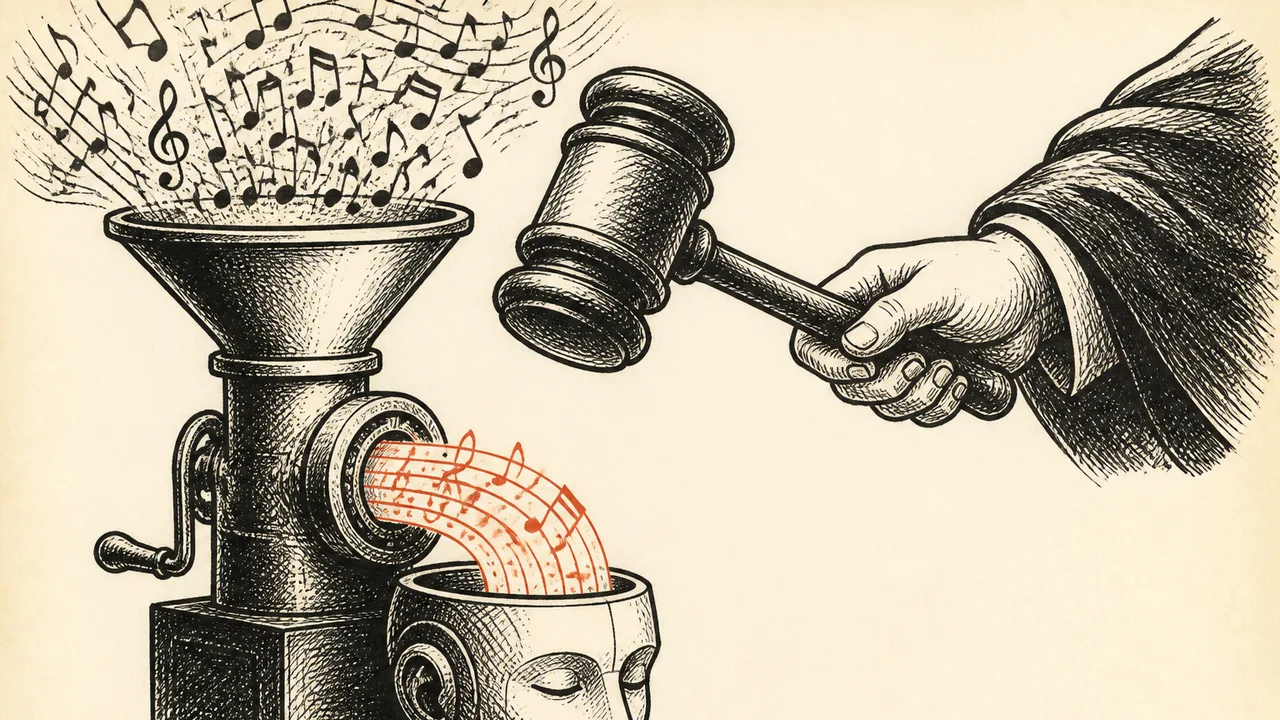
Universal Music Group and Sony Music sued Suno on September 18 over 60,202 sound recordings, nine days after the AI company launched its licensed v6 music models.
That timing turns the lawsuit into something larger than another argument over scraped training data. Suno presented v6 as a model built from scratch with licensed content from Warner Music Group, BMG and Believe. UMG and Sony answer that a new training run cannot erase what earlier models learned from recordings allegedly copied without permission.
The labels are advancing two connected arguments. First, they allege that Suno transferred capabilities from its earlier models into v6 through user feedback and a process called knowledge distillation. Second, they say Suno’s licensing agreements demonstrate that a market for training rights exists, undercutting its argument that earlier copying qualifies as fair use.
A court has not decided either issue. Suno calls the claims “fundamentally flawed on both the facts and the law,” and says v6 was trained on licensed partner content, community creations and preference signals, plus its team’s accumulated learning. Still, the case poses an awkward question for every AI company hoping that a licensed model can draw a clean line under an unlicensed past: How clean is the line if the new system learned from the old one?
How One Lawsuit Became Two
UMG, Sony and Warner first sued Suno in June 2024. That case identified 560 works and centered on whether training a music generator with copyrighted recordings can qualify as fair use. Suno has described such training as “quintessential fair use.”
Discovery expanded the fight. The labels say they used Audible Magic’s audio-fingerprinting technology to identify their recordings in Suno’s training data. Suno also acknowledged in a September 1 filing that it had obtained audio from YouTube with YT-DLP, a tool capable of downloading media from the platform, according to Music Business Worldwide’s account of the complaint.
The labels asked to add 61,026 recordings to the original case. On August 18, Judge F. Dennis Saylor IV rejected that request because the expansion would disrupt the schedule, while noting that the labels could pursue the works separately. The new District of Massachusetts case, numbered 1:26-cv-14275, asserts 60,202 recordings. The available accounts do not explain the difference of 824 works, so the two figures should not be treated as interchangeable.
The procedural history matters because the second suit did not appear solely in response to v6. The court’s scheduling decision created the parallel case, while v6 supplied a fresh target and a new theory about how information moves between generations of AI models.
The Student Model and the Allegedly Compromised Teacher
Knowledge distillation sounds like something performed with copper tubing in a steampunk laboratory. In machine learning, the basic idea is less theatrical: a smaller or newer “student” model learns to reproduce the behavior of a “teacher” model. The student can learn from the teacher’s outputs rather than receiving every item from the teacher’s original training set.
Suno has said v6 was trained from scratch on data that excluded Universal and Sony recordings. The labels’ complaint accepts that framing only for the direct contents of the new training corpus. It alleges that prior Suno models still acted as teachers, passing along abilities acquired from unlicensed recordings. User preference data matters here because Suno generates two tracks for a prompt and can learn from which one a user selects.
The labels call that transfer “laundering.” Their theory, as summarized in reporting on the 45-page complaint, is that training on outputs from an infringing model preserves value derived from the original works, even when the student never receives those recordings directly.
That proposition remains untested in this case. A technical connection between models does not by itself resolve the legal questions of copying, protected expression or fair use. The labels will need to establish what v6 inherited, how it inherited it and why that process implicates their copyrights. Suno, meanwhile, has room to argue that preference signals and synthetic outputs are distinct from the recordings used to develop earlier systems.
The comparison with first-generation AI training disputes is useful and limited. Authors, newspapers, visual artists, movie studios and labels have sued AI developers over direct ingestion of protected works. Here, the additional question concerns inheritance: whether a model trained partly from another model’s behavior carries legal exposure forward. Courts may eventually distinguish between copying a work, learning from an output and transferring general capabilities. The complaint asks Judge Saylor to connect all three.
Licensing Becomes Evidence for the Plaintiffs
Suno’s deals may prove more immediately useful to UMG and Sony than the distillation argument. Warner settled its part of the first lawsuit and partnered with Suno in November 2025. BMG followed in August 2026, and Believe signed in September. Suno launched v6 on September 9.
Those agreements support a straightforward inference: companies are buying and selling permission to train music models. Suno previously argued that no established licensing market existed because nobody was paying for training data. UMG and Sony now say Suno has become “a repeat, paying participant” in that market, as Billboard reported from the complaint.
That does not automatically defeat fair use. Courts examine several factors, and a defendant can argue that later commercial agreements differ from whatever uses occurred earlier. Suno chief product officer Jack Brody has also said the revenue-sharing arrangements are “not in exchange for training” and are “not really about the data.” Contract language and the actual exchange between the parties will matter more than launch-day branding.
Even so, the deals complicate Suno’s market argument. The company can maintain that earlier training was lawful while purchasing rights for later products, perhaps to reduce litigation risk or gain access to better-organized catalogs. The labels can answer that companies do not need a mature market with standard prices before copyright law recognizes lost licensing opportunities. Suno’s agreements give that hypothetical market customers, suppliers and checks.
The complaint also alleges a second form of market harm: a flood of generated tracks competing for finite listener attention and royalty pools. It cites Deezer’s July report that AI music had exceeded half of daily uploads, about 90,000 tracks per day, and Suno’s statement to investors that users produce the equivalent of Spotify’s catalog every two weeks, according to The Next Web’s detailed account. Those numbers describe volume, rather than proving that a Suno track displaced any named recording. They nevertheless show why the labels are framing generation at scale as an economic issue rather than an abstract quarrel over data provenance.
A License Can Still Leave Artists Outside the Room
The emerging licensing market also raises a question the corporate lawsuit cannot answer by itself: who gets to consent, and who gets paid?
BMG says its arrangement uses an opt-in system. Celine Joshua, the company’s executive vice president of global marketing and streaming, told Billboard that artists and songwriters default to being excluded unless they choose to participate. Mötley Crüe manager Allen Kovac offered the permissive case, saying the band would opt in if it gets paid and that AI-generated competition need not dilute demand for the original act.
Other representatives remain skeptical. Attorney Dina LaPolt said none of her clients would participate, while praising an opt-in structure over opt-out. Attorney Harold Papineau warned that some recording and publishing contracts may already give companies authority to license music for AI training, leaving less powerful artists with fewer choices. Another unresolved issue is how much revenue reaches writers and performers after rightsholders make platform-level deals. Billboard’s interviews with artist representatives found no public answer in the announced agreements.
That division prevents a tidy labels-versus-tech story. Warner moved from plaintiff to Suno partner. BMG endorses consent-based participation. UMG and Sony continue to litigate. Artists may support licensing, reject it or discover that old contracts made the decision for them.
The complaint seeks up to $150,000 per work for willful infringement, producing a theoretical ceiling just above $9 billion across 60,202 recordings. It also seeks up to $2,500 for each alleged circumvention of YouTube’s download protections, plus an injunction. Those figures are statutory maxima, not a forecast of what a court or jury would award.
The more consequential remedy may be a rule for model ancestry. Forward-looking licenses can govern what enters v6 directly. They cannot settle, by contract alone, whether knowledge carried from an earlier model remains legally attached to the recordings that helped create it. If courts accept that inheritance theory, AI companies will need to audit the family tree, not merely polish the newest branch.
More Like This

Suno v6 Tests Whether Licensed Training Data Changes the Deal
Suno's v6 model is the first built with Warner and BMG licensed data. What the undisclosed deal covers, what it leaves open, and what artists should watch next.
Cross-Entropy and the Math Behind LLM Training
Grant Sanderson's 3Blue1Brown video explains cross-entropy loss and why the logarithm in LLM training isn't a design choice — it's the only mathematically valid option.

AI Voice Cloning and the Accountability Gap
Voice cloning already passes in casual listening. The harder question isn't whether AI was used—it's who's accountable for what gets said with it.

AI Agents in Production: What Actually Works
IBM's Shailaja Patel-Pranav breaks down why AI agents fail in production—and the coordination patterns that make them actually reliable in enterprise workflows.