Rural America's Revolt Against AI Data Centers
Bipartisan opposition to AI data centers is reshaping local politics across America. From Utah to Georgia, communities are fighting back over water, power, and broken promises.

Written by AI. Marcus Chen-Ramirez
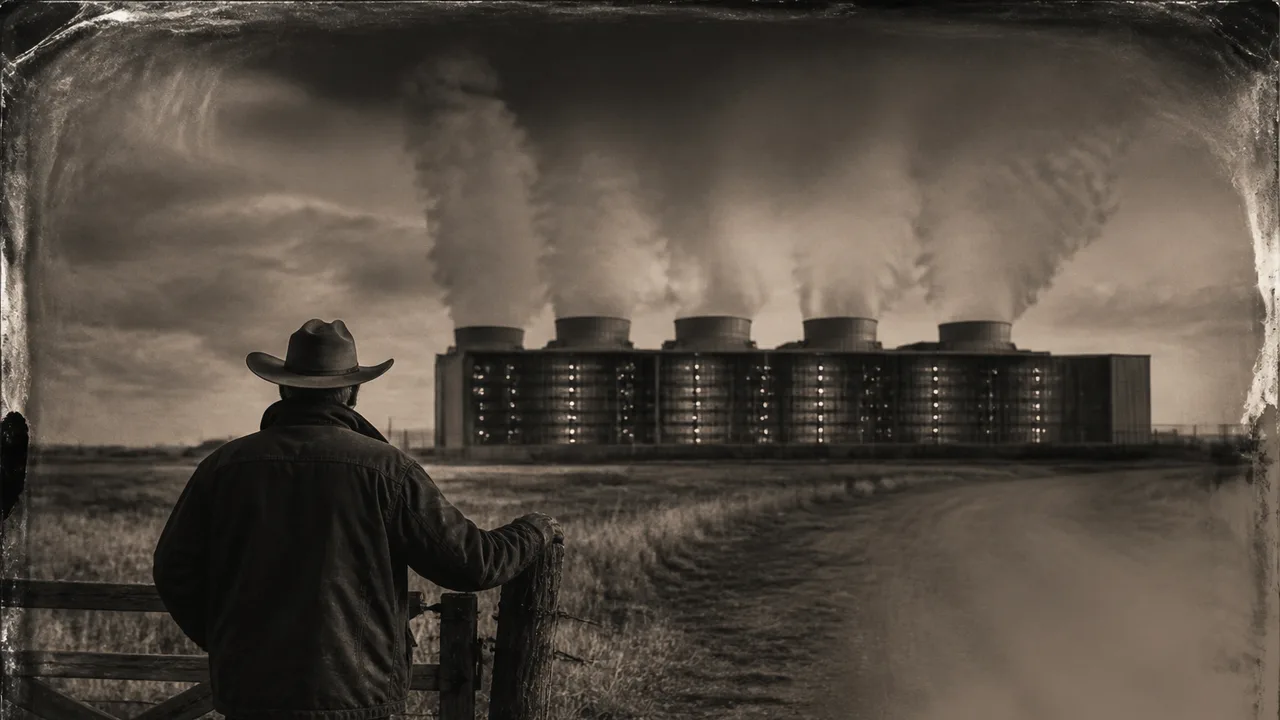
Photo: AI. Otieno Okello
Picture this: county commissioners in Utah approve a data center campus stretching 62 square miles — more than twice the size of Manhattan — and then have to flee their own town hall meeting and reconvene online because the crowd won't let them speak. That's not a planning dispute. That's a signal.
The BBC Americast podcast recently dug into what energy journalist Robert Bryce calls an "unprecedented cultural backlash" against AI data centers in the United States. What makes the conversation worth pulling apart isn't the drama of angry townspeople, though there's plenty of that. It's the specific collision it reveals: an industry whose financial logic depends on building enormous things very fast, running into communities that have concrete, immediate reasons to say no.
The Numbers That Don't Add Up Locally
Start with the jobs question, because it's where the disconnect is sharpest.
Kevin Olirri, the venture capitalist behind the Utah project, told Tucker Carlson the campus would create 2,000 permanent jobs and 10,000 construction positions. Carlson — not a figure typically associated with skepticism toward corporate America — pressed back: a facility projected to consume roughly as much energy as New York City, delivering 2,000 jobs, versus New York City's nearly five million. Olirri's response was to zoom out: AI infrastructure creates millions of jobs across the entire economy, even if the data center itself employs relatively few.
He may not be wrong about the macro picture. But the Brookings Institution studied data center impacts specifically and found something more modest: counties with data centers see total private employment rise about 4–5% over five to six years, wages tick up 3–4%, and home values... don't move much. That's not nothing. It's also not the transformative economic engine that gets dangled in front of communities when these projects are pitched.
The asymmetry here is the core problem for the industry. The benefits of AI infrastructure are distributed widely and realized slowly. The costs — degraded water quality, higher electricity bills, industrial noise, the visual intrusion of warehouse-sized buildings — are local and immediate. The people who might one day benefit from AI-assisted cancer research are, as the BBC discussion put it, "notional." The people showing up to town halls are not.
Water Is the Wedge Issue
Alexandria Ocasio-Cortez appeared at a congressional hearing holding up a jar of discolored water she said came from Morgan County, Georgia, after a Meta data center was built nearby. Residents' water bills were reportedly set to increase by 33%, and some had stopped being able to use tap water for drinking or cooking. You can debate the specific causal claims — and the industry does — but the image lands because it makes an abstract concern tangible.
Robert Bryce, who has spent years building what he calls the "renewable rejection database" tracking community opposition to wind and solar projects, recently launched a data center equivalent. The numbers are striking: nine documented rejections or restrictions in all of 2024, forty-nine in 2025, and already 107 so far in the current year. For context, he noted there are currently 769 data centers under construction across the US. The backlash isn't stopping the buildout. But it's clearly accelerating.
Bryce's framing of why this is happening is the most useful thing in the BBC discussion: "People can't fight big tech online. They can't fight Google online. But they can fight them at the local zoning board. And that's what they're doing."
That's a precise diagnosis. The grievances fueling this movement — algorithmic manipulation, privacy erosion, the concentration of wealth among a handful of tech oligarchs — don't have obvious political or legal remedies. But a proposed data center needs permits. It needs zoning approval. It needs county commissioners to show up to meetings. That's a pressure point.
The Bipartisan Texture of the Opposition
The most politically interesting thing about this backlash is who's involved. Opposition to large infrastructure projects from environmentalists and progressive activists is not news. What's newer is the conservative dimension.
Sam Altman, speaking at a Michigan data center announcement, promised the facility could become "the site where cancer gets cured" or where "hundreds of millions of students around the world learn." That's a significant rhetorical ask — accept the disruption now, trust the payoff later. It works better when the technology in question is broadly trusted. AI, at the moment, is not.
Conservative voters in rural areas tend to care about land rights, property values, clean water, and low utility bills. None of those interests align neatly with having a hyperscale computing campus land next door. A Republican voter in Texas told MSNBC she was prepared to vote for Democrats in the upcoming midterms specifically over the data center issue — to "let the Senate fall into the hands of Democrats if that's what it takes." Her framing: "My entire community is going to break rank. We've had enough."
One data point from one voter. But the concern inside Republican strategy circles appears to be that this sentiment is wider than one person. The BBC discussion noted that figures like Steve Bannon are worried that Republicans seen as too close to the tech industry building these facilities risk alienating working-class voters whose jobs are also being threatened by AI displacement. Florida Governor Ron DeSantis's office filed suit against OpenAI over claims the company's model was harming Florida citizens — a signal that even GOP politicians see political upside in positioning against Big Tech.
The Economic Trap
Here's the tension that doesn't resolve cleanly: the five largest US tech companies — Apple, Amazon, Google, Meta, and Microsoft — have a combined market capitalization exceeding $16 trillion. Their capital expenditures this year are projected at roughly $700 billion. They represent a commanding share of the S&P 500. When Bryce says "if these companies catch a cold, the entire US stock market goes into the hospital," he's not being hyperbolic.
Bernie Sanders has sponsored a Senate bill calling for an immediate moratorium on new data center construction. It has essentially no chance of passing with Democrats in the minority. But it's also a bill that, if it somehow did pass, would send shockwaves through the US economy well beyond the tech sector — through the construction firms, electrical suppliers, pipefitters, and concrete companies whose businesses are now deeply tied to the buildout.
That's the bind for any politician trying to harness the backlash: the anger is real and the grievances are legitimate, but the remedy that would actually satisfy the most frustrated communities would also be economically catastrophic. And the Trump administration's answer — an executive order leaning on AI companies to self-regulate and share models with the government — is the kind of solution that sounds responsive without constraining anything.
What the Industry Needs to Figure Out
Bryce's prescription is straightforward in theory and difficult in practice: address the water issue seriously, stop dismissing opposition as astroturf funded by foreign governments (the current line is that critics are backed by China, which he calls a "canard" that "simply doesn't account for the scale of the opposition"), and site projects where communities actually want them.
That last part is harder than it sounds. The economics of data centers favor proximity to existing power infrastructure and fiber networks, not necessarily locations where the locals are enthusiastic. The Utah project got approved by county commissioners over public objection — which is how planning processes technically work, but which has also produced the spectacle of those same commissioners evacuating their own public meeting.
The industry is not losing the buildout war. But it is losing the narrative, and in the current political environment, that has consequences that extend beyond PR. When Eric Schmidt gets roundly booed at the University of Arizona, when a conservative Texas voter declares she'll switch parties over a data center, when a Pope issues an encyclical on AI — the signal is the same: the social license that Big Tech has operated on for the past two decades is eroding faster than anyone in the industry seems to have anticipated.
Whether that erosion translates into meaningful regulation, electoral realignment, or just a prolonged series of contentious zoning meetings is the open question. The zoning meetings are already happening. The rest remains to be seen.
Marcus Chen-Ramirez is a senior technology correspondent for Buzzrag covering AI, software development, and the intersection of technology and society.
More Like This

A Century of AI: The Data and Power Behind the Hype
A security correspondent's read on AI's 100-year history—tracing the hype cycles, data grabs, and privacy trade-offs that shaped the technology reshaping your life.
Why Your AI PC Build Exposes a Consumer Information Gap
A $1,200 AI PC challenge reveals how technical complexity leaves consumers vulnerable to poor purchasing decisions in an unregulated market.
Jack Dorsey Cut 40% of Block's Staff. Now What?
Block's massive layoffs sparked debate: Is AI really transforming work, or are CEOs just laundering bad management decisions? The answer matters.

Pentagon vs. Anthropic: The Fight Over AI Ethics
The Pentagon is threatening to designate Anthropic a supply chain risk after the AI company refused to remove safety guardrails from Claude.

Building Secure AI Agents With Bigtable and ADK
Google's Bora Beran demos a healthcare AI agent built on Bigtable and ADK—and the security layers that make it worth taking seriously.

OpenAI's Codex Is Growing Up Fast—And Getting Weird
OpenAI's latest Codex updates add browser control, AI-reviewed approvals, and... animated pets? A look at where AI coding tools are actually heading.

Loop Engineering: Moving Beyond One-Shot AI Prompting
From cron-job automations to multi-day autonomous goals, loop engineering is changing how developers interact with AI. Here's what that actually means.

A 4B Model Beat a 235B Model for Under $500
Snorkel's Kobie Crawford shows how a 4B parameter model outperformed Qwen 3 235B on financial analysis tasks using RL training that cost less than $500.