Running Parallel AI Coding Agents Without Chaos
Running multiple Claude Code sessions in parallel creates real coordination problems. Here's the infrastructure stack that actually prevents them from breaking each other.

Written by AI. Bob Reynolds
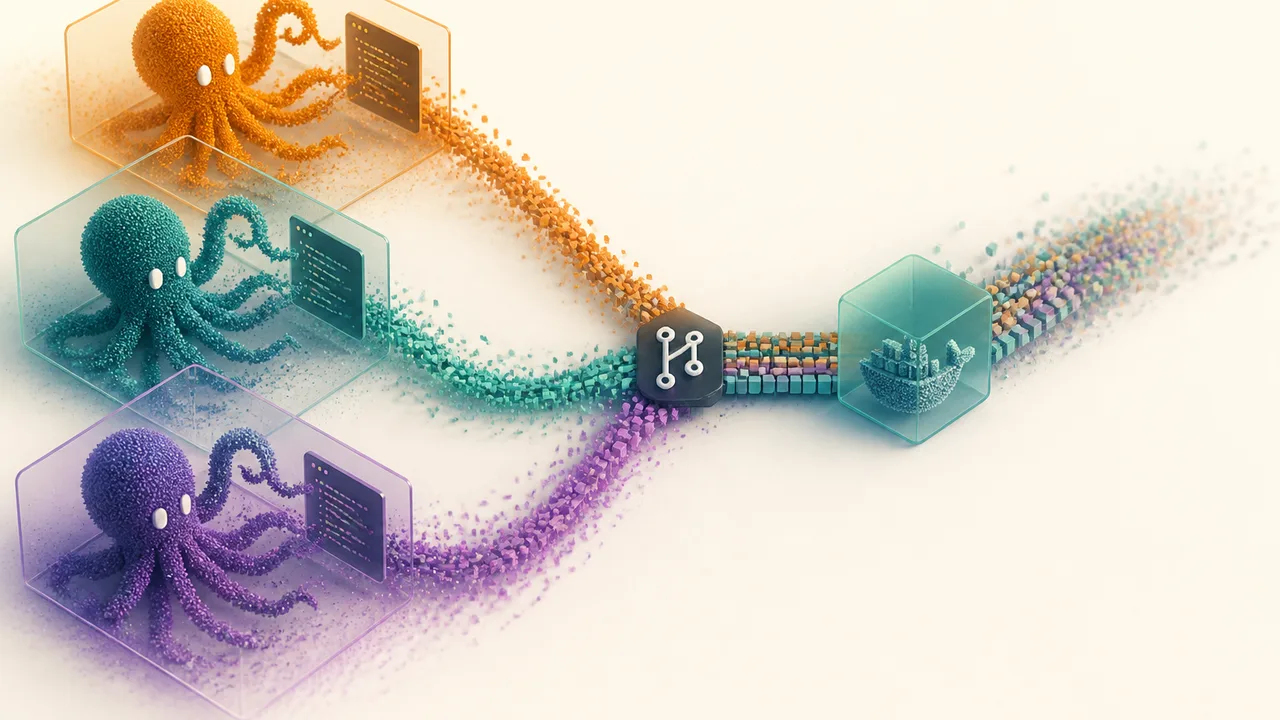
Photo: AI. Dexter Bloomfield
The coordination problem is as old as parallel computing. Distributed systems engineers have been managing analogous versions of it for thirty years — shared state, race conditions, conflicting writes, isolation failures. The coordination overhead never disappeared. It just moved to lower layers of the stack, got abstracted behind better tooling, and eventually became somebody else's problem until the next platform shift made it everybody's problem again.
We are now in one of those moments. AI coding agents have made it trivially easy to spin up multiple autonomous workers on the same codebase simultaneously. What the demos don't show you is what happens next: the sessions start fighting.
A recent walkthrough from the AI Labs channel maps this terrain with unusual specificity, and it's worth paying attention to — not because the solutions are revolutionary, but because the problems they're solving are genuinely structural, and the solutions draw on hard-won principles that predate the AI coding boom by decades.
The problems are real, and they compound
Start with something deceptively simple. Multiple Claude Code sessions running on the same project don't share live context. Each session reads the project's configuration files — the Claude.md instruction file, for instance — at startup, then works from that snapshot. If another session updates those files mid-run, the others don't know. They keep executing against stale assumptions.
That's just the context problem. Layer on top of it the file collision problem: sessions editing the same files will overwrite each other's changes, with no conflict resolution, because each session doesn't know the others exist. Then add the Git problem: multiple sessions pushing to branches simultaneously creates repository chaos. Then the localhost problem: every session wants port 3000, and they'll try to kill each other's servers to get it. Then the dependency problem: one session upgrading a package breaks every other session's build environment.
"The moment you run them in parallel," the AI Labs video explains, "you run into problems, and nothing looks wrong on the surface." That last part is the critical observation. The failure mode is silent. You only discover it when something is already broken.
This is, structurally, the same thing that happened when teams moved from single-threaded to multi-threaded programming. The computer appeared busy. The output appeared fine. The race condition was invisible until it wasn't.
The solution stack is layered, not monolithic
The AI Labs walkthrough presents its approach in two tiers: fixes for general session management, and fixes specific to software development. That distinction matters because conflating them leads to over-engineering solutions for problems you don't actually have.
At the general layer, Claude Code has built-in session persistence tools that solve the basic bookkeeping problem. The --continue flag resumes the last session; --resume lets you pick from a list. A recap command summarizes what a session was working on when you return to it. An export command converts a session's history to a portable file.
More interesting is the Handoff skill (available via Matt Pocock's skills repository on GitHub), which the video describes as a smarter version of export. Where export dumps the entire chat history into a file — carrying all the accumulated noise and detours — Handoff compresses the session into a clean document that points to relevant files by reference rather than copying their contents in. A new session bootstrapped from a Handoff document starts focused, not burdened. The distinction matters more than it sounds: bloated context degrades model performance, and the cleanup isn't cosmetic.
For monitoring, the Claude Agent Dashboard provides a terminal-based interface for watching background sessions in parallel. You can launch sessions with the --background flag, push a running session to the background with the bg command, and track progress across all of them from a single view. This is session management, not orchestration — the distinction the video is careful to maintain.
The development-specific layer is where it gets serious
Git worktrees are the linchpin. A Git worktree — a native Git feature, not an AI-specific tool — lets you check out multiple branches simultaneously into separate directories from a single repository. Each Claude session gets its own worktree: its own folder, its own branch, its own working copy. File collisions become structurally impossible, because each session is operating on physically separate files. Branch conflicts disappear for the same reason.
This is not a new idea. Worktrees have existed in Git since version 2.5, released in 2015. What's new is applying them as a coordination primitive for autonomous AI agents rather than human developers — and recognizing that the same isolation properties that made them useful for humans make them essential for agents that can't negotiate with each other the way humans can.
For automated dispatch — routing tasks to sessions without manual intervention — the video points to OpenAI's Symphony, an open-source orchestrator originally built for OpenAI's Codex agents. Per the project's GitHub repository, Symphony "turns project work into isolated, autonomous implementation runs, allowing teams to manage work instead of supervising coding." It tracks tasks through a project management layer, ensures tasks stay independent of each other, and manages the full cycle from assignment to pull request. A community fork adapts the same approach to work with Claude Code, running a background daemon that watches GitHub issues and launches sessions automatically when labeled tasks appear.
The honest observation here is that Symphony's core proposition — a task queue that dispatches work to isolated workers — is architecturally identical to what job queue systems have done in backend engineering for years. The novelty is that the workers are AI coding agents rather than application processes. The coordination patterns are not new. Their application to this context is.
Full environment isolation requires Docker sandboxing. Each session runs inside a dedicated micro-VM with a hard security boundary. When an agent installs packages or modifies build configurations, those changes stay contained inside the sandbox. The host system and other sessions are unaffected. Clone mode takes this further: the sandbox works against a copy of the project rather than the live files, so even within the sandbox, the original codebase is insulated from whatever the agent does.
This addresses the dependency problem that worktrees alone can't solve. Two sessions in separate worktrees still share the same Node modules directory, the same database, the same build cache. Sandboxes eliminate that shared layer entirely. It's the difference between logical isolation and physical isolation — and for serious engineering workflows, that distinction matters.
Who actually needs this?
Here's where I'll take a position the video doesn't: this stack is not for everyone, and the bar is higher than the framing suggests.
What the AI Labs walkthrough describes is, in aggregate, a fairly serious infrastructure operation. You're managing Git worktrees, running Docker sandboxes, configuring a Symphony daemon to watch GitHub issues, and maintaining Handoff documents across parallel sessions. That's real DevOps overhead. For a team already running containerized development environments and structured Git workflows, the marginal cost of adding this layer is low — they have the mental models and the tooling already in place.
For someone who just discovered Claude Code last month and wants to go faster, this stack will produce more problems than it solves. The failure mode isn't that the tools don't work; it's that you need to understand what each layer is protecting against before you can configure it correctly. Misconfigured isolation is often worse than no isolation, because it creates a false sense of safety.
The parallel task potential of Claude Code is real, and so is the risk of reaching for parallelism before the prerequisites are in place.
The right mental model isn't "set this up once and let it run." It's "design your task decomposition so sessions have nothing to fight over, then use isolation to enforce the contract." Plan Mode — asking a single Claude session to decompose a goal into genuinely independent subtasks before any parallel work begins — is the first step, and arguably the most important one. The tooling that follows is enforcement, not a substitute for thinking.
Coordination problems don't get solved by adding more infrastructure. They get solved by reducing the need to coordinate in the first place. The infrastructure makes that reduction durable. That's the lesson distributed systems engineers learned thirty years ago, and it's the same lesson the AI coding generation is working through now — on a faster timeline, with better marketing.
More Like This
Inside Anthropic's Daily Claude Code Workflow
The tools Anthropic's team actually uses in Claude Code—from open-source plugins to internal skills reverse-engineered from leaked source code.
Claude Code's Hidden Features That Change Everything
Boris Cherny reveals 15 underused Claude Code features that transform how developers work—from parallel sessions to remote dispatch.

Claude Code Workflow: Build Real Apps With AI Agents
Leon van Zyl's Claude Code workflow—parallel agents, automated security audits, reusable skills—raises real questions about how AI builds production apps safely.

How Theo Cut a $2,000 AI Coding Run Down to $150
Developer Theo shows how configuring Claude's Fable 5 as an AI orchestrator—not just a chatbot—cleared a month of backlog in three days for around $150.
Claude's Agent Teams Let AI Coders Actually Talk to Each Other
Anthropic's new Agent Teams feature lets multiple Claude AI instances communicate directly, cutting code review time from 10 minutes to 2-3. Here's what changes.
Cursor's Dynamic Context: A Game Changer for Coders
Explore Cursor's new dynamic context features transforming AI coding tools for better output.
Selling AI Is a Storytelling Problem, Not a Tech One
Nate B. Jones argues that AI sales stall because of weak storytelling, not weak tools. Here's what that means for agencies, operators, and C-suites.

DeepSeek's DSpark Squeezes More from Every GPU
DeepSeek's DSpark paper shows how smarter token verification—not more hardware—can deliver 50% to 661% throughput gains on frontier AI models.