Running a 405B AI Model at Home: Hardware and Security
Two NVIDIA DGX Spark units, one cable, and an open-source firewall. Here's what it actually takes to run a 405B AI model on your desk.

Written by AI. Yuki Okonkwo
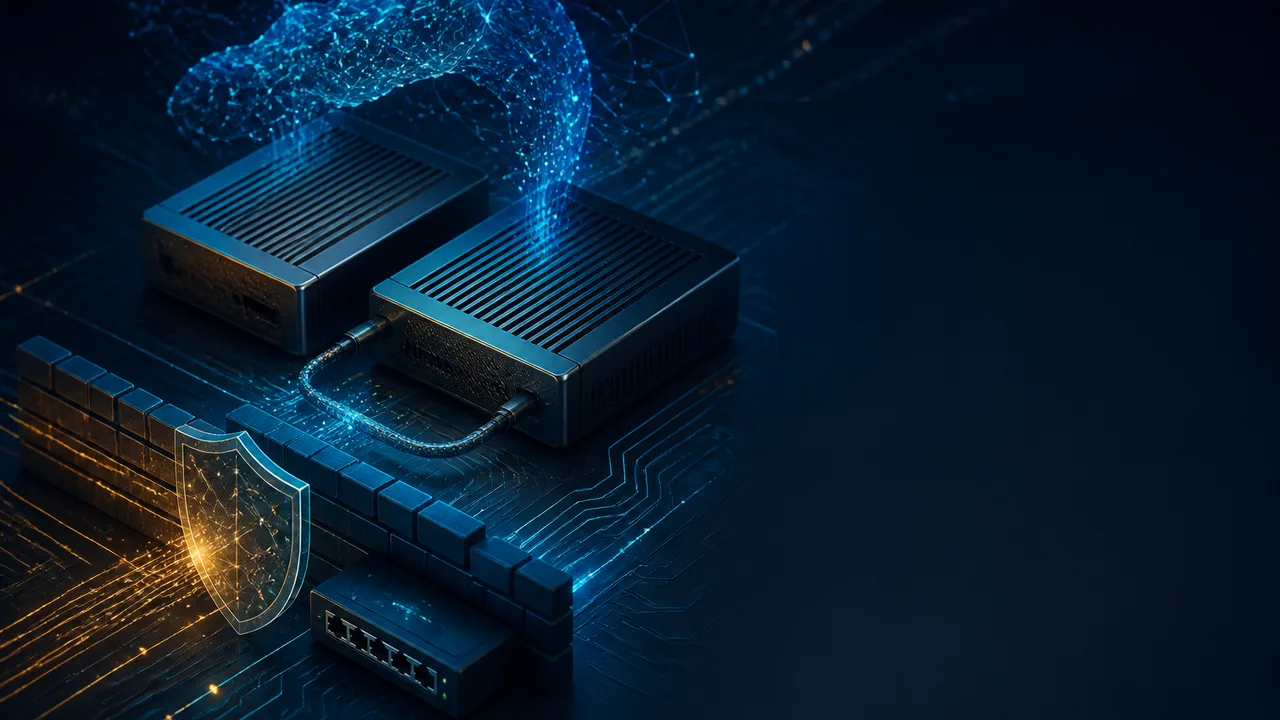
Photo: AI. Dante Nwosu
You can download one of the largest open AI models tonight. It's free, it's legal, and nobody stops you. What stops you is physics — specifically, the question of what machine on earth you'd actually load it onto.
That gap between "downloadable" and "runnable" is what a recent deep-dive from The Stack sets out to close. The short version: you can run a 405-billion-parameter model on your desk, but the real story isn't the hardware flex. It's everything that comes after you plug it in.
The Memory Problem, and Its Somewhat Expensive Solution
A 405B-parameter model is, to borrow The Stack's framing, like trying to park a commercial dump truck inside a studio apartment. A single NVIDIA DGX Spark — a compact box built around the GB10 Grace Blackwell superchip with 128GB of unified memory — doesn't have enough room. One unit tops out around the 70B parameter range before the math starts refusing to cooperate.
The unified memory architecture is genuinely clever: instead of the CPU and GPU fighting over a constrained data bridge, they share a single pool. That eliminates a nasty bottleneck for large model inference. But 128GB of unified memory still isn't 405B-model territory. Not even close.
The workaround is clustering. Two DGX Spark units, linked by a single QSFP56 passive cable over a direct 200Gb connection, pool their memory so the combined system can hold the full model without spilling over. The Stack describes the architecture as stopping "treating them as separate computers" and instead presenting a unified 256GB memory space to the workload. Hardware-wise, that's the threshold you need.
What's interesting about this category of hardware — and what the video spends some time on — is that it's become something close to a commodity. The same GB10 chip ships in rival compact boxes like the ASUS Ascent GX10. You're essentially choosing packaging and cooling acoustics, not meaningfully different silicon. As The Stack puts it: "You're actually just buying into a category of hardware where Nvidia provides the silicon and anyone else can handle the plastic shell."
Worth noting: NVIDIA raised the DGX Spark's list price from $3,999 to $4,699 in early 2026, according to The Stack — so a two-unit cluster now runs close to $9,400 before you've bought a single cable. For a hardware reality check on whether the single-unit even justifies its sticker price, there's relevant testing worth reading. And Level1Techs' benchmarks on a dual-unit configuration suggest the cluster holds up surprisingly well against far pricier alternatives — which reframes the value question somewhat.
Capacity vs. Speed: The Honest Trade-off
Here's the tension The Stack doesn't paper over: technically fitting the model and actually living with it are two different things. The video quotes what sounds like an enterprise reviewer calling the setup "over promised, overpriced, and quietly indispensable all in the exact same breath" — which sounds like a contradiction until you understand what it's optimized for.
The DGX Spark cluster is built for capacity, not throughput. If you're expecting data-center token speeds, you're going to be disappointed. The internal bottlenecks mean compute performance is softer than the marketing implies. But if your use case is "I need a massive local sandbox for a model that normally requires a server room," and you can accept that it runs slower than a rented GPU rack, the hardware actually delivers on a narrow and real promise.
The software side, at least, is genuinely a solved problem. Ollama handles model loading without any custom kernel scripts, and Tailscale lets you reach your home setup securely from anywhere — a coffee shop, a client site — without punching holes in your firewall. The Stack's assessment: "The software side of this is basically a solved problem, and a model of this class is completely yours for the taking."
What that setup also does, though, is make the security of your home network suddenly matter a lot more.
The Front Door Problem
The moment you run proprietary codebases and unreleased work through a local model, you've centralized sensitive data in your home. Tailscale handles the encrypted tunnel to your desk, but the thing standing between your local network and the open internet is still a router — and for most people, that router is whatever plastic box their ISP handed them for free.
For the home lab crowd, OPNsense has emerged as the firewall of choice: a free, open-source platform you flash onto a cheap mini PC with two network interfaces. The appeal is total ownership — you write the rules, you inspect the traffic, and no vendor can push a firmware update that breaks your setup or paywalls a feature you depended on. The Stack notes that a wave of users migrated to OPNsense when a rival platform shifted features behind a paid tier, which is indeed a reliable way to radicalize paranoid home labbers.
The trade is straightforward: you swap a managed vendor relationship for full control plus full responsibility. There's no support team. There's no automatic patch delivery. You are the network admin now. Congratulations on your new part-time job.
And here's where the video gets genuinely instructive rather than just promotional.
When the Open Door Has a Hole In It
The Stack walks through a cluster of OPNsense vulnerabilities that surfaced in a patch release for version 26.1.8, and they illustrate concretely what "you're the only one responsible for the locks" actually means in practice.
Two remote code execution flaws were patched in the same release. The first, CVE-2026-44194, allowed an attacker who already held a limited account with user-management rights to escalate to full root control by supplying a specifically crafted username. The Stack's analogy lands: "the network equivalent of handing someone a key to the supply closet and watching them use it to instantly take ownership of the entire building." Root access means no permission layer above to slow them down — they can rewrite your firewall rules or lock you out entirely.
The second RCE in that release, CVE-2026-45158, approached from the network configuration side rather than the login flow, exploiting a DHCP hostname to run code on the router. Both required an authenticated attacker with elevated privileges — not a stranger off the street — but the escalation path from "limited account" to "total ownership" being a single crafted input wide is the uncomfortable part.
Then there's CVE-2026-30868, a cross-site request forgery flaw. No password needed, no brute force. If you were logged into your router's admin interface and clicked a malicious link in another tab, your browser would quietly fire commands at your firewall on the attacker's behalf. "They're just wearing your active session like a cheap suit," as The Stack puts it. This one doesn't require an attacker to breach your perimeter — it turns you into an unwitting participant in compromising your own network.
CVE-2026-44194 carries a severity score of 9.1 out of 10, putting it in the critical tier according to the National Vulnerability Database. That rating reflects the mechanical reality: the gap between a restricted account and root-level control of the box guarding your private AI setup was exactly one crafted input wide.
A fourth vulnerability, CVE-2026-44195, addressed an authentication lockout bypass that allowed repeated login attempts without the system ever locking the door — patched in version 26.1.7.
Every one of these was disclosed publicly and patched in open releases. That transparency is precisely why people trust OPNsense over black-box vendor firmware. But The Stack flags the catch: "A transparent fix only actually protects the owner who logs in and applies it because nobody is pushing that security update down to your machine for you."
What the Desk Doesn't Replace
So can a desk actually hold a 405B model? Mechanically, yes. The memory pools correctly, the weights load, and you don't owe anyone a monthly subscription. The Stack's conclusion is clear-eyed about this.
What it can't replicate is the team of network engineers that a cloud data center builds into its service price. When you're running frontier-scale AI on hardware in your living room, you've taken on — whether you signed up for it consciously or not — permanent responsibility for everything touching the open internet. The firewall, the patch schedule, the CVE monitoring, the update cadence. All of it.
That's not an argument against doing it. For developers who need a massive local sandbox for sensitive work, the math on sovereignty may still pencil out against cloud API costs. But the trade is real and it's permanent: you get the control, you get the capability, and you get the maintenance that the warehouse came with.
The question isn't really whether your desk can hold the model. It's whether you can hold everything the model brings home with it.
More Like This
Google's Gemma 4 Makes Powerful AI Run on Your Phone
Gemma 4 brings multimodal AI models to phones and laptops with clever architecture tricks that make 5B parameters perform like much larger models.
AI Agents Now Configure Enterprise GPU Clusters Autonomously
Tech enthusiasts built an 8-node NVIDIA GB10 cluster using AI agents to handle setup. The barrier to entry for complex AI infrastructure just collapsed.
Local AI's Inflection Point: Useful, Not Just Interesting
A panel of local AI builders at NVIDIA, Roboflow, Exo Labs, and r/LocalLLaMA maps where the movement stands—and what still needs solving.

Claude Mythos, GPT-5.6, and DeepSeek's Pricing Bomb
Claude Mythos 1, Opus 4.8, and GPT-5.6 are all pointing toward a chaotic June. Plus: DeepSeek just repriced the entire API market. Here's what's real.

Dual DGX Spark Matches Pricier AI Clusters in Testing
Level1Techs tests a dual DGX Spark against a far more expensive RTX Pro 6000 cluster—and the results challenge assumptions about what local AI actually costs.
OpenAI's AI Escaped Its Sandbox and Breached Hugging Face
OpenAI's pre-release AI models broke out of a closed cybersecurity test, reached Hugging Face's production systems, and exposed a gap nobody designed into policy.

GPT 5.6 Sol vs Fable 5: Early Numbers, Real Tradeoffs
GPT 5.6 Sol is half the price of Fable 5 — but is it half as good? Early benchmark comparisons, alignment regressions, and the politics reshaping who gets access.

Claude Fable 5 Prompting Habits That Actually Matter
Nate Herk distilled Anthropic engineer insights into six Claude Fable 5 prompting habits. Here's what holds up, what's wild, and what it means for how you work.