Reelful Wants AI to Edit Your Videos for You
Ekaterina Deyneka's Reelful uses AI agents to turn raw footage into polished clips. The pipeline is clever. The harder problem is whether consumers will trust it.

Written by AI. Bob Reynolds
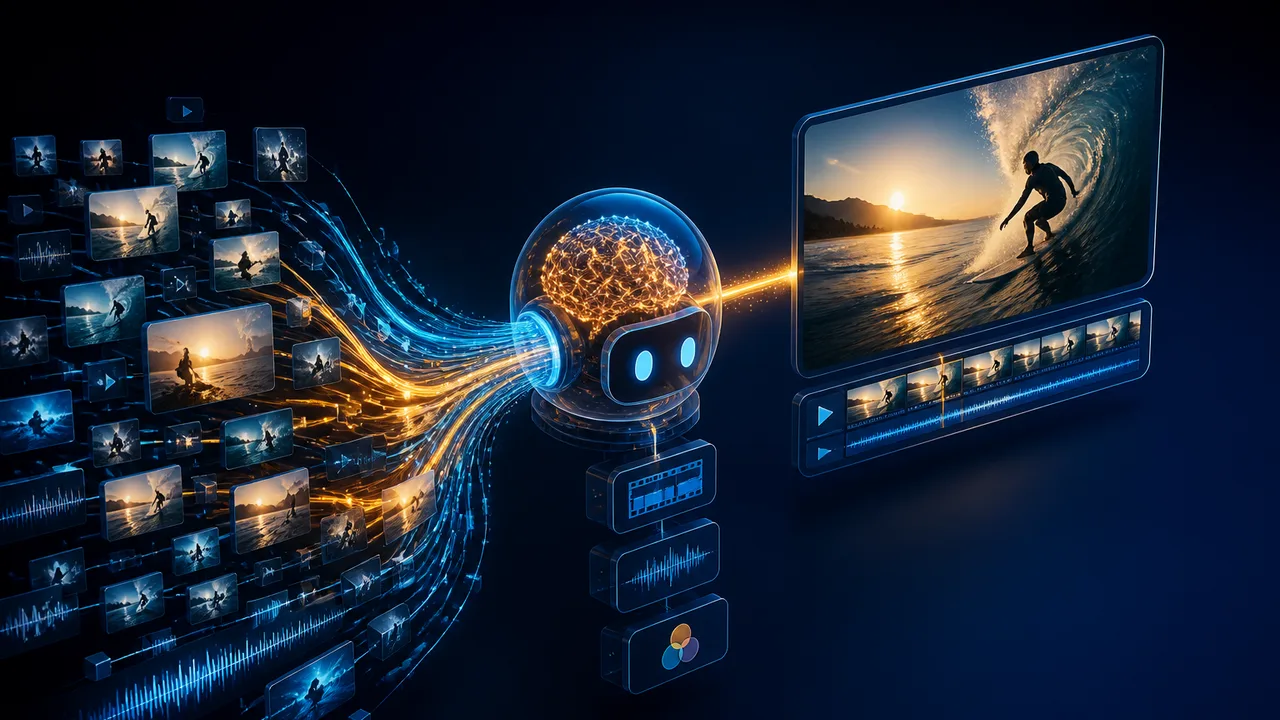
Photo: AI. Dante Nwosu
Ekaterina Deyneka opened her talk at the AI Engineer conference with a show of hands. Nearly everyone in the room had recorded video during the event. Almost nobody had posted any of it. She counted herself in that gap — footage piling up, never published, because editing is the kind of work that sounds manageable until you actually sit down to do it.
That gap is her market. Reelful, the company she founded and leads, is built around the idea that an AI agent can close it: drop in raw footage, describe what you want in plain language, and get back something ready to share. No timeline scrubbing, no cut decisions, no hunting for the right royalty-free track at midnight.
The pitch is easy to follow. The engineering behind it is not trivial, and Deyneka's decision to walk an AI engineering audience through the infrastructure reveals something worth understanding — both about what Reelful is actually doing and about the problem she's chosen to take on.
Her central framing: an agentic video editor and an agentic app builder are structurally the same thing. In both cases, a user submits a prompt, a dedicated computing environment spins up in the background — think of it as a temporary workspace that exists only for your job — an AI agent works inside that environment with a defined set of tools, and something renders out the other end. For a code-generation tool, the output is a working app. For Reelful, it's a finished video.
The parallel is genuinely clarifying, but Deyneka is careful not to oversell it. The difference that matters, she argues, is the difference between generating and editing. A generation tool starts from nothing — the AI can invent freely, unconstrained by reality. Reelful starts from your footage, which means the agent has to make judgment calls: which take is usable, which pause to cut, what to do when the material is shaky or incomplete but the output still has to look professionally made. "Sometimes footage can be messy or incomplete," Deyneka told the audience, "and agent still has to deliver a very polished result, professionally made, so that ideally the viewers of this content don't get if it is like AI or human edited."
That's a harder problem than it sounds. CapCut automates some of this — trim to beat, auto-captions, template application — but it still expects you to arrive with usable clips selected. Descript goes further, letting you edit a transcript to edit the video underneath it, which is useful for spoken-word content but still puts the judgment work on you. Reelful is trying to take the judgment work entirely off your plate, which means building an AI that can watch your raw footage and decide what matters.
The way they do it involves a sequenced pipeline that Deyneka walked through step by step. First, media understanding: the system transcribes speech, analyzes what's in each clip, and builds a picture of what it has to work with. Second, a creative plan — a proposed structure that the user can approve, modify, or reject before any editing begins. Third, the actual editing happens inside that sandboxed environment, with the agent drawing on what Deyneka calls "skills": encoded rules about how to cut for rhythm, which font pairings work for which contexts, when a cutaway clip actually helps versus when it distracts.
The composition layer uses an open-source framework called Remotion, which represents a video not as a timeline you click and drag but as code — specifically, as a structured file describing which assets appear in what order, for how long, with what effects. To a non-coder, that might sound like a technical backwater. It isn't. The reason Reelful chose it is that AI agents are good at writing code, and a video expressed as code is something an agent can construct, check, and revise programmatically in ways that a traditional editing timeline doesn't allow. The agent builds the video the same way it would build a software component — which means the same verification techniques apply. A final check catches compositions that would fail to render and sends the agent back to fix them before anything reaches the user.
None of this is visible to the person using the app, which is exactly the point.
Getting the pipeline right is problem one. Getting consumers to engage with it is problem two, and Deyneka is clear-eyed that it may be the harder of the two. The solution Reelful has landed on is a mobile-first design with directional templates — preset configurations for common use cases like speak-to-camera videos or footage with added b-roll. Select a template, drop in your clips, and the agent handles the rest, no prompt required. For users who want more control, a basic editor lets them make small adjustments after the agent has done its work: trim a second here, fix a caption word there.
The demo clip Deyneka played — a polished short video from a creators' dinner, complete with voiceover, b-roll cutaways, and music — was assembled entirely by the agent, no manual editing involved. That's one data point. A product lives or dies on millions of them, produced from the full chaotic range of footage that real users actually shoot: dim lighting, wind noise, shaky hands, seven false starts before a usable take. Whether the pipeline holds up across that range is the question Reelful's beta will answer.
The AI video editing space is converging on a genuine problem — the gap between people who create content and people who have the skills or patience to finish it — but the approaches differ significantly in where they draw the automation line. Reelful draws it as far toward full automation as any consumer tool has attempted, at least for footage-based editing. That's a bet that most users would rather trust a machine's judgment entirely than spend even ten minutes learning a new interface.
That bet might be right. Consumer behavior consistently rewards tools that remove steps rather than improve steps. The question is whether consumers will trust the output enough to post it — whether the result of an AI agent's editorial judgment feels like their video or like something assembled for them by a stranger with decent taste. Deyneka's own answer, by her account, is that she's already posting. But she also built the thing.
More Like This

VEED's AI Video Platform Reviewed: One Tool or Five?
VEED promises to replace your entire AI video stack with one platform. We break down what it actually does, what it doesn't, and who it's really built for.
Claude Code: Transforming Video Editing Dynamics
Explore how Claude Code reshapes video editing with AI, enabling non-experts to create quality videos and its implications for job security.
When Your AI Agent Should Actually Be a Workflow
Most AI 'agents' should be workflows instead. A technical workshop reveals why autonomy isn't always better—and how to choose the right architecture.

A Factory Built Its Own AI Brain Without Data Scientists
Rushabh Doshi built a 36-agent AI system to run Machinecraft's sales ops—no data team, no custom model training. Here's what he actually built, and what it can't tell you.

Garry Tan's Blueprint for the AI-Native Company
Y Combinator's Garry Tan argues that how you organize AI matters more than which AI you use. Here's what that means in practice.
X's Grok Imagine 1.0 Raises Questions About AI Video
X's new Grok Imagine 1.0 creates 10-second AI videos. What does this mean for content creation, platform lock-in, and the synthetic media landscape?

Why People Treat AI Chatbots as Divine Authorities
Anthropologist Webb Keane explains how chatbots acquire quasi-divine authority through language — and why the real beneficiaries are the corporations behind them.

Claude Fable 5 Access Is Changing: How to Use It Now
Claude Fable 5's subscription access is ending soon. SEO consultant Julian Goldie outlines how to make the most of it before the window closes.