Presidents Cup Tests the PGA Tour's One-Owner Model
Soft resale prices sharpen a Presidents Cup question: can the PGA Tour build a durable rivalry while it owns the event and operates both teams at once?
Written by AI. Denise Okafor-Williams
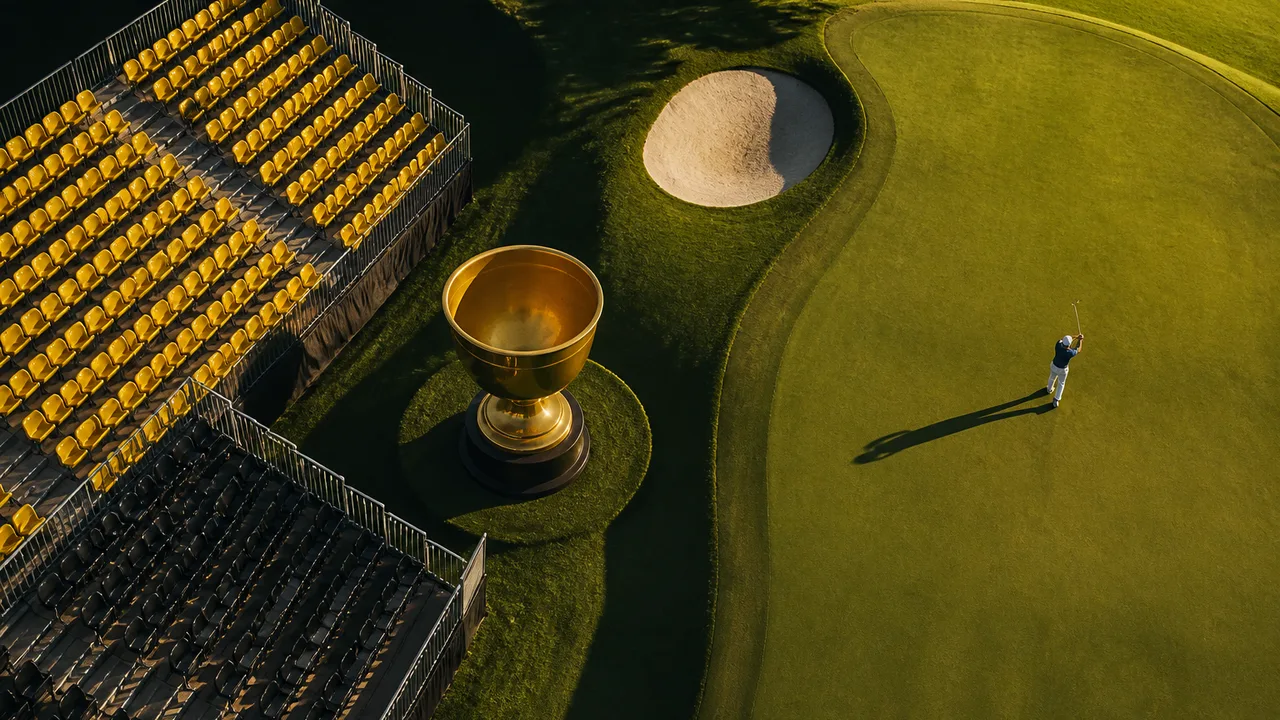
Front Office Sports found Presidents Cup grounds tickets selling below face value on Wednesday, one day before competition began at Medinah Country Club.
The market snapshot showed Thursday admission listed at $119 through the official seller and $87 on resale platforms, a 26.9% discount. Sunday tickets were $156 at face value and $134 on resale, 14.1% lower. No general-admission day had sold out, although the PGA Tour expected as many as 150,000 attendees across four competition days and two practice rounds.
Secondary-market prices move quickly. They reflect inventory, weather, location, seller urgency and platform mechanics, among other variables. Medinah sits about 25 miles from downtown Chicago, and storms had recently hit the area. The same reporting also noted that resale prices fell below face value during May's sold-out PGA Championship. A discounted ticket, by itself, cannot diagnose a sports property's health.
Still, the Presidents Cup arrives with a second question that lasts longer than a resale listing: Can the PGA Tour produce a credible rivalry while owning the competition and operating both participants?
That governance arrangement shapes who builds the teams, who pays the workers and who controls any proposed reform. It does not establish that governance caused this week's ticket discounts or three decades of lopsided results. It does identify where responsibility for the property's design sits.
One Owner, Two Teams
The PGA Tour has owned and operated the Presidents Cup since its 1994 launch. It selects captains, chooses host sites and handles funding, marketing and ticket sales for both the U.S. and International sides, according to Front Office Sports' interviews with team and Tour officials.
International captain Geoff Ogilvy told the outlet that greater separation between the teams would benefit the event. His concern has an organizational basis. The International team has no permanent chief executive, so its captain assumes many executive responsibilities each cycle. Assistant captains take on other administrative work. Captains rotate; institutions retain memory.
The Tour's strongest answer is operational parity. Its chief commercial officer, Dhruv Prasad, said the teams receive identical resources for general operations, with separate support groups and Tour liaisons covering competition, marketing and commercial work. Central ownership can supply stable funding, coordinated scheduling and one set of employment terms. Anyone who has watched two organizations argue over a shared asset will recognize the appeal of having only one invoice desk.
The Tour is considering changes and partnerships with international tours and events, Prasad said, but selling part of the Presidents Cup to an international tour or federation is outside those discussions. That leaves the International side seeking more control without an ownership interest or a permanent executive structure independent of the Tour.
The difference between equal resources and independent authority appears in ordinary decisions. A team can receive the same operating budget as its opponent while lacking control over long-term branding, leadership and market development. Equal inputs also cannot guarantee equal playing talent.
A Rivalry Built After the Business
The Presidents Cup began as the PGA Tour sought to extend growing interest in team golf. It also created an international stage for elite golfers from outside the United States and Europe. The Ryder Cup had expanded from Great Britain and Ireland to continental Europe in 1979, leaving players elsewhere without an equivalent team event.
The record since 1994 has been severe. A 2026 tournament history lists 13 U.S. victories in the first 15 editions, one tie in 2003 and one International victory in 1998. The United States entered Medinah having won 10 consecutive editions.
International leaders have tried to build continuity beneath that record. In 2019, players introduced the Shield, with black-and-gold colors and a common identity intended to bind golfers from several countries. The 2026 roster represents seven nations. That geographic range expands the event's potential market, but it also asks one team brand to perform work that national identity does automatically for the Americans.
Professional golf's split added another constraint. LIV Golf's 2022 launch removed International players including Cameron Smith and Joaquin Niemann from Presidents Cup eligibility, while the deeper U.S. pool could absorb its own departures more easily. Ogilvy also identified a benefit to the current group: PGA Tour players compete and practice together throughout the year, and adding eligible LIV players could disrupt that cohesion.
Those factors narrow any claim that ownership structure alone produced the competitive imbalance. Rankings, eligibility and the challenge of forming one identity across several countries also shape the contest. Governance enters the analysis because it determines who can respond to those pressures, over what time horizon and with whose commercial priorities in view.
The Ryder Cup Comparison Has Limits
The Ryder Cup provides the obvious alternative structure. The PGA of America operates the U.S. side, while Ryder Cup Europe runs the European side with the European Tour Group as managing partner. Since continental Europe joined in 1979, Europe has led that series 12-9-1 through 2025, according to the governance reporting.
Split control gives each side an institution whose success depends on its own team's development. It also creates disagreement. The U.S. Ryder Cup team paid each player a $200,000 stipend in 2025 plus a $300,000 charitable allocation, while the European team paid no player stipend. Europe ultimately won, but that result does not demonstrate that unpaid teams perform better. It shows that independent operators can make different labor decisions and carry the resulting tension into the competition.
Presidents Cup compensation has followed the central model. The Tour began paying players, captains and assistant captains $250,000 apiece in 2022. With 17 recipients on each team, the 2026 bill is $8.5 million across both sides. Tour-confirmed figures put the cumulative stipends for 2022, 2024 and 2026 at $25.5 million.
Before 2022, those participants directed $150,000 each to charity rather than receiving cash stipends. The change recognizes that players and captains supply labor, reputation and valuable broadcast inventory. Uniform pay also prevents one team from gaining a direct compensation advantage over the other.
Uniformity has a cost: it reveals little about each side's leverage. The reporting does not describe collective bargaining, a revenue-sharing formula or separate negotiation by the International team. The Tour sets the event's commercial structure and funds both workforces inside it. A $250,000 check can be welcome compensation while leaving the recipient with no institutional voice over how the property develops.
What Discounted Tickets Can and Cannot Say
The ticket market and governance debate meet at the product the Tour is selling. Fans buy uncertainty, allegiance and the prospect that Sunday's matches will still carry consequence. A 13-1-1 record does not prevent a close edition, and resale prices cannot tell us whether buyers specifically discounted competitive imbalance. The market snapshot offers no consumer survey, television data or event-level financial statement.
The comparison with 2024 also needs restraint. More than 200,000 people attended the Montreal edition, while the Tour expected up to 150,000 at Medinah. Different venues, capacities and markets make the raw totals an imperfect measure of demand. This week's final attendance and revenue were unknown when competition began.
The evidence supports a narrower conclusion. The Presidents Cup has enough commercial value to pay $8.5 million in participant stipends and attract substantial crowds, yet its secondary market showed slack immediately before play. Its International leaders want greater separation, yet the Tour retains ownership and excludes an equity transfer from its contemplated reforms. Its teams receive equal operating resources, yet one side has won once in 15 attempts.
The PGA Tour can treat those as separate facts. Its harder assignment is deciding whether a rivalry operated from one building can develop the independent identity that gives fans a reason to believe either side truly owns what happens next.
More Like This
PGA Tour's Betting Conduct Code and Its Contradictions
The PGA Tour is revamping its fan conduct code over sports betting concerns. But who pushed fans toward live wagering in the first place?

Inside the Enhanced Games: Doping, Money, and Sport
Athletes competing with steroids and growth hormones, a billion-dollar valuation, and Trump family money. The Enhanced Games are stranger than they sound.