NVIDIA's PAIR Turns Idle Home GPUs Into a Local AI Pool
NVIDIA's open-source Personal AI Router pools Ollama and LM Studio nodes across your network. What PAIR does well, and what it leaves unanswered.

Written by AI. Dev Kapoor
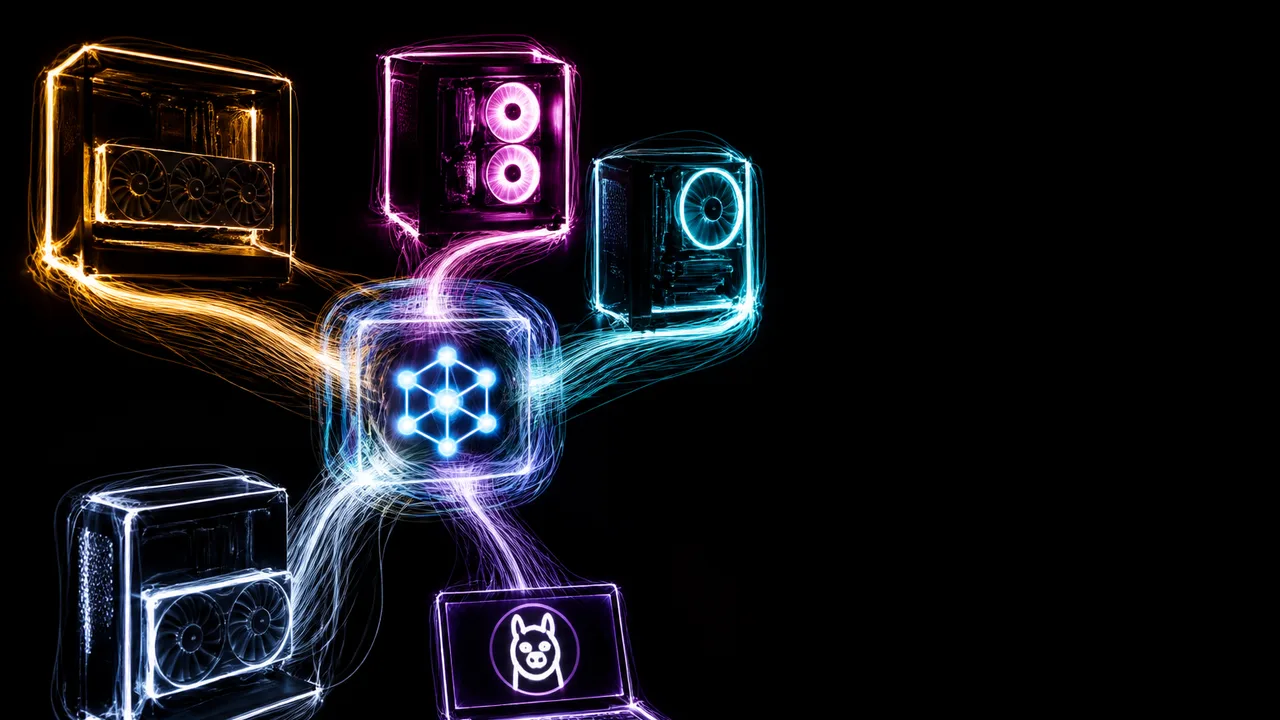
NVIDIA released Personal AI Router, or PAIR, an open-source tool that routes local AI requests across compatible machines on a home or small-office network. According to marktechpost.com, PAIR can proxy existing Ollama and LM Studio endpoints, so agent tools can address the whole pool without any application-level changes. The Verge's framing was blunter: theverge.com called it a free tool that links idle computers into a personal AI data center.
What PAIR Actually Does
The honest description, which the sources themselves largely stick to, is orchestration. PAIR does not run models and it is not a new inference engine. Its scheduler filters candidate nodes by readiness, engine state, exact model availability, current job load, and GPU utilization, per marktechpost.com. Tom's Hardware describes the target workload precisely: agentic AI tasks, where a swarm of parallel agent calls can hammer a single GPU while three other machines on the same network sit mostly idle.
That framing tracks with how local AI actually gets used in 2026. A single llama.cpp or Ollama request is latency-bound and wants the fastest single machine. Twenty agent calls firing at once are throughput-bound, and that is where pooling scattered hardware pays off. The list of supported node types matters here too: RTX machines, DGX Spark boxes, and Macs, per marktechpost.com. A router that treats a MacBook's unified memory and a gaming PC's RTX card as first-class peers is unusual; most prior homelab clustering efforts picked a side.
Engadget covered the tool's unveiling at IFA 2026, positioning it as a way to use idle PCs for AI tasks, and techbuzz.ai leaned into the cluster framing outright. NVIDIA's own page at nvidia.com markets PAIR under its AI on RTX umbrella, which tells you where the commercial gravity sits.
Why NVIDIA is Giving This Away
The obvious question for anyone who has watched NVIDIA's pricing behavior for a decade: why would the company with the most to sell give away orchestration software for free? The strongest answer comes from reading the supported node list. Every non-Mac node in the pool is a machine that already bought an NVIDIA GPU, and every RTX machine idling at 4 percent utilization between agent bursts is an argument for the next purchase. PAIR makes the existing RTX install base more useful, which is advertising that runs on hardware customers already own. It also nudges agentic workloads toward staying local, away from cloud inference bills, which conveniently keeps those workloads inside NVIDIA's ecosystem rather than on someone else's rented H100s.
Read cynically, PAIR is a land-grab for the homelab orchestration layer before an open-source project gets there first. Read generously, it is NVIDIA subsidizing the annoying glue work that nobody wants to maintain for free. Both readings can be true at once, and the license terms and telemetry behavior will do a lot to determine which one dominates.
The Open Questions
The record on several practical fronts is thin, and it is worth being plain about that rather than extrapolating from a demo.
Security. A router that proxies inference endpoints across a network is a new attack surface in a space where people currently run everything on localhost. The sources do not detail PAIR's authentication model, encryption, or what happens when a node joins the network. For a tool aimed at home networks this may be forgivable; for the small-office use case the brief mentions, it is a real gap until documentation says otherwise.
Model synchronization. The scheduler filters by exact model availability, per marktechpost. That means the pool is only as good as its weakest copy of the model your agent wants. Nobody in the coverage explains how PAIR handles version drift across nodes, whether it triggers downloads, or what happens when your gaming PC is running llama 3.3 8B Q4 and your Mac has Q8. Exact-match routing is the safe design choice; it also means the pool shrinks to whatever subset kept its models in sync.
Overhead versus benefit. For long agentic jobs with heavy prompts, a few dozen milliseconds of network hop is noise. For short interactive requests, routing to another room may cost more than it saves. The Verge's "personal AI data center" line is evocative, but data centers win on batching and interconnect bandwidth; a home wins on electricity it was already paying for.
Losing nodes mid-task. Any distributed system's real grade comes from failure handling. If a laptop closes its lid halfway through a batch of agent calls, does PAIR retry on another node, fail the request, or hang? The coverage is silent, and this is the question I would check first in the code, since it separates a demo from a tool.
Telemetry. NVIDIA shipping free software that watches GPU utilization across your LAN is exactly the configuration you would want visibility into. No source reports on what PAIR phones home about, if anything. That silence is itself information.
The Open Source Angle
The part of this story I find most interesting is not the router but the precedent. NVIDIA's open-source track record is famously lopsided: kernel drivers have arrived, documentation has improved, and the higher layers of the stack remain closed. PAIR being open source means the community can answer the questions above without waiting for NVIDIA, and it means the tool can be forked if NVIDIA loses interest. It also sets up an odd dynamic: the world's largest AI hardware vendor now competes with volunteer-maintained projects like open-source load balancers for llama.cpp fleets that homelab users have cobbled together for years.
For those projects, a well-funded incumbent shipping a polished, free alternative is the familiar squeeze. Some users will switch because PAIR just works and it proxies their existing endpoints. Others will keep their own glue because they trust it and they control it. That is a healthy market for orchestration tools, and PAIR's arrival may end up validating the volunteer projects more than threatening them, by proving the category matters enough for NVIDIA to enter it.
What to Watch
The demo is the easy part. Tom's Hardware identified the actual pain point PAIR targets, agent swarms hammering one GPU.
The tool's second release will say more than its first. If the repository shows active maintenance, honest failure modes, and a telemetry story you can read, PAIR becomes a default install for anyone running local agents on more than one machine. If it goes quiet after IFA, the homelab projects it briefly threatened will still be there, maintained by people who never had a marketing budget to begin with.
More Like This
Google's Gemma 4 Brings Powerful AI to Consumer Hardware
Google released Gemma 4 under Apache 2.0 license. The open model runs on standard GPUs, challenging the assumption you need enterprise hardware for capable AI.
AI Agents Now Configure Enterprise GPU Clusters Autonomously
Tech enthusiasts built an 8-node NVIDIA GB10 cluster using AI agents to handle setup. The barrier to entry for complex AI infrastructure just collapsed.

Perplexity Open Sources Lily, a Local AI Engine for Apple Silicon
Perplexity has open-sourced Lily, a Rust-based inference engine for Apple M5 Max. Here's what the benchmarks mean and why the OSS move matters.

Nvidia's Autonomous AI Agents: What Actually Shipped
Nvidia announced NemoClaw, Nemotron-3 Ultra, and OpenShell at GTC Taipei. Here's what the technology actually does—and what questions it leaves open.

NVIDIA Nemotron 3.5 Lightning Targets AI Agent Work
NVIDIA's Nemotron 3.5 Lightning is a 30B MoE model built to handle the repetitive, high-volume work inside AI agents—faster and cheaper than frontier reasoning models.

Self-Hosted AI Tools That Replace Paid SaaS
Ten open-source AI tools—from Tesseract OCR to OpenHands—that run locally, protect your data, and eliminate SaaS subscriptions. Here's what works and what doesn't.

Kimi K3 Exposes the Real Cost of Open-Weight AI
Moonshot's Kimi K3 is a genuinely impressive open-weight model—and a direct challenge to every assumption the OSS AI community has built its narrative on.
C++ Compile-Time Optimization: When Theory Meets Reality
Andrew Drakeford's C++Online 2026 talk on compile-time dynamic programming starts clean and gets complicated—in exactly the ways that matter for real teams.