Linux Spring 2026: Ubuntu, Fedora, Framework & More
Ubuntu 26.04, Fedora 44, Framework Laptop 13 Pro, the new Steam Controller, Zorin OS 18.1—Linux spring 2026 is stacked. Here's what actually matters.

Written by AI. Yuki Okonkwo
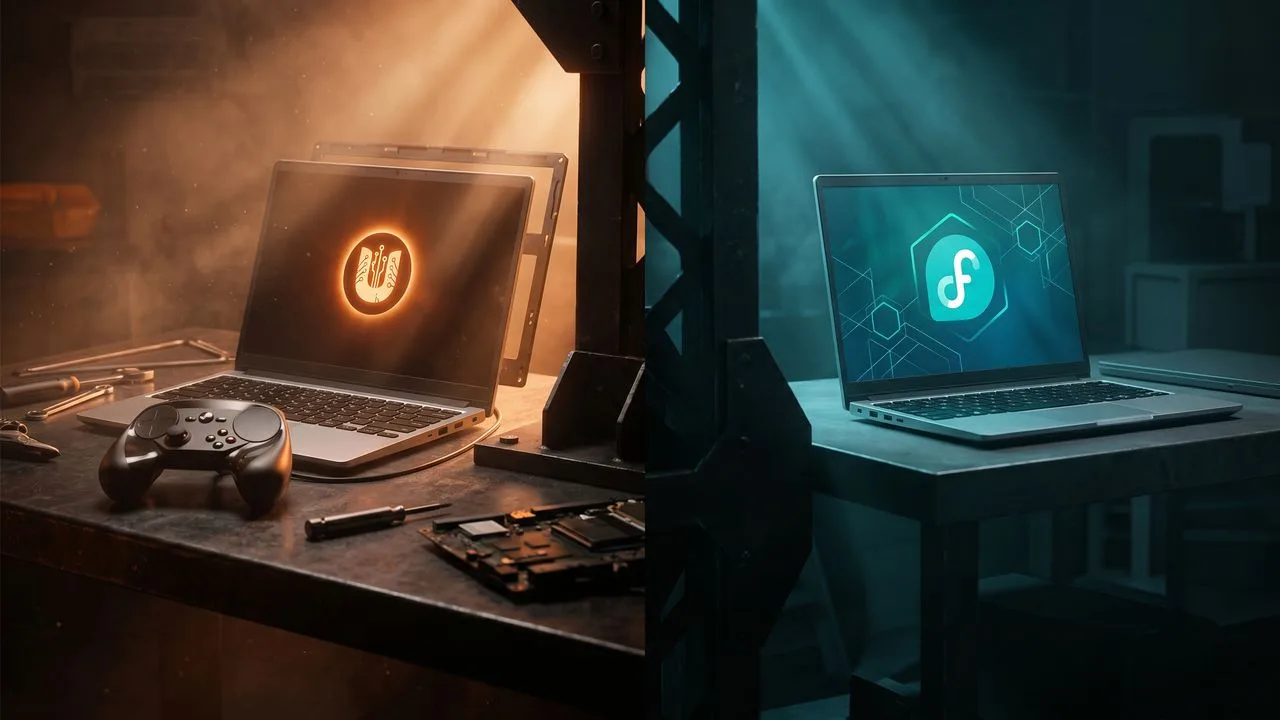
Photo: AI. Astrid Lehmann
Spring 2026 dropped a full payload of Linux news all at once—two major distro releases, a hardware reveal that's getting called "the MacBook Pro for Linux users," a new Steam Controller with an actual price tag, and a handful of smaller releases that each tell their own story about where the Linux ecosystem is headed. Let's get into it.
Ubuntu 26.04 LTS: Resolute Raccoon lands
The headline release is Ubuntu 26.04 LTS, codenamed Resolute Raccoon, and it's a meaningful one. Five years of standard security support, GNOME 50 as the default desktop, and—most significantly—Wayland-only by default. That last part isn't Ubuntu's call exactly; GNOME 50 dropped XOrg session support upstream, so this was always coming. The good news is the XWayland shim means your old X11 apps still work. The bad news is that if you were clinging to XOrg for a specific workflow reason, that rope just got a lot shorter.
The RAM recommendation bump from 4GB to 6GB grabbed some headlines, but OMG Ubuntu's Joey framed it well in a piece that Michael Tunnell cited on This Week in Linux: "The recommendation is not because Ubuntu requires 2 GB more memory than they did before, but more the way we compute does. The Resolute Raccoon's memory requirements better reflect real world multitasking." In other words: browsers are gluttons, GNOME is the heaviest desktop in the Linux ecosystem, and Canonical is just being honest about the math now. If you're on older hardware, Lubuntu and Xubuntu are right there.
Under the hood there's genuinely interesting stuff: Ubuntu 26.04 is the first Ubuntu release to natively distribute Nvidia CUDA through its own repositories, AMD ROCm is now in the repos too, TPM-backed full-disk encryption is generally available in the installer, and the real-time Linux kernel is now accessible outside of Ubuntu Pro. That last one matters for audio producers, robotics folks, and anyone running latency-sensitive workloads who didn't want to pay for Pro just to get there.
Also: Rust-based utilities (pseudo, uutils-coreutils, and Rust-written kernel drivers) continue expanding, though the release notes note that cp, mv, and rm are still backed by GNU coreutils due to unresolved bugs. The transition is real, just not complete yet.
LTS-to-LTS upgraders from 24.04 will need to wait for 26.04.1 in July before the official upgrade path opens.
Ubuntu's AI plans: opt-in or slippery slope?
Alongside the release, Canonical published their vision for AI in Ubuntu—and it immediately became the most contested part of the announcement. Tunnell's read on it is cautiously optimistic, noting that Canonical's John Seager broke the approach into two buckets: implicit AI (background model use to improve existing features, like first-class speech-to-text) and explicit AI (agent-style workflows for writing, troubleshooting, automation).
Seager explicitly distanced the effort from the "Copilot-ification" model: AI features will be opt-in preview for 26.10, cloud inference requires user-configured credentials, and local inference runs against local models by default. The snaps delivering AI functionality are subject to snap confinement, meaning models aren't supposed to have free rein over your filesystem.
The one gap: there's no single global AI kill switch. Seager acknowledged that's architecturally complicated, but noted that removing the relevant snaps effectively serves that function for Canonical-shipped features. That's a reasonable answer—it's also the kind of answer that only satisfies people who trust Canonical's implementation to stay that way.
Open questions remain around model licensing, training data provenance, and how agent-style tools get confined long-term. Worth watching as 26.10 approaches.
Fedora 44: doing what Fedora does
Fedora Linux 44 shipped around the same time, and it's a clean release. GNOME 50 on Workstation, KDE Plasma 6.6 on the KDE spin (with a new Plasma login manager for a more cohesive first-boot experience), and an installer networking change where Anaconda now only creates profiles for devices you actually configure during installation rather than blanket-profiling everything. Small change, noticeable quality-of-life improvement for anyone who does post-install network customization.
The gaming-relevant addition: NTSync kernel module support is now enabled automatically for packages that recommend it—notably Wine and Steam. NTSync is a newer synchronization mechanism that improves Windows application compatibility and performance. The fact that it configures itself on install means users who don't know what NTSync is will still benefit from it without ever having to Google it.
Fedora ships with Mesa 26.0.3 and kernel 6.19.14, with Linux 7.0 expected through updates. That rolling-within-stable approach is one of Fedora's real differentiators—you get a stable release with cutting-edge graphics drivers that actually keep moving after launch.
Framework Laptop 13 Pro: repairability meets premium 🔧
Framework's NextGen event was the hardware story of the cycle. CEO Nirav Patel announced a full ground-up redesign of the Laptop 13 that they're billing as the MacBook Pro for Linux users—while somehow maintaining backward compatibility with earlier Laptop 13 mainboards and displays.
The specs are genuinely premium: Intel Core Ultra Series 3 (Panther Lake) with Xe3 graphics, up to 64GB of LPCAMM2 memory (modular LPDDR5X—you can actually replace it, which is the whole point), up to 8TB PCIe Gen 5 NVMe, a 74Wh battery rated for 20+ hours of Netflix streaming or 17 hours of active web use, Wi-Fi 7, four Thunderbolt 4 ports via the expansion card system, and a 13.5" 2880×1920 touchscreen at up to 120Hz with 700 nits and per-unit color calibration.
The aluminum chassis is machined from extruded 6063 blocks. It's 15.85mm thick and 1.4kg. The haptic touchpad uses four piezo elements. Ubuntu comes pre-installed as an option, and it's Framework's first Ubuntu-certified product. LVFS firmware updates are supported. First shipments are June.
One transparency note worth flagging: Michael Tunnell disclosed during the segment that he joined Framework's marketing team at the end of last year. He's been covering Framework since their first product five years ago and frames his enthusiasm as preceding his employment—but readers should weigh that context when reading his coverage of Framework products going forward.
Steam Controller: May the 4th be with you
Valve's new Steam Controller launched May 4th at $99 USD. It features next-gen magnetic thumbsticks using TMR technology, trackpads, grip buttons, gyroscope with "GripSense," a wireless puck that doubles as a magnetic charging dock, and 35+ hours of claimed battery life. Works across any Steam-enabled device: PC, laptop, Steam Deck, and eventually the Steam Machine and Steam Frame (which still have no release date—supply chain issues are still affecting that broader rollout).
The framing Tunnell used is apt: this isn't just another controller, it's the Steam Deck control scheme turned into a standalone peripheral. The original Steam Controller's trackpad implementation was divisive—functional for some genres, frustrating for others. This iteration looks more conventional while keeping the things that made the Deck's controls work well.
Zorin OS 18.1, Trisquel 12, and Linux Mint's new timeline
Zorin OS 18.1 is out, and its headline feature is quietly clever: the database of Windows .exe files that Zorin detects and redirects to native Linux alternatives grew by 40%, now covering 240+ apps. Download a Plex installer? Zorin pops up and says "hey, here's the actual Linux version." It's the kind of friction-reducer that doesn't get enough credit in distro-to-distro comparisons. The Light edition (XFCE 4.20) also returns, though Zorin has signaled it plans to sunset Light after the Zorin 18 series.
Trisquel 12 (codenamed Ecne) is based on Ubuntu 24.04 LTS and is for users who want an FSF-endorsed, fully free-as-in-freedom computing environment—Linux-libre kernel, no firmware blobs, no proprietary drivers. Hardware support is narrower by design. The release brings apt 3.0, improved AppArmor rules, and new browser options including GNU IceCat and Ungoogled Chromium. It's a niche with a committed constituency, and the Trisquel team does genuinely hard work maintaining a clean free-software stack on top of Ubuntu's base.
Linux Mint 23 is targeting Christmas 2026—a deliberate extension of the release cycle to give developers room to fix bugs, work on Wayland support in Cinnamon, and overhaul the installer (replacing Ubiquity with LMDE's live installer, which supports secure boot, LVM+LUKS, and OEM installs). The development branch is already on Ubuntu 26.04, kernel 7.0, and Cinnamon 6.7 unstable.
The longer cycle creates an obvious hardware support problem, and Mint addressed it directly: they're now publishing HWE ISOs (Hardware Enablement ISOs—same stable release, newer kernel) for situations where the standard image won't boot on newer hardware. Linux Mint 22.3's HWE ISO ships with kernel 6.17 versus the standard 6.14. The caveat Mint themselves flag: proprietary drivers including Nvidia, Broadcom, and VirtualBox modules may have limited support with the newer kernels. The guidance is to try the regular ISO first.
It's a practical solution to a real problem—but the edge cases where even the HWE ISO doesn't cover new hardware configurations are worth keeping in mind if you're buying hardware today and planning to run Mint on it.
The through-line across all of this: Linux in 2026 is increasingly comfortable competing at the premium tier—both in software (Ubuntu's AI infrastructure, Fedora's rolling driver updates, Cinnamon's Wayland migration) and hardware (Framework building a laptop they're genuinely calling a MacBook Pro alternative). The question isn't whether Linux is ready for more users. It's whether the ecosystem is building the right things for the users who are already here.
More Like This

Framework 13 Gets ARM—But Should You Actually Want It?
MetaComputing's new ARM mainboard for Framework 13 promises modular computing's future. Tech journalist Jeff Geerling tests whether it delivers.
Intel's 18A Chip: A $20B Bet That Breaks Every Rule
Intel's Fab 52 is producing chips with two radical innovations at once—something the industry never does. Here's why that's either genius or catastrophic.

Better Auth Plugins You Need in 2026
Explore 10 essential Better Auth plugins for 2026, enhancing efficiency, security, and user experience.
Linux Defends Against AI Scrapers as Ubuntu Preps LTS
Debian blocks AI bots hammering its servers while Ubuntu locks in kernel plans. Plus: Nvidia finally brings GeForce NOW to Linux, six years late.
Linux Kernel 6.19 Arrives as Discord Stumbles on Privacy
Linux 6.19 brings decade-old AMD GPUs back to life while Discord's age verification rollout raises questions about who controls access to platforms.
Linux Mint 22.3 & Wine 11: Community Dynamics
Explore Linux Mint 22.3 and Wine 11 releases, focusing on community and sustainability in open-source projects.

How Optimization Powers Modern AI and Engineering
From training ChatGPT to imaging black holes, optimization is the hidden engine behind modern AI and engineering. Steve Brunton's lecture explains how.

David Patterson on CPUs, GPUs, TPUs, and 50 Years in Computing
Turing Award winner David Patterson breaks down RISC vs. CISC, the GPU-to-TPU shift, Moore's Law's real status, and what 50 years in computing actually taught him.