iPhone 17 Pro Long-Term Review: Is It Worth $1,000?
Fernando from 9to5Mac has used the iPhone 17 Pro since launch. Here's what held up, what didn't, and whether you should actually spend $1,000+ on it.

Written by AI. Tyler Nakamura
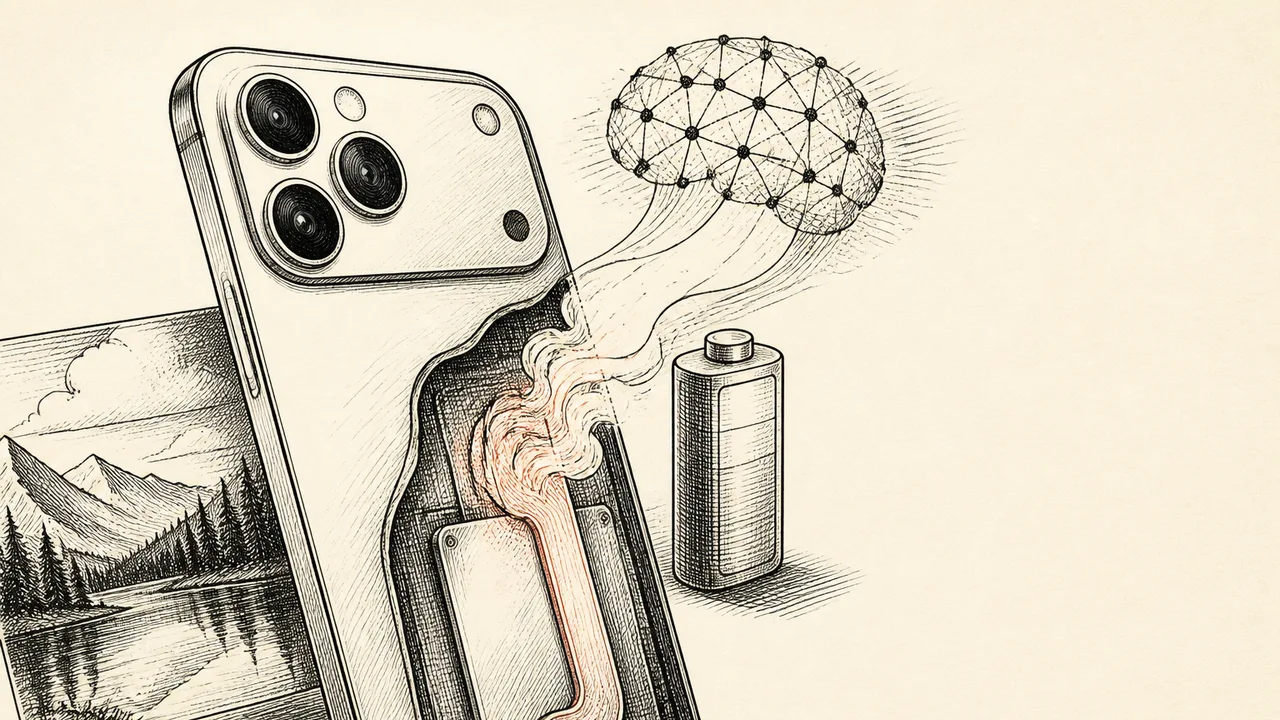
Photo: AI. Eira Pendragon
Quick heads-up: The iPhone 17 Pro and iOS 26 are forward-looking products based on this 9to5Mac video published ahead of Apple's anticipated fall release cycle. Fernando has been using pre-release or early hardware — treat his long-term impressions as some of the most useful signal we have right now, not a final verdict on shipping software.
Okay. So Fernando from 9to5Mac dropped a 14-minute video this week that's basically the long-term iPhone 17 Pro review I've been waiting for someone to do. Not the "48 hours in" take. Not the unboxing hype. The "I've been carrying this thing every day since September and here's what I actually think now" version. Those reviews are rare, and they're the ones that actually matter if you're staring down a four-digit price tag.
Let me tell you what he found — and where I think the more interesting questions actually live.
The iPhone Air Did Something Sneaky for the Pro Lineup
This is the reframe that stopped me cold, and I think Fernando is genuinely onto something here.
For years, the iPhone Pro had to be everything — the most powerful, the best camera, AND the thinnest, most premium-feeling device in the lineup. Those goals are sometimes in direct conflict. Vapor chambers take up space. Bigger batteries make phones thicker. You can't optimize for maximum thinness and maximum performance at the same time without something losing.
The iPhone Air changed the game by becoming Apple's dedicated thin-phone offering. As Fernando puts it: "It allowed Apple to make the Pro-level iPhones all about being pro. They didn't really care about thinness. They don't really care much about form factor."
That sounds simple. It's actually kind of huge. The iPhone Pro no longer has to apologize for being a chunky workhorse because the Air exists to scratch the elegance itch. Apple basically pulled a product line separation that gave its engineers permission to go all-in on capability — and the vapor chamber is the most concrete proof of that.
The Vapor Chamber Thing Is a Bigger Deal Than It Sounds
Bear with me here because I know "vapor chamber cooling" makes your eyes glaze over. Mine too, honestly. But stay with me for ten seconds.
You know that moment in summer when you're outside, phone running hot, and your screen just dims on you mid-video? Or when your phone is charging fast and gets so warm you put it face-down because it feels weird to hold? That's your phone actively throttling itself to avoid damage — and it happens more than most people realize, especially in warm weather.
Fernando says the vapor chamber basically killed that problem for him. "It is really cooled down how much you're feeling it on a day-to-day basis. It's very rare nowadays that my phone is getting hot to the touch." He specifically calls out using it in direct sunlight in summer without the screen dimming on him. That used to be a normal iPhone experience — it's apparently not anymore on the 17 Pro.
I find this more interesting than a benchmark number, because benchmarks don't run while you're sweating at an outdoor concert trying to shoot video. Real sustained performance in warm conditions does.
The Camera Is Good. The Zoom Is The Part People Actually Use.
Fernando's camera praise zeroes in on the 4x and 8x telephoto, and I think that's the right place to focus. He frames it from the perspective of a parent trying to shoot a kid's gymnastics recital from the back of the room — and that's exactly the use case where phone cameras live or die. Not in a controlled lab. In a dimly lit school gymnasium from 40 feet away.
His take: the 4x telephoto is "extremely crisp, especially for video," and the 8x (which crops into the center 12 megapixels of the 4x sensor) holds up even in low light. He's honest that maxing out the digital zoom degrades like it does on any phone, but at the ranges most people actually use, he calls it top of class.
Worth noting: if you're coming from an Android with crazy zoom specs — Samsung's 100x "Space Zoom" gets thrown around a lot — the real question is always what the usable zoom range looks like. Raw zoom numbers are mostly marketing. The 4x-to-8x window is where Fernando says the 17 Pro is genuinely excellent.
Aluminum's Back. Fernando Already Cracked His Screen.
This is the trade-off Apple made and it's worth being clear-eyed about: they ditched titanium and went back to aluminum, primarily because titanium retained heat badly — which undermined the whole performance story. Aluminum dissipates heat better. It also dents and scratches more visibly when you drop it.
Fernando dropped his. Screen cracked. He's measured about it — "I don't think that titanium would have held up any better" — and he's probably right that the fall would've broken most phones. But he also copped to no case, no screen protector, and a drop onto pavement. His conclusion is that the aluminum frame doesn't feel cheaper day-to-day; you only notice it in worst-case scenarios. One upside he genuinely loves: the anodized aluminum holds color better than titanium. The Cosmic Orange is his proof point. Hard to argue with.
If you're the type to go caseless, this is a real consideration. If you use a case, probably irrelevant.
Charging: Around 40W Wired, Faster Wireless — But Context Matters
Fernando cites charging speeds of around 39–41 watts wired, which he notes can vary depending on how you're testing it and what battery level you're at. On the wireless side, he mentions support for what he calls "Qi2.2" at 25 watts — though Qi2.2 as a finalized, ratified standard with confirmed 25W delivery is worth verifying before you go buy new accessories based on that number alone.
What's not in question: faster charging than previous iPhones is real, and Fernando specifically calls out that the phone now shows time-to-80% estimates while charging, which he appreciates. That kind of transparency about charging state is something Android users have had for a while and iPhone users have been asking for.
One honest contextual note: the fastest charging speeds in the market right now — particularly from brands like Xiaomi and Realme — hit 65W, 80W, or higher on mid-range Chinese-market devices. Global mid-range Android (Pixel A-series, Samsung A-series) hasn't consistently hit those numbers. So "~40W" isn't embarrassingly slow globally, but premium phones at $1,000+ are playing in a different expectations bracket.
iOS 26 Is A Mixed Bag and Low Power Mode Is Broken
iOS 26 introduced Liquid Glass — a translucent, layered visual design overhaul — and Apple spent multiple point releases adjusting opacity and clarity settings as user reaction ranged from "this feels premium" to "I can't read anything." Fernando lands in the "I like it" camp but acknowledges it's genuinely divisive, and Apple clearly kept tuning it based on feedback.
The stuff he actually cares about: digital ID in Apple Wallet for TSA use (cool, with the caveat that you should still carry a physical backup), smarter Spotlight search, and call assist features that screen incoming calls in real time. That last one — "I'll just send it to my call assist feature. It'll figure out who it is. It'll show me exactly what that person is saying in real time" — is the kind of thing that sounds gimmicky until it saves you from picking up a scam call on a Tuesday afternoon.
What doesn't work: Apple Intelligence. Fernando's verdict is blunt: "Inside of iOS 26, it just wasn't good." He's holding out hope for iOS 27 and WWDC to change that, but as of this review, the AI features are a bug-shaped promise wrapped in a feature announcement.
The other broken thing is low power mode. This one actually surprised me reading his notes — he says frame drops in low power mode have gotten bad enough that it's "pretty close to unusable." Low power mode is supposed to be the safety net when your battery is dying. If the safety net makes the phone feel unusable, that's a real problem, not a minor complaint.
Okay, But Should You Actually Buy This Thing?
Here's where I have to answer the question Fernando — as someone reviewing his own phone — doesn't have to answer.
If you're on an iPhone 15 Pro or older: The vapor chamber and the telephoto upgrades alone are probably enough to feel like a meaningful jump. Go for it, especially if you're a heavy user who's ever been frustrated by a hot, throttled phone.
If you're on an iPhone 16 Pro: Harder case to make. The core camera system and chip are iterative from that generation. The vapor chamber is the biggest new thing, and whether that's worth $1,000+ is genuinely a you question.
If you're choosing Pro vs. Pro Max: Fernando switched to the smaller Pro and mostly loved it — but he also explicitly says he can't get through a full day on the battery. He charges at high brightness with the screen always on, so his usage is extreme, but the battery limitation is real. If battery is a priority, the Pro Max solves it at the cost of pocketability.
If you're considering waiting: The iPhone 18 Pro is coming in September. Fernando gives the 17 Pro a "B+ to A-minus" — solid, not perfect. If battery life is your main complaint with your current phone, silicon-carbon battery technology is something he flags as a potential improvement Apple could make in the next generation. Waiting might actually be the move.
If you're Android-curious: The 17 Pro's camera and performance are genuinely competitive, but "should you switch ecosystems for this phone" is a different question — and one that depends heavily on whether you want to stay in the Apple ecosystem for things like iMessage, AirDrop, and Apple Wallet.
Fernando's final rating lands at B+ to A-minus, and I think that's honest. The hardware is dialed in. iOS 26 is a work in progress. Apple Intelligence is — so far — mostly a promise.
The real question isn't whether the iPhone 17 Pro is good. It clearly is. The question is whether "very good, with one glaring software gap" is worth a thousand dollars or more when WWDC is weeks away and the 18 Pro is months away. That's not Tyler's call. That's yours.
More Like This
World's Fastest Drone Reclaims Record with V4
Discover how Peregreen V4 reclaimed the world's fastest drone title with a speed of 657 km/h.

How to Build Git Version Control Into Your Apps
LibGit2 lets developers embed Git functionality directly into applications. Here's what that actually looks like in practice, and why it matters.
This Engineer Built a Real-Life Undo Button for Pen Drawings
Creator It's Triggy built a robotic arm that actually erases pen marks by retracing your strokes with heat. The engineering is wild.
Apple's iPhone Fold: What Seven Years of Watching Taught Me
After covering foldables since Samsung's first attempt, Bob Reynolds examines what Apple's rumored iPhone Fold means for a market that's finally mature.

Penpot Wants to Fix Design Handoff—Does It Actually?
Better Stack demos Penpot, an open-source design tool that speaks CSS natively. We look at what it solves, what it doesn't, and who should care.
iPhone 18 Pro: Six Upgrades That Actually Matter
Leaked specs paint the iPhone 18 Pro as a year of internal gains over flashy redesign. Here's what the rumors actually mean for you.
Meta Faces Lawsuit Over AI-Driven Layoff Decisions
26 former Meta employees allege AI scoring systems—not managers—decided who got laid off. Here's what that means for anyone who wants to work in tech.

Room-Temperature Quantum Materials Are Here
LSU physicists built a quantum material that works at room temperature. Here's what that actually means for quantum computing, and why it matters right now.