Garden City's AI Election Scare Exposes a Timing Gap
A fake AI website appeared before a Garden City vote. The case reveals a dangerous response gap, but offers no proof synthetic media changed the result.

Written by AI. Samira Barnes
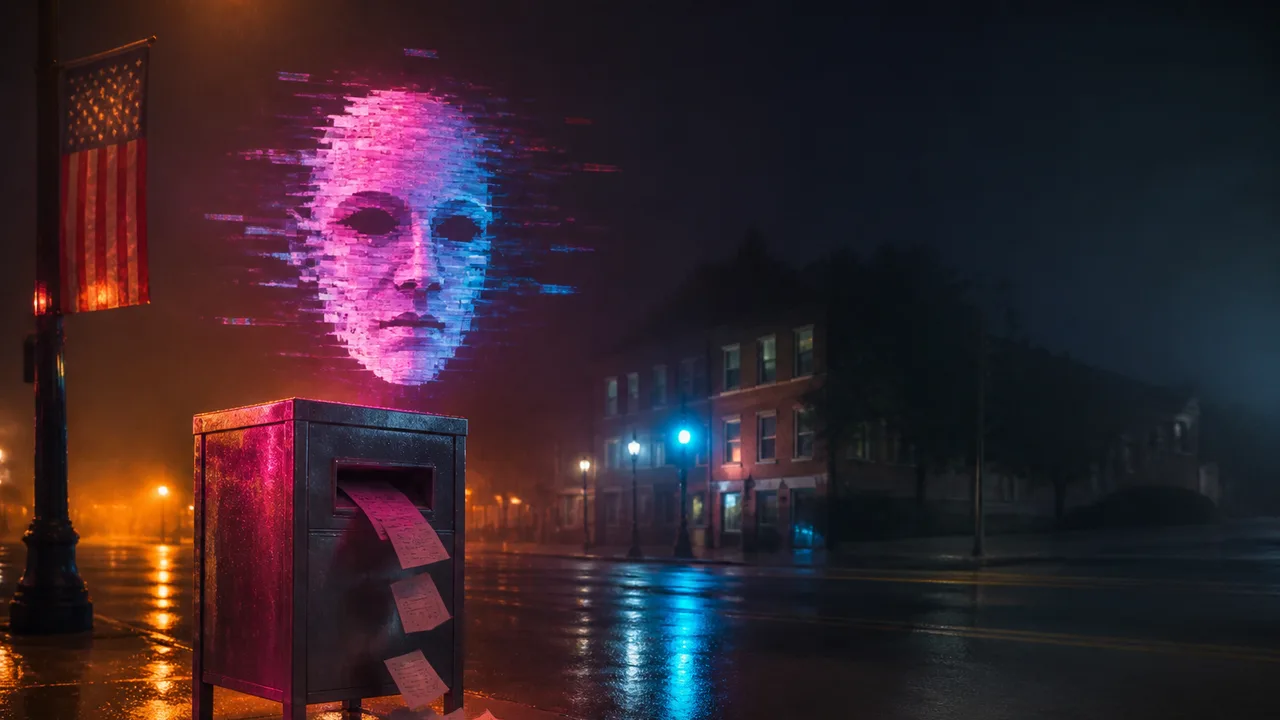
Five days before Garden City, New York, elected its Board of Trustees on March 18, two AI-generated videos began directing Instagram users to a fabricated campaign website.
The site purported to represent For A Better Garden City, or FABGC, and falsely presented its candidates as supporters of affordable and “diverse” housing at the St. Paul’s School property. The local dispute over that site was already politically combustible. AI supplied faster packaging and a sheen of documentary authority.
The Garden City News reported that the site was created with Manus, an AI website platform offering plans from $20 a month. Garden City real estate attorney Roy Parlanti posted the promotional videos on March 13, alongside a link to the site. The newspaper also documented a fake memorandum of understanding and an apparent deepfake showing FABGC candidate Jo-Ann Frey signing a document and kissing Parlanti on the cheek.
By March 30, the Instagram videos had accumulated almost 5,400 views. That number measures plays, not voters persuaded, unique local viewers or even people who noticed the claim. The newspaper published its investigation on April 2, more than two weeks after voting ended.
Those facts establish an attempted deception and a delayed public accounting. They do not establish that the material changed the result.
The Causal Claim Outruns the Available Evidence
A September commentary in Barrett Media called the fabricated website the “nail in the coffin” for a different election outcome and said a candidate favoring demolition of St. Paul’s had been leading in polls. The column identified no poll, exposure study, precinct analysis or voter survey supporting those assertions.
The local record supports a more disciplined finding. FABGC lost, then its candidates accused the opposing Community Agreement Party candidates and Mayor Brian Finneran of knowing about the fabricated material and refusing to denounce it. The CAP candidates disputed that characterization, condemned misleading content and personal attacks, and argued that residents could evaluate the information themselves.
No evidence in the published account connects individual exposure to a changed vote. The 5,400-view total was recorded 12 days after the election, so it cannot be treated as an election-day audience figure. Nor does the record disclose how many viewers lived in Garden City, had already voted or encountered a correction.
The documented harm is therefore an unresolved dispute over campaign conduct and institutional response. A false campaign infrastructure appeared shortly before voting, while the detailed local account arrived after ballots had been cast. Losing candidates then had grounds to ask why other political actors had not intervened sooner, even though the available evidence cannot show that earlier intervention would have altered the tally.
That production-response gap deserves more attention than claims of a proven election flip. A website builder can assemble persuasive graphics, candidate photographs and invented documents in hours. Verification still requires someone to preserve the material, contact the named people, establish who created it and publish findings under accountable authorship. Automation accelerates one side of that contest. The village newspaper still had to do journalism at human speed.
Slovakia Showed How Timing Can Become the Mechanism
Garden City has a larger and darker precedent. During Slovakia’s September 2023 parliamentary campaign, synthetic recordings impersonated then-President Zuzana Čaputová and Progressive Slovakia leader Michal Šimečka. One fake claimed Šimečka’s party planned to raise beer prices by 70 to 100 percent. Another purported to capture Šimečka and journalist Monika Tódová discussing ballot manipulation and a bribe.
The AI Incident Database timeline places the second recording on September 28, during an election moratorium that limited the ability of parties and news organizations to respond. Meta reportedly left some earlier cloned-voice videos online because disclaimers identified the voices as unreal and the company treated the material as satire.
Slovakia and Garden City differ in scale, political system and distribution. The Slovak material impersonated nationally prominent figures during a parliamentary contest. Garden City involved a village board election and a fabricated website attached to an intensely local property dispute. Slovakia’s moratorium formally constrained rebuttal; Garden City’s correction lag arose without such a rule.
The shared feature is the calendar. Both operations placed false material into circulation during the final days, when verification time was scarce and political attention was high. Neither case supplies causal evidence that synthetic media determined the result. Their value as comparisons lies in showing how late deployment can reduce the practical usefulness of a correction. A perfect fact check published after voting is an excellent archive and a poor campaign intervention.
AI Can Persuade, Although the Mechanism Counts
Caution about causation should not become complacency about persuasion. A peer-reviewed Nature study, published in December 2025, ran preregistered experiments around the 2024 US presidential election and the 2025 Canadian and Polish elections. Participants held conversations with AI models advocating for one of the two leading candidates. The researchers found significant shifts in candidate preference, larger than effects typically observed for traditional video advertisements.
The experiment also found that the models generally persuaded through facts and evidence, some of which were inaccurate. It demonstrates that interactive AI can influence political attitudes under controlled conditions.
A conversation tailored through multiple exchanges has a different persuasive mechanism from a passive website or short Instagram video. Participants in the study were assigned to engage with the model, while Garden City voters’ exposure, attention and prior beliefs remain unknown. The research establishes capability, not an estimate of what Parlanti’s posts accomplished.
That distinction also helps avoid treating every political use of AI as deception. Sayash Kapoor and Arvind Narayanan examined 78 documented uses of AI in 2024 elections and found that half were non-deceptive. Their analysis argues that distribution remains the bottleneck: generative tools make content cheaper to create, while reaching and persuading an audience still requires networks, attention and demand.
They also found that conventionally edited “cheap fakes” could be much more common. In one election they examined, cheap fakes appeared seven times as often as AI-generated content; cited fact-checking from Bangladesh found them more than 20 times as prevalent. A policy that recognizes only machine-generated deception would therefore regulate the production method while leaving similar lies made with older software untouched. That is a wonderfully precise way to miss the conduct.
What an Effective Response Would Have to Measure
Garden City suggests three separate intervention points. Platforms and tool providers can address production, social networks can address distribution, and election institutions or news organizations can address verification and rebuttal. Each solves a different problem.
A label may help viewers identify synthetic media, but it cannot establish whether the underlying claim is false. Rapid removal can limit distribution, though satire, parody and legitimate campaign speech complicate any rule based only on altered media. A right to seek a correction or court order may offer recourse, but the remedy loses electoral value if the process finishes after voting.
The case also shows why view counts make poor substitutes for impact studies. A serious assessment would need to know who saw the content before March 18, whether they believed it, whether they were eligible voters, whether their preferences changed and whether any change affected the margin. None of those measurements appears in the public record.
For readers assessing the next AI election alarm, the useful questions are correspondingly plain: Who created the content? When did it circulate? How was it distributed? What evidence shows that voters encountered and believed it? When did an authoritative correction arrive? Claims that synthetic media “flipped” an election should rise or fall on those answers.
Garden City leaves the vote-changing question open. It answers another one rather crisply: for $20 a month, a local political actor could manufacture a campaign’s apparent website and supporting documents faster than the community’s verification machinery could publicly dismantle them. The next election test will be whether the correction clock can run before the ballot clock expires.
More Like This
X's Grok Imagine 1.0 Raises Questions About AI Video
X's new Grok Imagine 1.0 creates 10-second AI videos. What does this mean for content creation, platform lock-in, and the synthetic media landscape?

AI Voice Cloning and the Accountability Gap
Voice cloning already passes in casual listening. The harder question isn't whether AI was used—it's who's accountable for what gets said with it.
ByteDance's Seaweed 2.0 Rewrites AI Video Generation Rules
ByteDance's Seaweed 2.0 video model generates frighteningly realistic clips—and highlights how different regulatory approaches shape AI capabilities.
Kling 3.0 AI Video Generator: Testing the Hype
CyberJungle stress-tests Kling 3.0's AI video generation: multi-shot scenes, native audio in 5+ languages, and character consistency. The results reveal both promise and problems.

AI Training Data: The Legal Vacuum No One Is Filling
AI companies built trillion-dollar products on data they never paid for. Courts are starting to push back—and Congress still hasn't shown up.

Quasars, AI, and the Vera Rubin Data Flood
Matt O'Dowd joins StarTalk to explain how quasars work, what gravitational lensing reveals, and whether AI can handle the Vera Rubin Observatory's data deluge.