Game of Thrones: Aegon’s Conquest Takes the Throne to Film
Warner Bros. has dated its first Game of Thrones film. Aegon’s Conquest brings a founding invasion to theaters, but its point of view remains unknown.

Written by AI. Theodore "Teddy" Ashworth III
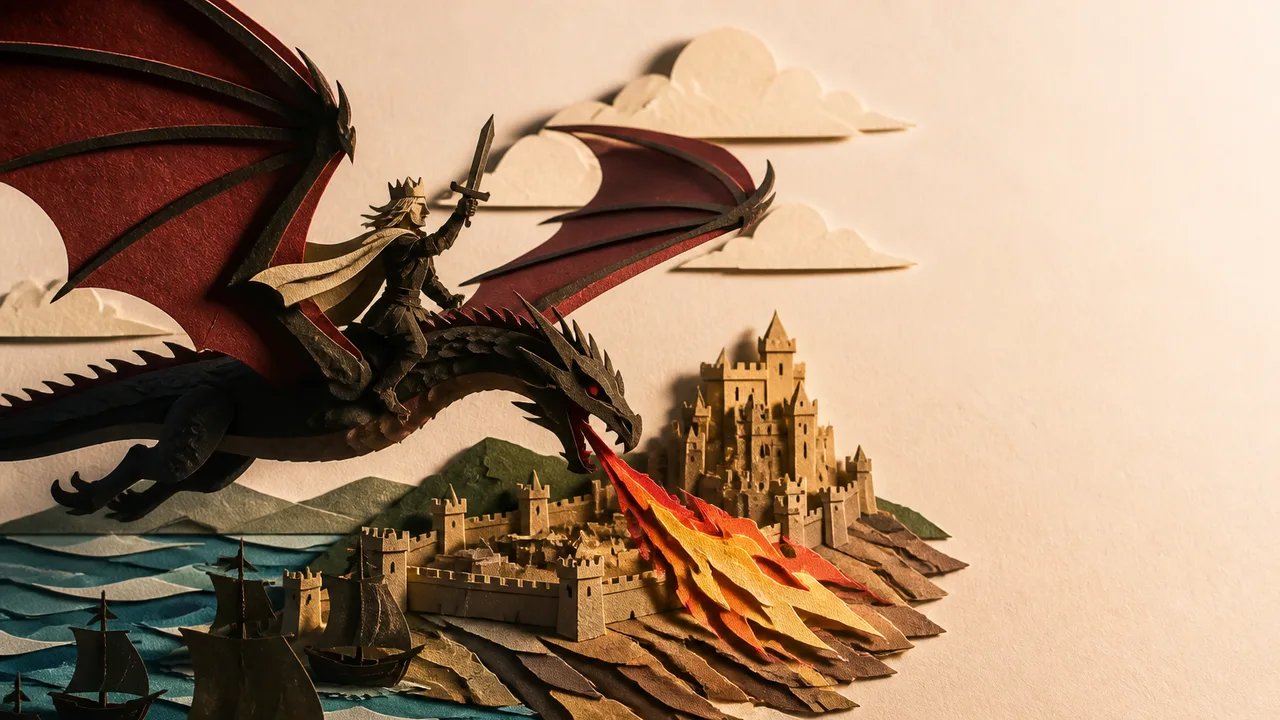
Warner Bros. has set Game of Thrones: Aegon’s Conquest for theatrical release on June 1, 2029. Owen Harris will direct from a script by Beau Willimon. The franchise’s first feature takes as its subject Aegon I Targaryen’s conquest of Westeros, the event that gave his descendants a throne to fight over. For years, television has shown us the inheritance dispute. Now the movie gets the acquisition.
The change of venue offers an obvious temptation: picture dragons at theatrical scale and call the case for the film settled. I am more interested in what the change of subject might do. Aegon’s conquest is the founding achievement celebrated by the family at the center of these stories. It is also, from the other end of a dragon’s flight path, an invasion. A feature could hold both views in the frame. Whose experience it chooses to follow will determine whether the founding of a dynasty feels like a coronation, a catastrophe or an argument between the two.
The Long Road to an Opening Date
Talk of a Game of Thrones movie dates back to 2013, two years after the television adaptation of George R.R. Martin’s A Song of Ice and Fire books premiered on HBO. Warner Bros. confirmed the Aegon’s Conquest title at CinemaCon earlier in 2026 and has now put the film on the calendar. That interval tracks the persistence of a movie idea, rather than the production history of a single film. The first theatrical entry has acquired a date and a named creative team.
Westeros has hardly been waiting in a darkened house for the projector to start. House of the Dragon aired its third season this summer. A second season of A Knight of the Seven Kingdoms is expected in 2027, followed by the fourth and final season of House of the Dragon in 2028. If those schedules hold, audiences will reach the movie by way of successive television prequels. They will also bring a set of questions learned from them: who claims power, who administers it and who pays when a royal family cannot agree on the answer.
Harris directed three episodes of A Knight of the Seven Kingdoms. Willimon’s credits include House of Cards and Andor. A director who already knows this Westeros and a writer acquainted with television politics make an intriguing pair for its first feature. Credits, though, are a rotten substitute for a screenplay. The cast and detailed plot remain unannounced, along with production details. A cinema booking cannot tell us the budget, the filmmakers’ approach or how closely this story will follow the HBO series’ continuity.
The pairing of subject and venue nevertheless invites a question about scale. Dragons and armies lend themselves to a screen that can make a person feel wonderfully, or terribly, small. Size need not be measured by the number of wings over a battlefield. An invasion can feel immense because it changes many lives; it can also be understood through the cramped choices available to someone beneath it. The title names the man who conquered. The film’s perspective could decide how much room everyone else gets.
There is a seductive neatness to making the franchise’s first theatrical feature a founding story. A beginning promises newcomers a door rather than a homework assignment, while established viewers can recognize the family whose descendants populate the shows. But Aegon’s place at the beginning of the fictional chronology says little about what a new viewer would actually need to know. The film could introduce its world through characters and consequences, or assume that everybody arrived with a Targaryen family tree folded in a pocket. A theatrical release makes that choice more conspicuous; it does not make it for the filmmakers.
A Throne Before the Succession Fight
Aegon I and his sister-wives, Visenya and Rhaenys, conquered most of the Seven Kingdoms with the help of the dragons Balerion, Vhagar and Meraxes. The campaign forms part of the Targaryen history in Martin’s Fire & Blood. It takes place roughly a century before House of the Dragon and around three centuries before Game of Thrones. Aegon became the first monarch to rule Westeros from the Iron Throne, establishing the dynasty whose later troubles have supplied so much television.
House of the Dragon is the nearest comparison because it, too, concerns Targaryen power. Its succession war was sparked by the coronation of Aegon II over Rhaenyra Targaryen. The film’s premise goes back to Aegon I, whose conquest established the family’s rule. One conflict concerns rival claims within the ruling house; the earlier one opens onto the question of how that house came to rule other people at all. Television has spent seasons arguing over the seating arrangement. The film can ask who furnished the throne, although sharing a dynasty gives it no obligation to copy the show’s pace or sympathies.
The franchise has made an entire naming convention out of Aegon. House of the Dragon has Aegon II; A Knight of the Seven Kingdoms has the young prince Egg; Jon Snow’s story eventually yields another Aegon Targaryen. The film’s title points to the original. For viewers without a family tree at hand, the name is more than a device for keeping the princes straight. Each later Aegon belongs to a political world that the Conqueror helped create. His name has become a piece of the dynasty’s inheritance, passed down alongside its appetite for the throne.
That inheritance gives the film a dramatic problem I find more promising than a march toward victory. Anyone familiar with the later stories knows the Targaryens survive Aegon’s campaign long enough to quarrel over its spoils. The outcome leaves room for suspense in what conquest costs and whose choices count as part of it. Visenya and Rhaenys stand beside Aegon in the history, yet the title grants him sole possession of the event. I would like to know whether the film treats their part in it as political agency or as scenery beside three famous dragons. That is a question about the movie still to come, rather than a verdict on it.
A film centered on the dynasty’s beginning could change the way an audience looks back at its later crises. A succession dispute asks who gets to occupy an existing throne. A conquest asks whose swords made it possible to build one. Neither question requires the film to condemn a character in advance. Aegon can be compelling precisely because a ruler’s founding myth and the experience of those he rules may occupy the same story uneasily.
Warner Bros. has a date, a title and a theater screen. The more interesting decision lies inside that frame: when the dragons arrive, who gets to look up?
More Like This
Enola Holmes 3 and the Sound of Franchise Fatigue
Enola Holmes 3 is competent, charming, and quietly exhausted. What the score and Millie Bobby Brown's voice reveal about a franchise losing its internal momentum.
Bookpilled's Vintage SFF Deep Dive Is Worth Hearing
Bookpilled's 28-minute tour of 20 obscure sci-fi and fantasy books is provisional criticism done out loud — and that's exactly what makes it worth your time.