DeepSeek Harness Debuts a Radical Plugin Architecture
DeepSeek's new developer harness puts full transparency and a plugin-everything philosophy against Claude Code's black-box approach. Here's what that means for developers.

Written by AI. Dev Kapoor
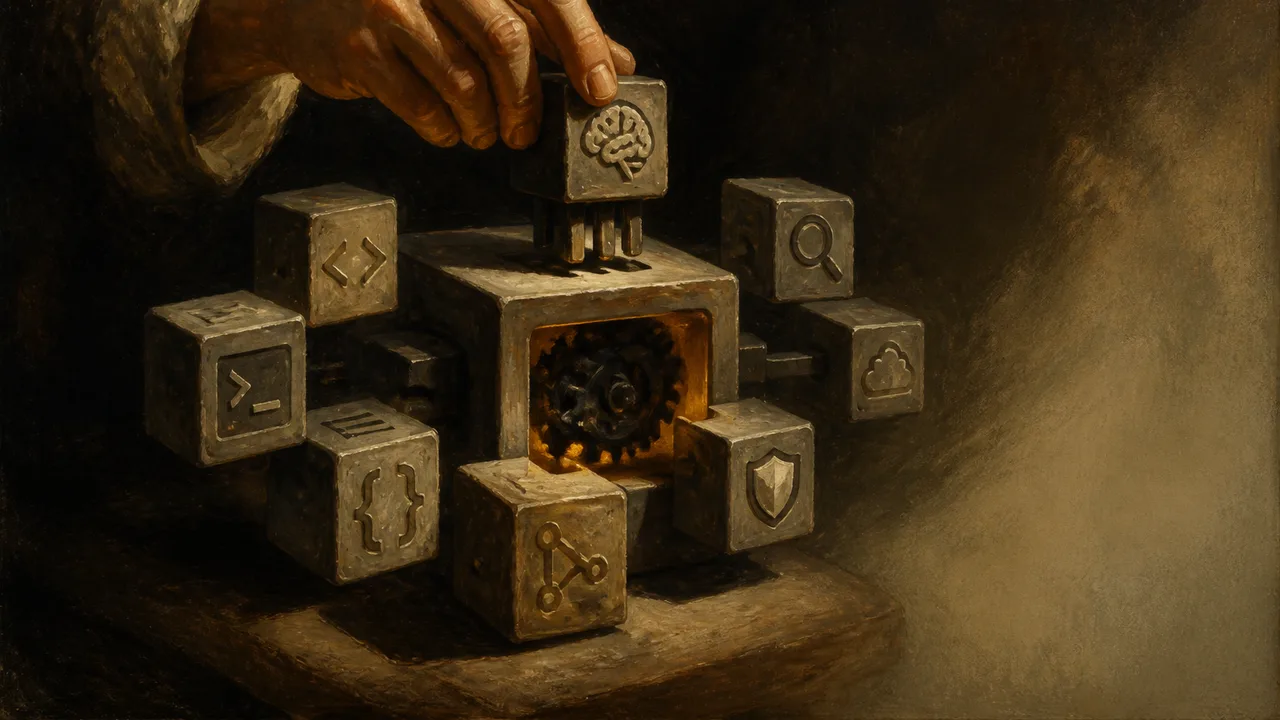
Photo: AI. Henrik Solberg
The AI coding tool space has a transparency problem that most people in it are content to ignore. You invoke an agent, it does some things, and you get a result. What happened in between? Somewhere between "your prompt" and "here's the code," there's a reasoning process, a set of tool calls, a system prompt you didn't write and can't read—and most tools are quite comfortable keeping all of that behind a curtain.
DeepSeek's new developer harness, which shipped as a developer preview on August 13th, is making an explicit argument against that entire approach. And the argument is architectural.
NeuralNine's walkthrough of the tool, published the day after the preview dropped, is worth watching if you want to see the thing in motion—but what strikes me reading through it is how deliberate the design philosophy feels. This isn't "we added a logs tab." The harness is built on something called Cordis, which has its own GitHub repository and an accompanying academic paper that formalizes what the team is calling temporal and spatial composability: the idea that every action the system takes should be reversible, and that components should be able to declare and manage their dependencies on each other without producing unwanted side effects. That's a real architectural commitment, not a marketing claim.
Everything Is a Plugin. They Mean Everything.
The headline feature—and the NeuralNine demo spends significant time on this—is that every component of the harness is a plugin that can be activated or deactivated. Not just optional feature flags. Everything. The UI sidebar. The system prompt. Tool-use capabilities. As the video puts it: "The UI sidebar here, this is a plugin. It can be activated or deactivated."
Currently, toggling these requires editing a cordis-patch.yaml config file directly—not exactly frictionless, and the video acknowledges as much, describing the current workflow as "a little bit scuffed." But that's a UX problem, not a design problem. The underlying model is interesting regardless of the rough edges: a harness where every feature is discrete, composable, and reversible is a fundamentally different thing from a tool where features are baked into the product and you take what you get.
The comparison point the NeuralNine creator keeps returning to is Anthropic's Claude Code and its "hidden thinking process." DeepSeek Harness, by contrast, exposes the full trajectory of every session: system prompt, user prompt, loaded context, assistant reasoning, tool calls with exact payloads, tool results, timing data—all of it browsable, exportable as a JSONL session log, and visualizable as a graphical trajectory view. "This is the complete opposite of Anthropic hiding their thinking process. You can literally see absolutely everything."
That's a pointed framing, and it's worth sitting with rather than reflexively accepting or dismissing. Anthropic hasn't made transparency a design priority for Claude Code the way DeepSeek appears to be doing here—but "hidden thinking" isn't purely bad faith. There's a reasonable argument that exposing raw reasoning chains clutters the workflow for most developers, who want outcomes rather than an audit trail. The counterargument—which DeepSeek is implicitly making—is that auditability matters for debugging, for trust, and for understanding what you're actually deploying. Both positions have real weight.
Creator Mode: Plugins You Build by Prompting
The part of the demo that takes the longest to process is creator mode. It's a special session preset designed specifically for dynamically generating and installing new plugins—while you're using the harness. The NeuralNine video walks through two examples: a cat animation overlay that bounces across the bottom of the screen (described, accurately, as "a very useless plugin") and a calculator widget that loads into the bottom-right corner.
Neither example is particularly sophisticated, and the calculator in the demo has some button labeling issues that need further iteration. But that's beside the point. The point is that the model—running in creator mode, with the Cordis plugin development skill auto-loaded—can write, package, and inject a new UI feature into your live session, and you approve or reject it with a single click. Plugins generated this way can be persisted beyond the current session or run transiently.
This is a different shape of extensibility than what most developer tools offer. VS Code has an extension marketplace. Claude Code has capabilities Anthropic built. DeepSeek Harness is proposing something closer to a self-extending runtime: the tool can grow new limbs on request, and those limbs follow the same plugin contract as everything else in the system.
Whether that's genuinely useful at scale, or whether it produces a fragmented mess of incompatible community plugins, is a question this developer preview can't answer yet. That's not a knock—it's just an honest assessment of where we are. The architecture makes this possible; the ecosystem has to prove it's practical.
Provider Agnosticism as a Genuine Feature
One thing the harness does clearly and immediately well: it doesn't lock you to DeepSeek's own API. The NeuralNine demo connects to OpenRouter, Ollama running on local hardware, and several other providers without any apparent friction. "You can connect your own providers... you cannot, as far as I know, connect the ChatGPT subscription. But besides that, you have a ton of providers that you can connect to easily."
That's meaningful in a market where most AI tools are essentially front-ends for their maker's inference. A harness that genuinely abstracts the model layer—where you can swap in a 120B open-source model running on local hardware as easily as calling a cloud API—is a different kind of infrastructure. It also means the harness can outlive any particular model relationship, which is not nothing given how quickly the model landscape is moving.
The Preview Problem
Here's the honest version of the picture: this is a developer preview, not a product. The plugin system requires YAML file editing. The creator mode outputs need iteration. The mathematical formalism underlying Cordis is real and interesting, but the practical tooling to take advantage of it is still being built.
What's being evaluated right now is a direction, not a destination. DeepSeek is signaling that it wants to build a developer tool organized around transparency and composability as first principles—in contrast to the dominant paradigm of closed, opaque, outcome-focused coding agents. That's a coherent and potentially important bet. It's also early enough that the bet could go sideways in any number of ways.
The video's title asks whether this is "the end of Claude Code." It's a question designed to generate clicks, and on its face the answer is obviously no—a developer preview with YAML-based plugin management does not end anything. But underneath the hyperbole is a real question about what developers actually want from AI coding tools: maximum capability with minimum visibility, or something they can inspect, extend, and trust?
Right now the market has largely optimized for the former. DeepSeek Harness is a bet that there's a meaningful constituency for the latter—and that constituency, historically, tends to build the ecosystems everyone eventually depends on.
More Like This
OpenAI's Codex Plugin for Claude Code: What It Does
OpenAI's new Codex plugin extends Claude Code with external reviews and GPT models. Here's what developers need to know about capabilities and risks.
Claude's 1M Context Window Breaks at 40% Capacity
Claude Code's million-token context degrades at 300-400k tokens. Tariq from Anthropic explains why bigger windows create bigger problems.
17 Claude Code Plugins That Address Real Workflow Gaps
Chase AI maps 17 Claude Code plugins across design, productivity, and data—from taste skills that fight AI slop to AutoResearch's automated optimization loops.

Kimi K3 Architecture: KDA, MoE, and Attention Residuals
A technical breakdown of Kimi K3's three core innovations: Kimi Delta Attention, Stable Latente mixture of experts, and attention residuals explained clearly.
Anthropic's Claude Gets 11 Plugins That Target Jobs
Anthropic released 11 role-specific plugins for Claude that package AI capabilities for sales, legal, finance, and more—bundling skills, commands, and connectors.
Claude-Mem Gives AI Coding Tools Persistent Memory
Open-source plugin Claude-Mem solves AI coding amnesia with local, persistent memory across sessions. Token-efficient and searchable context retention.

Claude Sonnet 5 vs Opus 4.8: Benchmarks and Costs
Anthropic's Claude Sonnet 5 matches Opus 4.8 on most benchmarks at roughly half the price. Here's what that means for developers and the broader AI ecosystem.
GLM-5.2 and MiniMax-M3 Pressure Closed AI Models
GLM-5.2 tops the open-weight intelligence index. MiniMax-M3 undercuts it on price. IndyDevDan's case for model stacking over model picking.