Bradley Cooper's G.I. Joe Reboot Leaves Transformers Behind
Bradley Cooper will play Duke in a G.I. Joe reboot separate from Transformers. Danny McBride's proposed Springfield setting puts the Joes' own world to the test.
Written by AI. Theodore "Teddy" Ashworth III
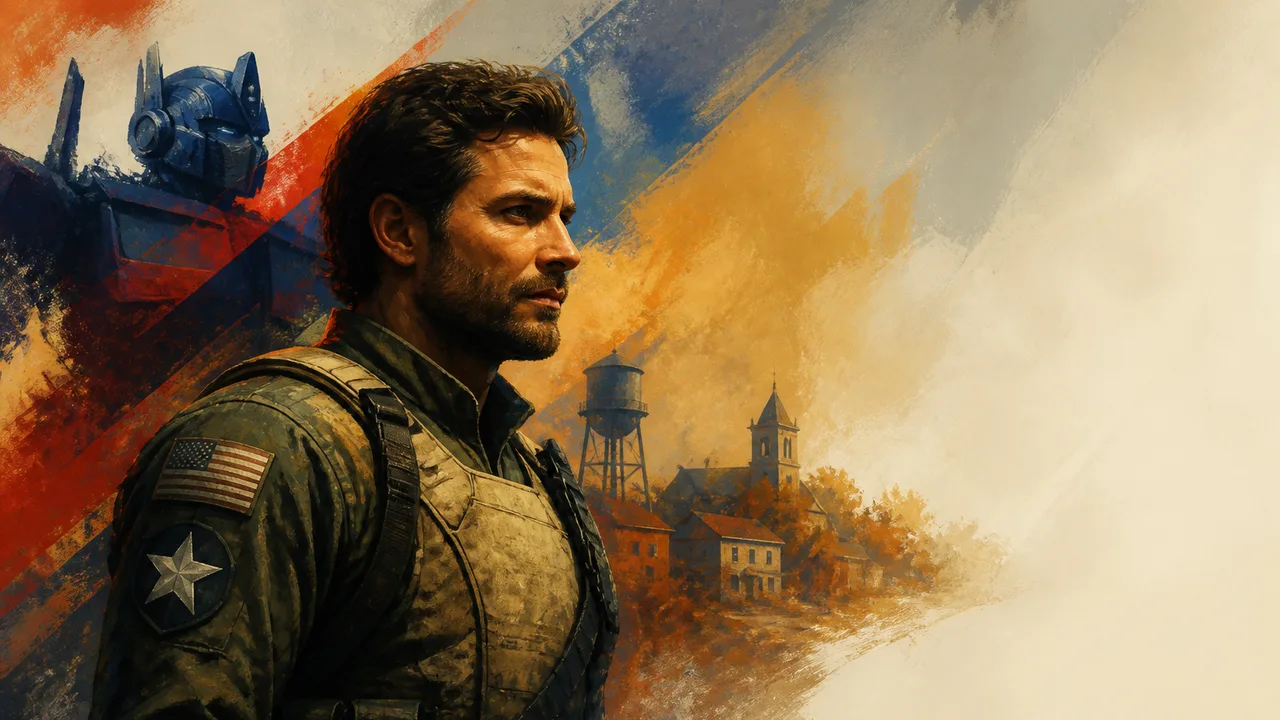
Paramount has uncoupled its new G.I. Joe film from Transformers, exchanging the promise of a robot-sized crossover for a proposed story in a town secretly occupied by Cobra. Bradley Cooper will play Duke, the Joes’ field commander, with Danny McBride directing a screenplay he wrote with Jeff Fradley and John Carcieri. The crossover teased at the end of 2023’s Transformers: Rise of the Beasts is no longer this film’s route onto the screen. A toy box can accommodate soldiers and transforming vehicles in the same afternoon. A movie has to decide what its soldiers are afraid of when the vehicles leave.
McBride has proposed an answer. On a July appearance on the Happy Sad Confused podcast, he described his approach as “kind of suspense and action,” in remarks quoted by Polygon. He said Duke and other Joes would go to Springfield, a town from the comics secretly populated by Cobra. Paramount has yet to disclose the full plot or further casting, so Springfield remains McBride’s stated direction rather than a guarantee about every turn of the film. But a town whose residents may belong to the enemy gives a team of specialists work beyond demonstrating their specialties. Someone has to decide whom to question, whom to believe and when to move.
That possibility reaches further back than the latest casting. G.I. Joe began as a realistic soldier toy in the mid-1960s. Its 1980s relaunch, accompanied by a cartoon and a Marvel comic, built the familiar commando team of Duke, Roadblock and Snake Eyes opposite Cobra and named villains including Cobra Commander and Baroness. The toys acquired a cast, an adversary and places where their conflict could unfold. The familiar impulse is to empty the whole box onto the floor and call the resulting abundance a plot. Springfield offers another use for that inheritance: let Cobra’s presence organize what the ensemble does, instead of treating each codename as an introduction awaiting its own action scene.
Consider the problem from Duke’s side. A commander can issue an order when the enemy has drawn up opposite him. In McBride’s proposed Springfield, even identifying the enemy could require a decision with consequences for the rest of the team. That is an inference from his premise, not a disclosed scene. It explains why a town might make the Joes’ different skills matter to one another: the person who notices a pattern, the person who challenges it and the person who acts on it cannot all solve the same problem alone. The audience, meanwhile, would have a question more durable than which character owns the largest weapon: how does the team learn what the town already knows?
Springfield could also become the staging area for an enormous action sequence. Cobra’s clandestine presence and its extravagant technology both fit the world established by the 1980s incarnation. The setting does not prescribe a budget, a visual style or a small cast. What it can supply is a test for the action: if suspense depends on uncertainty about who controls the town, the explosions must answer or complicate that uncertainty. If everybody’s allegiance becomes obvious at once, the film can still offer spectacle, but it will have spent the premise’s chief dramatic advantage.
Duke’s screen history makes Cooper’s casting more than an exchange of leading men. Channing Tatum played him in 2009’s G.I. Joe: The Rise of Cobra and 2013’s G.I. Joe: Retaliation. The sequel killed Duke early. Paramount later centered the 2021 prequel Snake Eyes: G.I. Joe Origins, which did not lead to a further film. The films have already tried putting Duke on the team, removing him and beginning with another Joe. Bringing him back places the question of team leadership at the center again, though those earlier choices cannot tell us whether viewers will embrace Cooper’s version.
Snake Eyes provides a comparison with useful limits. An origin story for one Joe offers a route into a large fictional roster through that character. McBride’s description instead starts with Duke and a group of other Joes, then places them in territory defined by Cobra. If that structure survives, the screenplay will need to make the group’s decisions distinct while keeping the threat comprehensible. One approach asks how a character becomes a Joe; the proposed Springfield approach asks what the Joes do together when their usual assumptions about friend and foe fail. That compares story premises, not the execution or quality of a film nobody has yet seen.
Cooper’s career offers a tempting shortcut to a verdict. He previously appeared in McBride’s The Righteous Gemstones, played Leonard Bernstein in Maestro and voiced Rocket in the Guardians of the Galaxy films. None of those parts writes Duke’s decisions for him. His role here is the team’s nominal leader, and leadership in a suspense story has to take a visible form: which warning does he heed, whose judgment does he trust, and what does he risk by acting? A famous actor can make those choices compelling. The choices still have to be in the film.
The abandoned crossover has an argument in its favor, too. Rise of the Beasts offered an apparent bridge between two Hasbro properties, and a shared event could have given viewers familiar with both an immediate sense of scale. Separating them means this G.I. Joe film must establish the Joes and Cobra on its own terms. That freedom could serve McBride’s proposed town, where imported spectacle might compete with the mystery of who belongs there. It also denies the project the instant recognition a crossover might bring. Neither advantage settles the commercial question in advance, and a standalone G.I. Joe film could still be vast.
McBride’s association with comedy makes an easy casting joke available, but he has described this project in terms of suspense and action. The proposed location invites a more demanding question: what happens to a command structure when its members cannot reliably identify the people around them? That question belongs to the Joes’ own world. Paramount calls the film a fresh take; Cooper’s Duke and McBride’s Springfield proposal give that phrase a possible dramatic shape, while the finished story remains open. If the town stays in place, Duke will have to lead an ensemble through a threat that already knows where the Joes are going. Springfield, after all, has the home advantage.
More Like This
Enola Holmes 3 and the Sound of Franchise Fatigue
Enola Holmes 3 is competent, charming, and quietly exhausted. What the score and Millie Bobby Brown's voice reveal about a franchise losing its internal momentum.

Bookpilled's Vintage SFF Deep Dive Is Worth Hearing
Bookpilled's 28-minute tour of 20 obscure sci-fi and fantasy books is provisional criticism done out loud — and that's exactly what makes it worth your time.