Apple's Welcome Home Event Tests the Case for a Screen
Apple's October 13 event may bring a home display. Existing Home app controls and HomePod and Apple TV hubs set the test for what a shared screen could add at home.

Written by AI. Bob Reynolds
Apple has scheduled a “Welcome Home” event for October 13 at 9 a.m. Eastern in New York. Greg Joswiak, Apple’s senior vice president of worldwide marketing, posted the date with an embroidered Apple logo. Apple has not announced a product lineup. The invitation establishes where and when; the proposed hardware remains a prediction.
A home device with a display, a new HomePod mini and a new Apple TV are expected. A home hub and updates to the speaker and TV box are also possibilities. For anyone considering a purchase, the useful question begins with what Apple already sells and supports.
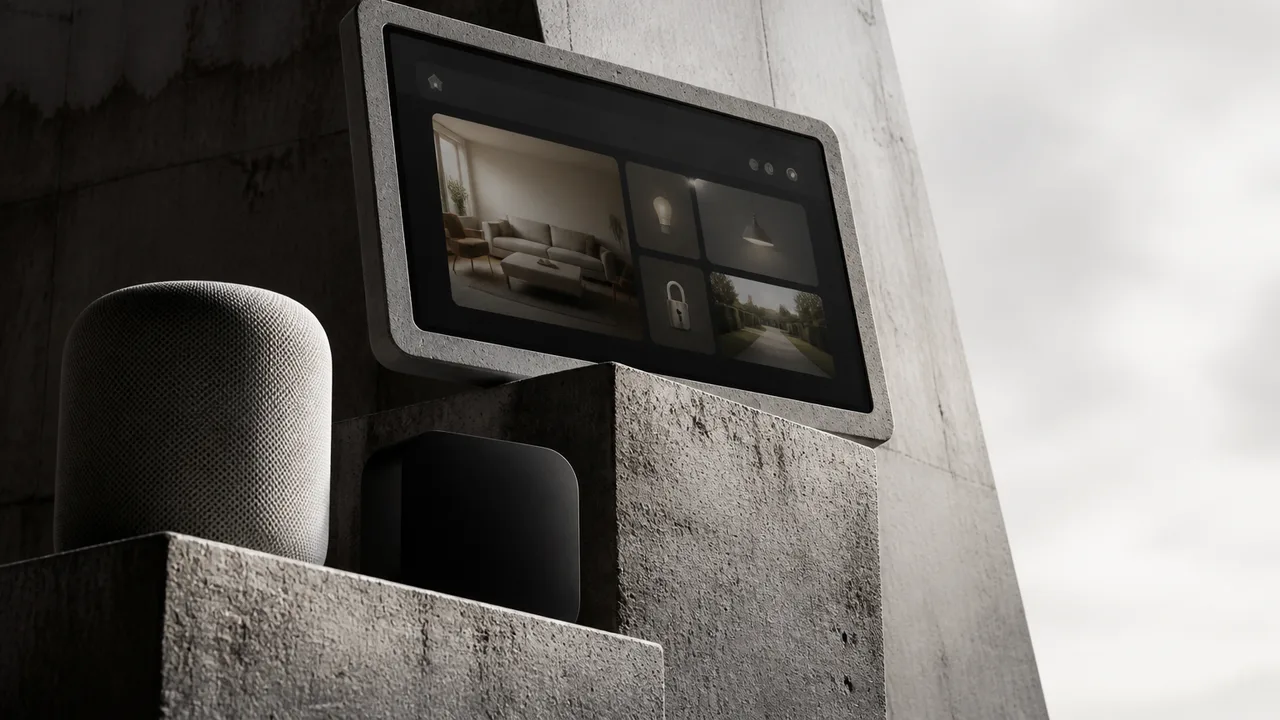
The screen is the interesting prospect because Apple already has a home-control system. A phone can show controls. A HomePod or Apple TV can perform the behind-the-scenes job Apple calls a home hub. A display intended to sit where several people can see it would have a different job: making controls easy to find without first picking up someone’s phone. Whether Apple’s rumored device does that well is a question for an announcement and, eventually, use in a home.
Apple Already Built a Place to Control the Home
In its 2016 introduction of the Home app, Apple described one place to set up, manage and control compatible accessories. People could operate accessories individually, group them into scenes and use Siri. Apple also described remote control and automation using Apple TV, including triggers based on time, location or an action.
That history narrows what would count as a new idea on October 13. A screen showing a list of lights would give Apple’s existing controls another address. A screen that stays in a common room could change how readily a household uses those controls. One person checking the state of a light would no longer have to locate the Home app on their own device, assuming the new product presents that information clearly. The possible improvement is access, not the invention of centralized control.
Apple uses the word “hub” for a separate function. Its current setup instructions say a HomePod, HomePod mini or Apple TV can serve as a home hub. The hub enables control while away, shared control and automations. Apple says a home hub is required to add Matter accessories to the Home app; some Thread-enabled Matter accessories require a compatible Thread-enabled home hub or a supported third-party border router. Those are operational requirements, not properties a device gains merely by having a screen.
Apple’s instructions give a concrete example of how the existing system works. A HomePod becomes a home hub when set up. An Apple TV becomes one when added to a room in the Home app. The Home app can show which hub is active. A household can therefore have a working hub that nobody ever approaches to tap a home-control dashboard. The hub keeps the system running; the app gives people a way to direct it.
The reported display would enter this arrangement as a potential third role. The anticipated device is described as a central interface. “Central interface” describes where a person might interact with the system. Until Apple explains what the device does, treating those roles as interchangeable would make a purchasing decision harder rather than easier.
The Screen Has to Earn Its Place
Consider the alternatives already inside Apple’s system. The Home app puts controls on an iPhone, iPad or Mac. HomePod and Apple TV can each serve as a home hub for remote control, sharing and automations. A dedicated home display, if Apple announces one, would presumably put a control surface in a fixed location. These roles could coexist, but the reason to choose each would differ.
A fixed screen could be useful when several people need the same quick answer: are particular accessories on, and where is the control to change them? A phone travels with its owner; a screen in a shared room could remain in a predictable place. That argument assumes the interface exposes useful information at a glance and lets household members act on it without unnecessary steps. A larger display alone does not settle either question.
Location would also change the test. A screen in a room where people regularly adjust lights could save a trip through the Home app. The same screen in a room where nobody changes settings would add little to an existing setup.
If a household already uses the Home app and its automations comfortably, a stationary screen might mostly duplicate controls people have learned to reach for elsewhere. Apple’s 2016 pitch already included scenes and triggers that reduce the need to tap anything. For someone whose lights follow a schedule, the strongest case for another control panel may arise on the days the schedule needs changing. How often that happens will depend on the home, not on the size of an event invitation.
The existing hub requirement also changes the shopping question. Someone trying to add Matter accessories should check which compatible home hub or Thread setup their planned accessories need. Someone who already has a suitable HomePod or Apple TV can ask what a new screen would add to daily use. Apple’s setup instructions establish the present requirements; they do not specify what an unannounced display will support.
Gurman’s expectation of new HomePod mini and Apple TV hardware makes that separation especially useful. If Apple updates those products, buyers will need to look past the device names to the functions Apple actually changes. A new speaker or revised TV box could still serve the established hub role; the grounds for upgrading would depend on features, compatibility and performance Apple demonstrates. The same test applies to a display: what can people do at that screen that is cumbersome in the Home app?
For now, Apple has promised an event with a home-themed invitation. The company’s own documentation shows that centralized controls and home hubs preceded it by years. If a display appears on October 13, its most persuasive case will be a modest one that Apple can show plainly: making an existing home system easier for the people who share it to use.
More Like This

Grok 4.5 Benchmarks, Costs, and Coding Performance
Grok 4.5 is cheaper than GPT 4.5 and Claude Opus 4 — but does that make it the right coding model? A clear-eyed look at what it actually delivers.

Booking Holdings CEO on AI, Scale, and Survival
Booking Holdings CEO Glenn Fogel survived the dot-com crash and now faces the AI wave. His take on moats, agentic travel, and job displacement is worth your time.