How Tech Lock-In Shapes Our Present and Future
Exploring how early tech decisions, like AI and QWERTY, still impact our daily lives.

Written by AI. Amelia Nwofor
In the intricate tapestry of our daily lives, the invisible threads of past technological decisions tug at the present. Imagine typing on a keyboard designed not for efficiency but to prevent typewriter jams—a relic of the QWERTY layout's origins. Or consider train tracks, whose gauge may—or may not—trace back to Roman chariots, dictating the design of everything from space shuttle components to modern transportation infrastructure.
These are not just quaint historical anecdotes. They are prime examples of "technological lock-in," a phenomenon where early, often suboptimal, technologies become entrenched, blocking the path for potentially superior successors. Anil Ananthaswamy, in conversation with Dr. Brian Keating, dives into this concept with a fresh perspective, particularly as it applies to the burgeoning realm of artificial intelligence (AI).
The AI Conundrum: Locked into LLMs
As Ananthaswamy notes, we're at a crossroads with AI, particularly with large language models (LLMs). "The economic incentives now to succeed in this arena are so high," he points out. Indeed, the financial windfall that accompanies breakthroughs in AI has led to a disproportionate emphasis on scaling up existing models. This focus on LLMs, bolstered by vast amounts of internet-scraped data and the computational prowess of GPUs, risks overshadowing more energy-efficient and potentially innovative approaches.
Yet, is this lock-in a foregone conclusion? Ananthaswamy suggests it's "entirely possible," but the story is more nuanced. While the success of LLMs may crowd out alternative research, it also reflects a broader trend in tech investment: the allure of immediate returns over long-term potential.
Economic Incentives and Their Discontents
The economic landscape driving AI development is shaped by more than just profit. Investors, researchers, and policymakers form a triad of influence, each with their own stakes. The rush to scale up LLMs can be likened to a gold rush, where the promise of intelligent behaviors fuels investment, sometimes at the cost of exploring diverse methodologies that could offer breakthroughs in general AI.
But what of the claims that economic incentives are skewed? A closer look reveals a complex ecosystem where scaling is often seen as the safest bet. However, the potential drawbacks are significant. Models that are "much more sample efficient like our brains," as Ananthaswamy puts it, may be left underfunded, their promise untapped.
The Broader Human Implications
The choices we make today in AI development could ripple through generations. As we lock into certain technologies, we risk narrowing the scope of innovation. But there's a silver lining: awareness of technological lock-in can guide more informed decision-making.
Imagine a future where our tech landscape isn't dictated by the ghosts of decisions past but is instead a testament to thoughtful consideration and adaptability. It prompts a reflection: how do we ensure that the technological choices we make today serve not just immediate needs but also foster a fertile ground for future innovation?
As we navigate this landscape, the question isn't just about which technologies will dominate but how we can maintain agility in an ever-evolving world. After all, the most significant lock-in might not be technological but a mindset that resists change.
More Like This

Neil deGrasse Tyson on Jupiter, AI, and Alien Humor
Neil deGrasse Tyson tackles Jupiter's magnetic core, the AI naming problem, and whether aliens laugh in StarTalk's Cosmic Queries grab bag episode.

The Enigma of Simultaneity in Relativity
Explore how the relativity of simultaneity reshapes our understanding of time and challenges the concept of a universal 'now.'
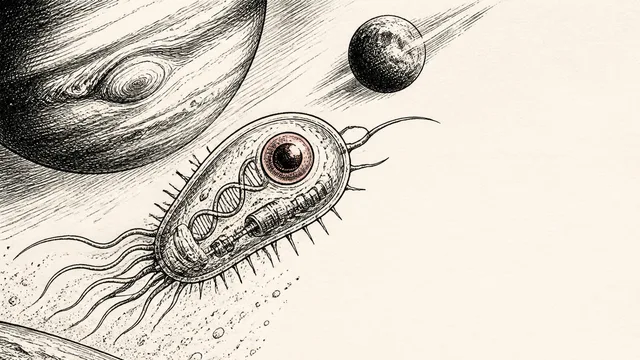
Are We Alien Probes? Yampolskiy's Wild AI Theory
AI safety researcher Roman Yampolskiy argues aliens would send biological von Neumann probes—and humans might be them. Then physics complicates everything.

Could CERN's LHC Create a Black Hole?
Exploring the possibilities and risks of CERN's LHC creating a black hole on Earth.
Leadership and Legacy: The ISS Change of Command
Explore the symbolic ISS Change of Command, highlighting international cooperation and leadership in space.

Does Reality Require Us? Exploring Quantum Mysteries
Unpack the role of observers in reality, exploring quantum mechanics, entropy, and the nature of existence.

Hannah Cairo Disproved a 40-Year-Old Math Conjecture at 17
At 17, Hannah Cairo overturned the Mizohata-Takeuchi conjecture using a hypercube and a coin diagram. Here's what she actually did—and why it matters.

How Language Shapes Thought, According to Lera Boroditsky
Cognitive scientist Lera Boroditsky explains how the language you speak shapes memory, color perception, and thought—and what's lost when languages disappear.