The Calculator Moment Returns: Why Kids Need Both AI and Pencils
AI tutors are doubling learning outcomes while students lose the ability to read chapters. The answer isn't choosing sides—it's remembering what we learned in 1975.

Written by AI. Mike Sullivan
We've been here before. In the 1970s, when electronic calculators became affordable, the education establishment had what can only be described as a full-blown panic attack. Calculators in classrooms were cheating, full stop. They would destroy children's ability to do arithmetic, produce a generation mathematically illiterate, incapable of thinking numerically. Schools banned them. Parents protested. The debate consumed education policy for over a decade.
We know how that story ended. Calculators didn't destroy mathematical thinking—they changed what mathematical thinking meant. Once students didn't need to spend twenty minutes on long division, they could spend that time on the concepts long division was supposed to serve: proportional reasoning, algebraic thinking, problem decomposition. The tool freed learners from the mechanical to engage with the meaningful.
Here's the part that gets left out: The transition worked because students still learned those mechanics first. They understood what the calculator was doing. They could estimate whether an answer was reasonable. They could catch errors. They had the foundation, and the tool extended it.
Now we're in that calculator moment again, except it's not just arithmetic. It's reading, writing, research, analysis, coding, creative work, communication, problem-solving—every cognitive task that AI can now perform competently. The scope is fundamentally different from 1975. The principle, I'd argue, is not.
What The Numbers Actually Show
Nate B Jones, an AI strategist and parent of three, lays out the tension in stark terms. A Harvard study found that students using AI tutors learned more than twice as much material in less time than students in traditional settings. A collaboration between Edtech companies and Google DeepMind showed AI tutoring systems outperforming human tutors on problem-solving tasks—66% versus 60%. When you combine human teachers with AI tutoring, knowledge transfer doubles.
These aren't marginal improvements. Benjamin Bloom established decades ago that one-on-one tutoring produces about a two-sigma improvement in standard deviation—a massive effect. The constraint was never whether personalized tutoring works. We figured that out. The constraint was that you can't give every child a personal tutor. AI is removing that constraint.
Khan Academy's AI tutor, Khanmigo, went from 68,000 users to 1.4 million in a year. An 8-year-old can build video games with Claude by typing "make the bad guys tigers." An 18-year-old CEO is pulling down $1.4 million a month with an AI-built app. This is the water every kid on Earth is swimming in.
Meanwhile, college professors report that students are arriving who can no longer read a full chapter, who can no longer synthesize arguments from multiple sources or sit with difficult text long enough to extract meaning. High school teachers report writing quality has collapsed—not just because students submit AI-generated work, but because even students who aren't using AI have lost the habit of struggling through a draft. The muscle has atrophied before anyone noticed it was weakening.
The Specification Problem
Jones describes his 10-year-old doing long division by hand with a pencil—and also teaching her to "vibe code" with Claude. These aren't contradictory positions, he argues. They're the only positions that make sense together.
The reasoning connects to something he's observed watching autonomous AI agents operate in the real world: The quality of output is determined by the quality of human specification. He cites an agent that negotiated $4,200 off a car purchase while its owner was in a meeting. That same week, a different agent sent 500 unsolicited messages to friends and family. Same technology, same architecture. The difference was the human's ability to specify clear objectives, defined constraints, bounded communication channels.
"You don't get to write a good spec for something you don't understand," Jones says. "You can't evaluate an AI's output in a domain where you have no knowledge. You cannot exercise good judgment—taste, discernment, critical thinking—about work you've never engaged with deeply enough to internalize."
When his kid asked Claude to add enemies to her game, Claude added enemies that spawned offscreen, moved in the wrong direction, couldn't be hit. After talking through what she actually wanted, she refined the prompt: "Add three enemies that spawn from the right side of the screen, move them left at medium speed, and make them disappear when the player touches them." Suddenly it worked.
That conversation, Jones argues, taught specification quality better than any scripted lesson. The kid wasn't debugging code—she was debugging her own intent. And that skill transfers to everything from professional software development to articulating what you want from any system.
The Metacognition Gap
Andre Karpathy, Tesla's former head of AI and founder of Eureka Labs, an "AI-native school," has a formulation Jones keeps returning to: The goal is to raise young people who are proficient in the use of AI but can also exist without it. Proficient and independent. Not one or the other.
Karpathy also said something every parent and teacher needs to hear: "You will never be able to detect the use of AI in homework. Full stop."
He's right. The arms race between AI writing detection and AI writing generation was over before it started. Schools buying AI detection tools are judging kids based on a heuristic that is mathematically impossible to implement correctly. The educational response cannot be better detection. It has to be a fundamental rethinking of what we're measuring and why.
The skill connecting foundation to AI fluency is metacognition—the ability to think about your own thinking. To know what you know and what you don't. To make deliberate decisions about when to rely on yourself versus when to delegate to a tool. Researchers increasingly call this the defining competence of the AI age. Not what you know, not what the machine knows, but your capacity to move strategically between the two.
In practice, it's the difference between a kid who asks ChatGPT to write the essay and a kid who drafts the essay, uses AI to identify weak arguments, strengthens them with her own thinking, and produces something neither she nor the AI would have created alone. First kid completed an assignment. Second kid learned something.
The Learned Helplessness Loop
There's a concept in psychology called learned helplessness. A person repeatedly experiences situations where their effort doesn't matter, where outcomes are determined by forces outside their control. Eventually they stop trying. Not because they're lazy—because their brain has learned the effort doesn't matter.
The AI version plays out through what researchers call cognitive offloading. You delegate a mental task to a tool. The tool handles it. Over time, neural pathways that would have handled the task don't develop, or if they existed, they weaken. The offloading becomes dependence. The dependence becomes helplessness. It's not a dramatic moment. It's a quiet erosion that comes from never needing to exercise that skill.
Educators are reporting it in real time. Students who can't read chapters. Can't synthesize arguments. Faculty redesigning courses around in-class work and oral exams because take-home assignments have become functionally meaningless as measures of capability. The phrase Jones keeps hearing: "They can't do it anymore." Not won't. Can't.
And it extends beyond academics. Three-quarters of teenagers now use AI companion chatbots for emotional support—not as a supplement to human relationships, but in some cases as a primary source of emotional connection. The chatbot is always available, always patient, never judges, never makes demands. It also isn't real. It cannot teach conflict resolution because there's no genuine conflict. It can't build relational resilience because it never pushes back when stakes are real.
The trap isn't that AI will be too powerful or take over. The trap is that it will be so helpful, so frictionless, so immediately gratifying that reaching for it becomes the default before a child tries to think through the problem themselves. Each time they choose that path, the harder path gets a little more difficult. Not because AI is making kids dumber, but because it's making it easy to avoid the difficult route where actual learning lives.
What Actually Works
The families pretending AI doesn't exist are making the same mistake as schools that banned calculators in 1975. Technology won't go away. Children who don't learn to use it critically, skillfully, as a tool under their direction rather than a crutch, will fall behind in ways that compound annually.
But the answer isn't handing kids a jet ski before they've learned to swim. It's both. Foundation first, then leverage. Read physical books because the cognitive work of struggling with text, of rereading, of integrating ideas is itself the learning a human brain needs. Do math by hand because it builds an intuitive feel for magnitude and proportion you don't get from talking to ChatGPT about statistical distributions. Write with pencils because it builds the connection between thinking and expression that typing compresses.
Then give them Claude. Let them build games. Let them iterate on specifications. Let them learn what good output looks like and how to recognize when the machine is confidently wrong.
Singapore's AI education framework captures this as a progression: Learn about AI, learn to use AI, learn with AI, learn beyond AI. That last step—where students don't just use the tool but transcend its limitations through their own judgment—hasn't been solved systematically yet. Jones doesn't think it gets solved in classrooms. He thinks it gets solved at kitchen tables, in conversations about what AI got right and wrong and why, in moments where we ask kids to try it themselves before asking the machine.
The parents who said calculators would make kids stupid were wrong. The parents who would have said skip the math and just give them calculators would have been wrong too. The right answer was both. Build the foundation, then give them the tool. That's still the right answer. It's just harder to execute when the tool can do everything instead of just arithmetic.
More Like This
Open AI Models Rival Premium Giants
Miniax and GLM challenge top AI models with cost-effective performance.
Task Queues vs. Chat: The AI Interface Showdown
Explore why task queues might beat chat interfaces in AI work, reshaping productivity tools for the modern age.
Pentagon vs. Anthropic: The Fight Over AI Ethics
The Pentagon is threatening to designate Anthropic a supply chain risk after the AI company refused to remove safety guardrails from Claude.
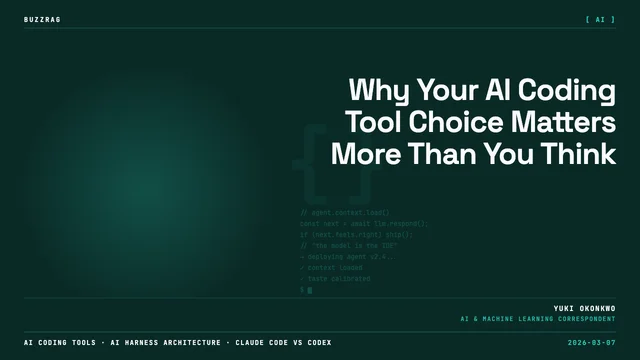
Why Your AI Coding Tool Choice Matters More Than You Think
The AI model gets all the attention, but the harness—how it integrates into your workflow—is where the real performance difference lives.
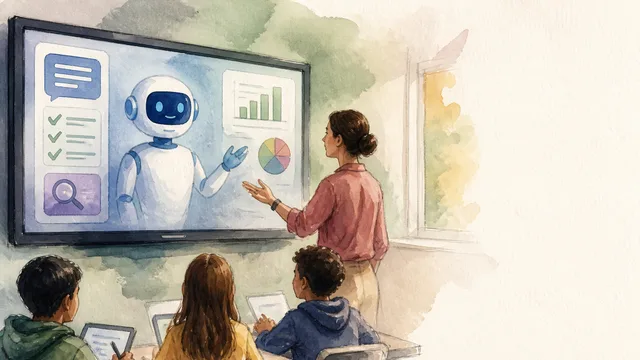
Samsung Brings AI Teaching Assistant to Classrooms
Samsung's AI Assistant is now live in classrooms, offering live transcription, quiz generation, and AI search built into interactive displays. Here's what it means.
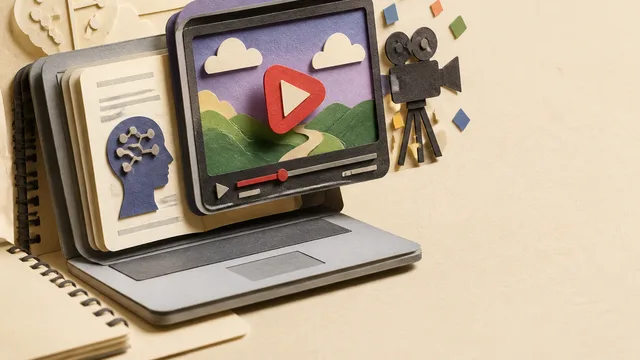
NotebookLM Now Generates Short Videos Automatically
Google's NotebookLM can now turn your research notes into short educational videos. Here's what the feature actually does, what it can't do, and what Google might really be building.

IBM NanoStack and the Future of Chip Architecture
IBM's NanoStack stacks transistors from separate wafers using atomic bonding. The physics works. The harder question is whether anyone can manufacture it at scale.
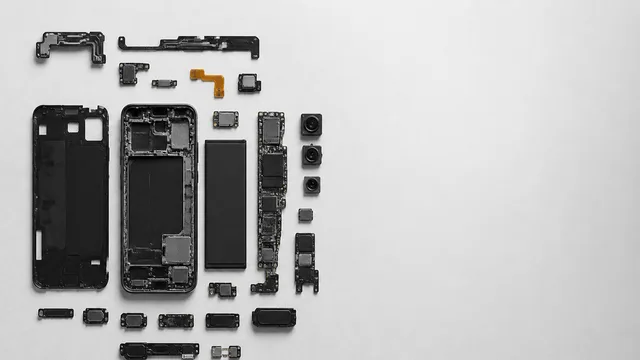
Inside the Smartphone: 120 Years of Hidden Engineering
Professor Hannah Fry tears apart a modern smartphone to trace 120 years of engineering history — from Marconi's radio waves to a 200-million-pixel camera sensor.