GitHub Wants AI to Write Your CI/CD Pipelines Now
GitHub's Agentic Workflows lets you describe CI/CD tasks in plain English. Is this the future of DevOps automation, or just vibes-based infrastructure?

Written by AI. Zara Chen
Here's a thing that's happening: GitHub is now letting you tell your CI/CD pipeline what to do in plain English, and it'll figure out the YAML for you. Their new project, Agentic Workflows, comes from GitHub Next and Microsoft Research, and it's basically asking the question: what if instead of writing deterministic automation rules, we just... described what we wanted and let AI handle the judgment calls?
The concept they're pushing is called "productive ambiguity," which is honestly a wild phrase to attach to infrastructure management. But the idea makes sense—sort of. Traditional GitHub Actions are pure if-then logic. If someone opens a PR, run these tests. If the build fails, notify this Slack channel. But what about the messy middle stuff? Triaging bugs, catching architectural issues, deciding if documentation needs updating—these tasks require context and judgment, not just binary decisions.
Agentic Workflows wants to handle that gray area. You write instructions in markdown (literally just describing what you want in sentences), run a compile command, and it generates a locked-down GitHub Actions workflow that can analyze your code and make suggestions. The demo from Better Stack shows this in action: they created what they call a "Big O auditor" that reviews pull requests, identifies inefficient code, and proposes optimizations—complete with performance impact calculations.
How It Actually Works
The setup is surprisingly straightforward, which might be the most interesting part. You create a markdown file in your .github/workflows folder with two sections: a header specifying permissions and your AI provider (GitHub Copilot, in their example), and then free-form natural language instructions about what the agent should do.
In the demo, they literally wrote: check code commits, calculate Big O complexity, identify inefficiencies, suggest better approaches, format findings in a markdown table. That's it. No YAML syntax, no action triggers, no matrix configurations.
You run gh aw compile on that markdown file, and the system generates a .lock.yaml file plus supporting GitHub Actions infrastructure. Push it to your repo, and the agent activates based on whatever triggers you specified.
The Better Stack team intentionally committed code with O(n²) complexity to test it. Three minutes later, their agent flagged the inefficient function, explained why it was problematic, and proposed an optimized solution. "Look at that it even calculates the performance impact we could gain by implementing the optimized solution," the presenter notes, genuinely surprised by the thoroughness.
The Security Angle (Or: Why This Isn't Terrifying)
Okay so the obvious concern here is: you're giving AI write access to your codebase? But GitHub seems aware that "AI agent with repo permissions" sounds like a security incident waiting to happen. That's why they're building this on top of the existing GitHub Actions infrastructure rather than creating something new.
These agents inherit the entire Actions ecosystem: team-visible logs, secrets management, auditable permissions. They run with minimal permissions by default, meaning they can analyze and suggest but can't perform write operations without explicit approval through "predefined sanitized pathways."
It's "intelligence with guardrails," as the demo puts it—you get the pattern recognition and contextual understanding of an AI system, but constrained by the same security boundaries you'd set for any automation. The agent can tell you your code is inefficient; it can't merge a fix on its own.
Whether those guardrails are sufficient is... an open question. This is a research prototype from GitHub Next, not a production-ready feature. The presenter acknowledges you'll "probably run into some latency, and you definitely still need that human in the loop to verify the final checks."
The Productive Ambiguity Question
Here's what I keep turning over: is "productive ambiguity" actually desirable in infrastructure management, or is it just a euphemism for unpredictability?
The traditional DevOps philosophy is that systems should be deterministic and observable. You want to know exactly what will happen when a condition is met, not trust an AI to exercise "judgment." The entire point of infrastructure-as-code is that it's code—readable, reviewable, predictable.
Agentic Workflows is arguing that this rigidity has a cost. Some tasks genuinely benefit from contextual understanding. A human reviewer doesn't just check if tests pass; they consider whether the approach makes sense, whether documentation is clear, whether the change introduces tech debt. That's the ambiguity they're trying to encode.
But there's a difference between an AI assistant that helps with these judgment calls and an AI agent that makes them autonomously. The demo shows the assistant version—it flags issues and suggests improvements, but a human still reviews and decides. The vision of "continuous AI" that GitHub is describing sounds like it's heading toward the agent version, where these systems "monitor and manage our CI/CD pipelines autonomously."
That's where it gets interesting—and potentially concerning. Not because the technology can't work (it clearly can, at least for code quality checks), but because it shifts the failure mode. When a YAML workflow breaks, you debug the YAML. When an AI agent makes a bad judgment call, you debug... what, exactly? The training data? The prompt? The model's reasoning process?
Who This Is Actually For
The pitch here is that writing YAML is tedious and maintaining complex CI/CD pipelines is a pain. Both true! But I'm not convinced this solves the problem for the people who feel that pain most acutely.
If you're at a scale where CI/CD pipeline complexity is a genuine bottleneck—like you're managing dozens of services with intricate build dependencies—you probably already have platform engineers who've abstracted away the YAML writing. You've got internal tooling, reusable workflow templates, maybe even custom GitHub Actions.
If you're a small team or solo developer, the YAML probably isn't your biggest problem. You copied a workflow from a tutorial, maybe tweaked it a bit, and now it just runs. The cognitive overhead isn't in the syntax; it's in understanding what you want to automate.
Agentic Workflows seems designed for a middle ground: teams sophisticated enough to want nuanced code quality checks but not so large that they've built custom tooling. That's a real segment, but it's not clear it's big enough to justify the additional complexity layer of AI-driven automation.
The three-minute processing time in the demo is also... not nothing. If every PR takes three minutes for the agent to analyze, that adds up fast in active repositories. Traditional linting and test suites run in seconds.
What Happens Next
GitHub Next projects are research explorations, not product commitments. Some ideas from GitHub Next have made it into the platform (like Copilot itself), while others remain experiments. Agentic Workflows feels like it's testing the boundaries of what developers are comfortable delegating to AI.
The fact that it's built on GitHub Actions rather than replacing it suggests they're hedging—if this doesn't work out, it's an optional layer that can be deprecated without breaking the underlying system. If it does work, they've created a migration path from traditional automation to AI-assisted workflows.
What's worth watching: do developers actually want this? The response to AI coding tools has been mixed—some people love Copilot, others find it more trouble than it's worth. The difference with Agentic Workflows is that it's not helping you write code faster; it's making decisions about your codebase based on criteria you described in natural language.
That's either the future of DevOps or a solution looking for a problem, depending on whether you believe "productive ambiguity" is a feature or a bug.
More Like This
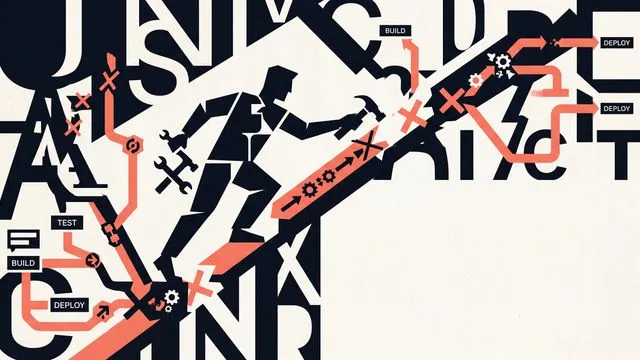
When Your AI Agent Has Write Access to Production
A developer built AI agents that autonomously fix CI/CD failures and open pull requests. The security architecture is smarter than most. Here's what it gets right.
Run AI Models at Home with Exo—No Cloud Needed
Exo lets you run AI models locally, bypassing cloud costs and data privacy issues. Discover how it works.
Choosing the Perfect Dev Laptop: AI vs. Traditional Coding
Explore top laptops for AI and coding, balancing performance, price, and specs at MicroEnter Phoenix.
NVIDIA's Rubin: AI Inference Revolution or Ecosystem Trap?
Exploring NVIDIA's Rubin: A game-changer for AI inference or another ecosystem lock-in? Discover the potential and challenges.
Open AI Models Rival Premium Giants
Miniax and GLM challenge top AI models with cost-effective performance.
Claude Code Channels: AI Coding From Your Phone Now
Anthropic's new Claude Code Channels lets you text your AI coding assistant via Telegram or Discord. Here's what it means for autonomous AI agents.

Netflix Used AI in 300 Titles. Here's What That Means.
Netflix disclosed AI use in roughly 300 titles in its Q2 2026 earnings. We break down what that number actually tells us — and what it doesn't.

Applied Computing Bets $20M on AI for Oil and Gas
Applied Computing raised $20M to build a foundation AI model for oil, gas, and petrochemical plants. Here's why that's more complicated than it sounds.